ENO: Partenope

Christopher Alden’s Olivier Award-winning production of Partenope returns to ENO starring Sarah Tynan
Partenope

Opens Wednesday 15 March at 7pm at the London Coliseum (5 performances)

One of the most celebrated new productions of Handel’s work in the last decade will return to ENO in March, with the original partnership of Christopher Alden and Christian Curnyn resuming their roles as Director and Conductor respectively. Called ‘riveting’ byThe Guardian and ’superb’ by The Sunday Telegraph in a five-star review, the original run won the 2009 Olivier Award for Best New Opera Production.

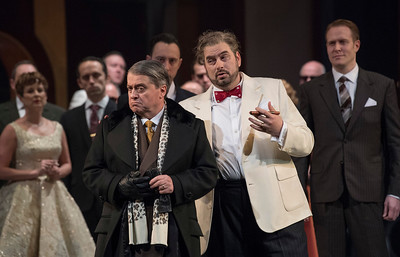
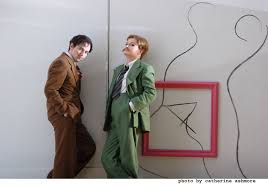
One of Handel’s outstanding comic works, the tale of Queen Partenope and her three suitors features cross-dressing, mistaken identity and the crazed politics of romance. In Alden’s production, which has also been seen to great acclaim at the Sydney Opera House and the San Francisco War Memorial Opera House since its London premiere, the action is relocated from mythical ancient Naples to the salons and drawing rooms of the socialite set of twenties Paris, with design inspired by the surrealist photography of Man Ray.

The production will feature an outstanding cast showcasing some of the best British singers at work today, led by Sarah Tynan (’some of the finest baroque singing you’ll hear anywhere’ – The Guardian) in the title role. Sarah’s previous Handel roles at ENO include a ’superbly beautiful’ (Opera Today) Romilda in the 2014 performances of Xerxes, with Marzelline in 2013’s Fidelio and Zerlina in 2012’s Don Giovanni being other highlights. This marks her role debut.

Mezzo soprano Patricia Bardon will sing Queen Partenope’s dashing suitor Arsace. Patricia most recently sang at ENO in 2014 as Mary Magdalene in The Gospel According to the Other Mary, described as ’the performance of her life’ by The Guardian. Her strength as a Handelian has been praised, giving an ’utterly melting’ (New York Times) performance as Zenobia in The English Concert’s 2013Radamisto.

Countertenor James Laing sings as the shy suitor Armindo. James has previously appeared at ENO as Nireno in Julius Caesar in 2012. He has sung Handel’s operas on numerous other occasions, including as Tirinto in Imeneo for the 2016 Göttingen International Handel Festival and as Medoro for Welsh National Opera’s 2015 Orlando.

Returning ENO favourite Robert Murray sings Emilio, the suitor warring for the Queen’s hand. In addition to his starring roles here inThe Pirates of Penzance and The Mikado, his singing of Handel in Acis e Galatea at Wigmore Hall in 2013 was called ’splendid’ by TheObserver. Rosmira, the former lover of Arsace in disguise as the male Eurimene, is sung by Stephanie Windsor Lewis, who debuted at ENO last year as Suzuki in Anthony Minghella’s production of Madam Butterfly. The cast is completed by ENO Harewood Artist Matthew Durkan as Ormonte.

Conductor Christian Curnyn is well-known as one of baroque’s foremost interpreters in the UK: ’Find anything exciting happening in period opera in the UK and Curnyn will be involved’ (The Spectator). He founded the Early Opera Company in 1994 in order to champion the relevance of baroque opera, and has won great acclaim for his recordings and performances in the area since. His most recent Handel conducting at ENO, for 2014’s Rodelinda, was called ’well-nigh flawless’ by The Guardian.

Christopher Alden has directed numerous ENO productions across the years including Norma and The Makropulos Case. He has directed operas across the world, long known for his challenging and innovative concepts. On top of winning the 2009 Olivier Award for Best New Opera, this production of Partenope won the 2011 Helpmann award for Best Opera in Australia.

The design team of Andrew Lieberman (set) Jon Morrell (costume) and Adam Silverman (lighting) provide the striking surrealist look while the witty English translation is by Amanda Holden.

Partenope opens on Wednesday 15 March 2017 at 7.30pm for 5 performances – 17, 20, 22, 24 March.
CDs February 2017

CPE BACH – SOLO KEYBOARD MUSIC, Vol 32
Miklos Spanyi (Tangent piano)
BIS 2205 78’54

This massive survey of CPE Bach’s keyboard music continues with the remaining pieces from the “fur Kenner & Liebbaber” collections featured in Vol 31. That recording was made on a clavichord. Here Miklos Spanyi produces some delightfully light and characterful sounds from a Tangent piano, a variant of the Fortepiano. There is a satisfying symmetry to the programme which alternates between a Sonata and a Rondo, three of each in total. An enjoyable stand-alone disc as well as a welcome expansion of this series.

CARL CZERNY – ORGAN MUSIC
Ian Quinn(organ),  Miller Chapel, Princeton Theological Seminary, Princeton, NJ, USA
NAXOS 8.573425 75’11

For many of us the name of this composer brings back memories of early piano lessons with books of his studies. I was unaware that Czerny had also composed for the organ. This is an enjoyable and interesting collection consisting of a substantial Prelude & Fugue in A minor, and two sets of pieces – 20 Short Voluntaries for organ with obbligato pedal and 12 Introductory or Intermediate Voluntaries.
The style is typical of the 19th Century and some of the voluntaries were apparently intended for the English market.

JOHANN PACHELBEL – COMPLETE ORGAN WORKS II
Jurgen Essi, Michael Belotti, James David Christie (organs )
Stephanskirche, Simmern   &  Kilianskirche, Bedheim
CPO 777 557-2  (2CDs) 117’21

As is the case with so many composers there is a wealth of organ music from the pen of Johann Pachelbel that is rarely heard today. In this second volume of the complete organ works we have Christmas music from Das Kirchenjahr  together with Psalmlieder III. As well as being a useful reference resource this collection is very suited to listening to as a programme in its own right. There are intricate passages, beautiful sustained lines and delicate and colourful registrations to be found as well as full-blooded movements such as the opening Toccata. The mix of organists and organists gives added interest to this release.

JAKOB PRAETORIUS / PAUL SIEFERT– COMPLETE ORGAN WORKS
Friedhelm Flamme (organ)
St Laurentius-kirche, Langwarden & Martin-Luther-Kirche, Schonhagen
CPO 777 959-2 (2 CDs) 138’48

Although it gives no indication on the sleeve the booklet states that this is Vol 14 of Organ Works of the North German Baroque. So much of this vast period of organ composition stands to be rediscovered. Here we hear the 11 pieces that remain by Praetorius and 17 by Siefert. There is also an extended chorale prelude by Jakob Kortkamp. A particularly enjoyable performance is to eb found at track 6 on the 2nd CD,  Seifert’s Puer natusin Bethlehem – beginning with a particularly bombastic theme and followed by much more delicate registration. An interesting collection but maybe not one to be listened to in one sitting.

KENNETH LEIGHTON – COMPLETE ORGAN WORKS
Stephen Farr (organ), Chloe Hanslip (violin), Nicky Spence (tenor)
Organs of St Giles’ Cathedral, Edinburgh, Symphony Hall, Birmingham & St Paul’s, Knightsbridge
RESONUS RES10178 (3 CDs) 78’31, 53’16, 76’19

This comprehensive production is a further sign of Resonus’ commitment to producing significant recordings of lesser known music. Whilst Kenneth Leighton’s name is known in some circles recordings of his music are not always easy to come by, and so this set of the complete organ works is a very welcome release. The Missa de Gloria is one of the more substantial works presented here, together with Prelude, Scherzo & Passacaglia and Et Ressurexit (Theme, Fantasy & Fugue). More melodic in nature are the opening Six Fantasies on Hymn Tunes, most based on familiar hymn repertoire. Possibly the best known of the shorter works is  Paean, a wonderfully celebratory burst. As well as all the solo organ compositions this set also includes These are the wonders, for organ and tenor and Fantasy on a chorale “Es ist genug”  for organ and violin – an interesting and seldom heard combination.  An extended set of Improvisations “De profundis” for solo harpsichord completes the final disc. Stephen Farr gives wonderful performances throughout. Once again a variety of organs adds interest to what is already a very valuable collection. Highly recommended.

O SING UNTO THE LORD – SACRED MUSIC BY HENRY PURCELL
St Thomas Choir of Men & Boys, Fifth Avenue, New York, USA
Concert Royal
John Scott (conductor)
RESONUS RES 10184 54’03
GABRIEL FAURE – REQUIEM
St Thomas Choir of Men & Boys, Fifth Avenue, New York, USA
Orchestra of St Luke’s
John Scott (conductor)
RESONUS RES 10174 58’14

These two CDs of more mainstream repertoire are also released by Resonus, continuing their output of fine recordings of the Choir of St Thomas, Fifth Avenue, under the leadership of the late John Scott. Both CDs make for repeated listening. The Faure CD also includes his other popular sacred works –  Messe Basse, Ave verum corpus, Tantum ergo and Cantique de Jean Racine.

CLASSICAL VIENNA – Music for Guitar & Piano
James Akers (romantic guitar), Gary Branch (fortepiano)
RESONUS RES 10182 67’47

This is an interesting release from a historic angle – recreating the sound world of a bygone age combining the sounds of an 1826 fortepiano with guitar. This is one of the last recordings to be made at Finchcocks, now sadly no more. The programme is varied, including compositions by Mauro Giulani and Ferdinando carulli amongst others. The duo work well together and in fine solo performances. However, on a personal note, I’m just not that keen on the sound of the fortepiano. I am sure others will relish it.

SP

Eat, Drink, Love!

Opera House, Wetherspoon, Tunbridge Wells, Sunday 19 February 2017

The annual Sunday on which Tunbridge Wells’s glorious Opera House reverts to its musical roots and sets aside its current pub incarnation is always a  festive event. All credit to Wetherspoon for facilitating it. This year Merry Opera Company’s new show is revue rather than opera. And an engaging melange of musical theatre, songs from various genres and – of course –  opera it turns out to be.

An accomplished and versatile quartet – Andrea Tweedale, Gemma Morsley, Lawrence Olsworth-Peter and Matthew Quirk – shift between genres so adeptly that it feels as if we’re moved from classical (Mozart’s Un’aura amorosa nicely sung by tenor Olsworth-Peter, to Horrible Histories at a stroke. A rousing rendering of The Roast Beef of Old England complete with mezzo-soprano Morsley, sporting a colander-crown  on her head as Elizabeth I, ends the first half. In between the extremes are numbers such as a pleasing account of Purcell’s If Music Be the Food of Love from soprano Tweedale, and bass-baritone Matthew Quirk, having fun with Ted Waite’s I’ve Never Seen a Straight Banana.

Several things strike me about this show. First, it’s interesting to hear musical theatre numbers sung without radio mics by trained opera singers. I have long contended that there is no valid distinction between musical theatre and opera. It is all simply musical drama and any differences are often very blurred. Merry Opera’s take on the material in this show cheerfully reinforces that.

Second, it’s splendid to hear such a variety. Some of it is familiar. I have sung the surprisingly difficult The Banquet Fugue from John Rutter’s The Reluctant Dragon myself and it’s a pleasure to hear it done with such slickness and panache. What a stylistic contrast though with Harry Champion’s music hall number Oh! That Gorgonzola Cheese or Quirk and Morsley being  wittily outrageous in the well known Have Some Madeira M’Dear  by Flanders and Swann, or Quirk and Olsworth-Peter in a dead-pan take on I Gave My Love a Cherry. The four of them do as well with American-style 1930s close harmony as with Baroque and Bizet’s Omelette Quartet with which the show ends is entertaining.

Third, the choreography (by Carole Todd) provides quite a lot of clever grouping and movement so that the show works reasonably well visually as well as aurally.

There is a problem, though with the linking narrative with which John Ramster, director has tried far too hard. The show is themed on three inter-related human activities and some of the dialogue and flirting amongst characters between sung numbers is excruciatingly contrived and hammy, The show would be better with much less of that and an additional sung item in each half.

Moreover, the show takes a while to get going and some of the singing is wobbly in the first fifteen minutes – or at least it was at the performance I saw. The second half is both better structured and more assured.

Generally speaking though, Eat, Drink, Love! was a very pleasant way of spending a Sunday afternoon.

Susan Elkin


Brighton Philharmonic Orchestra

Brighton Dome, 5 February 2017

THOMAS-CARROLL

Thomas Carroll, looking as if he’s about to win a snooker tournament in a snazzy red waistcoat, has a knack of bending almost double to coax intricately nuanced pianissimo playing from his players. It’s effective too. Almost all the playing in this very pleasant concert was sensitive and well balanced.

After a momentarily ragged start Mozart’s K201, with all its sophisticated simplicity, soon settled into a suitably crisp, sparkling opening allegro with the following movements in careful contrast, For both this, and the Haydn which came next, the Brighton Philharmonic was reduced to just 36 players – strings with two horns and two oboes ensuring that the mood remained light, tight and classical.

The Haydn C major concerto (rediscovered as recently as 1961) is a resolutely cheerful work and multi-talented Carroll conducting from his cello appeared to smile from the sheer joy of the music almost continually. He achieved a fine rapport with the orchestra and his cello sound was lushly mellow especially in the beautiful Adagio and the well controlled Allegro Molto finale.

And so to the concluding Mendelssohn Italian Symphony for a happy ending to a sunny concert – and a few more players and instruments added to the mix. The opening was lively and incisive with some clearly articulated string work in the busy passages which typify much of Mendelssohn’s orchestral writing. One or two wobbly moments in the third movement were soon forgotten once we reached the Saltanella and the glorious conclusion which was played with panache.

Susan Elkin

Hastings Philharmonic

St Clement’s Church, Hastings Old Town, 4 February 2017

Hastings Phil Choir

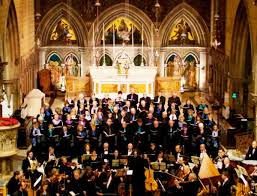
There was an unexpectedly relaxed atmosphere at the baroque concert presented by Hastings Philharmonic last Saturday in St Clement’s church in Hastings Old Town. During the radiant performance of Monteverdi’s Beatus Vir, Marcio da Silva moved around between the horseshoe of singers and the small string ensemble, seemingly drawing the music out of them. It was visually captivating, and set a tone of intimacy and expectation which continued through the evening.

The works we heard covered the whole of the baroque period from Monteverdi in the early 17th century to CPE Bach’s Symphony No5 which dates from 1773.

The Monteverdi was full of colour, its rich textures being exploited by the well balanced choral forces. The progress the choir has made over recent years was exemplified in the change of tonal impact when they came to Bach’s Jesu Meine Freude BWV227.  The rhythms here were kept light and fast moving, allowing the piece to flow naturally, even though the text is more weighty and dense. The male trio were particularly impressive before the well-argued final chorus and more formal chorale.

After a pause – which could just as well have been an interval! – the instrumental ensemble returned to play CPE Bach’s Symphony No5. Though there are many obvious connections with earlier works it is the hints of late Haydn and Beethoven in the reserved and often acerbic scoring which impress,and the edgy original instrument tonalities were particularly effective.

Handel’s Dixit Dominus brought us back to more familiar ground, with bright lines and rapid tempi. The chorus obviously enjoyed this despite the challenges, and the solo parts were finely integrated – with even Marcio providing a baritone line at one point.

In the final sections the conquassabit was hammered with splendid precision and the top sopranos were able to soar easily above the other singers.

A lovely evening – proving that Hastings Philharmonic are more than up to the challenge they have set themselves.

The next event this season is a Chamber Music Concert in Christ Church, St Leonards at 7.00pm on 18th March. Be there!


Maidstone Symphony Orchestra

Mote Hall, 4 February 2017

J Lill

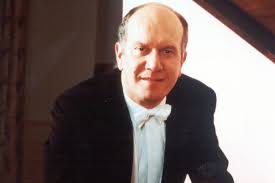
John Lill CBE has been president of the Maidstone Symphony Orchestra since 1980 and his association with it goes ten years further back when he played his first concert with them, shortly after winning the Tchaikovsky Piano Competition. To this day, he generously plays an occasional concert with MSO and unassuming as he is, his presence in the hall has a palpable effect on both players and audience. He seems to bring out an extra edge in a band which always delivers competently but on this occasion they surpassed even their own high standards.

Lill’s account of Beethoven’s third piano concerto was unshowy but intense, the concentration showing only in a slight working of his mouth. It’s a treat to hear the concerto played at a speed which allows us to hear every note of Beethoven’s glorious C minor detail – a refreshing contrast to the usual prestissimo gallop most conductors want to impose on it. The triplets just before the end came across in this performance as an intelligent question and answer dialogue between piano and orchestra. Other high spots included the long cadenza full of virtuosic tension at the end of the first movement, which had me (and most of the rest the audience) on the edge of our seats, and the exquisite lyricism in the largo.

The Beethoven was sandwiched between Weber’s chirpy Oberon overture and Brahms’s most magnificent symphony – the Fourth and last. The Weber presents a challenging opening with its horn solo and muted strings – all very exposed before it leaps away into the first dance tune. It isn’t the easiest way to start a concert but it came off adequately.

And by the time we reached the vibrant warmth of the Brahms, all nervousness had gone and the John Lill effect had worked its magic.  From the exuberant precision of the opening allegro through the delicacy (all that pizzicato!) in the middle movement to the initially ponderous, grandiloquent fourth movement, it was glorious. I once heard the late, great Antony Hopkins (the musicologist not the actor) give a talk for children about this last movement and he told them to remember “B-R-A-H-M-S Spells Brahms” and explained how to listen for the opening statement in various forms for the rest of the movement. If only there had been more children and young people in the audience at this concert to hear this enjoyable account of it.

For various reasons this was the first MSO concert I’ve managed to get to this season and I’m struck afresh by the quality and freshness. I think it is scaling new heights of achievement. Andrew Pearson is certainly the most charismatic leader the orchestra has had in a while and I’m sure he is part of the reason. The string sound is rich and rarely falters and – among other fine performers – Anna Binney, principal flautist – more than deserved the applause Brian Wright directed towards her at the end.

Susan Elkin

Pull Out All the Stops 2

R QuinneyRobert Quinney,
Royal Festival Hall, London  3rd February 2017


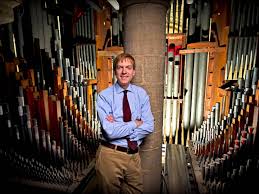
Robert Quinney’s highly anticipated all-Bach recital, the second in the 2016-17 Pull out all the Stops season at RFH, did not disappoint.  A large and appreciative audience reflected the reputation of this Oxford based organist who has recently released a number of excellent Bach programmes on CD including many of the works which made up this recital.

Beginning with such a popular and sometimes over-exposed piece as Toccata & Fugue in D minor, BWV 565 could have been a mistake but on this occasion, delivered with flair and colour as well as a few of the performer’s own flourishes which did not detract, this was an inspired opening to an evening of music consisting mostly of works that are heard less often.

The chorale prelude Vater unser in Himmelreich was a lovely contrast to the opening piece, with softer voices and tremulant throughout. With a lightness of touch that was heard frequently throughout the programme, Robert Quinney demonstrated the beauty of this measured music played with attention to detail to create an intimacy sometimes missing from performances on this large scale instrument.

Four Duets provided much interest. These pieces for two equal voices played just on the manuals have a complexity beyond what might be expected from such a simple structure. Once again the carefully chosen registration maximised the impact of each line and allowed melody to emerge from often very busy and dense writing.

Other works in the recital were Prelude & Fugue in C (BWV 547), Prelude & Fugue in Eminor (BWV 548), Canonic Variations on Von Himmel hoch da komm’ ich her and Prelude & Fugue in G (BWV 541). A rousing and full-throttled encore rendition of Bach’s Sinfonia brought the evening to a close.

My criticism of some of the programmes in previous recitals at this venue has been that some performers have been tempted to overdo the “fast and loud”. In the hands and feet of a careful and well-planned organist this instrument is capable of so much variety – from the most raucous low pedals and full on grand choruses played with gusto to the delicate flutes and soft reeds, with so much in between. The combination of tonight’s well-chosen and varied programme with this organ and performer certainly brought something of JS Bach’s vision of God’s heaven to this listener’s earth. I hope we shall see a return to the RFH from Mr Quinney in the not too distant future.

Stephen Page

ENO: Rigoletto

'Rigoletto' Opera directed by Jonathan Miller performed by English National Opera at the London Coliseum, UKLondon Coliseum, Thursday 2 February 2017


Jonathan Miller’s famous Mafia staging of Rigoletto has returned to ENO’s repertoire. Though thirty five years old now, it is more than worthy its return, as it makes sense of both the narrative and the music. The dark spaces in Patrick Robertson’s designs are a fitting reflection of the even darker emotions on stage. That the first night of this thirteenth revival did not have quite the frisson one might have hoped for came more from a combination of details rather than any one problem.

Sir Richard Armstrong in the pit took a cautious approach to the score, with few moments of real excitement or passion. Tempi were often on the slow side with little sense of excitement. By contrast the chorus was in exciting and attacking form.

The solo cast sang well but with the exception of Sydney Mancasola’s radiant Gilda, were all leaning on the side of caution. This was probably why Nicholas Folwell made such an impact as Monterone, spitting venom at all around him even as he is led off to summary execution, and smaller parts like Marullo and even the police officer, came across so strongly.

Unfortunately the two leading men made a limited impact. Joshua Guerrero has the secure top for the Duke and phrases well but his approach seemed over-comfortable with little sense of the menace or threat the part involves and which this production has in the past brought out very well.

This was also true of Nicholas Pallesen’s Rigoletto. While the voice is well focussed for the part his presence rarely moved us. Where the character calls for a wide range of emotions which will sweep us away, here everything was careful, often to the point where it lacked emotional impact. The great cry for vengeance in act two gave no sense of catharsis, so that we never felt the weight of the curse. Rigoletto takes it seriously and so should we.

I have no doubt this production will be revived again. It deserves it. If the present cast can throw off what may have been first night nerves and become a little more reckless, it might yet be worth a visit.

A NEW ORCHESTRA FOR THE SOUTH EAST

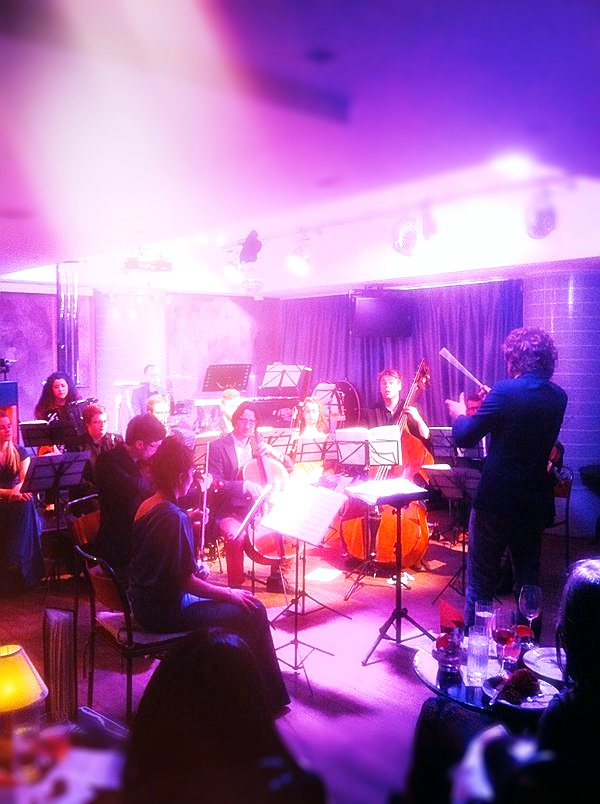
Led by South Coast native William Kunhardt, the Arensky Chamber Orchestra (ACO), Britain’s orchestra of revolutionaries, make their South Coast debut in March 2017.

Sea Fever 1

Their first project, Sea Fever, is a classical experience inspired by the ocean. Sea Fever will tour the Cultural Coastal Trail Galleries, with performances at Eastbourne’s Towner Gallery on March 4th, Bexhill’s De La Warr Pavilion on March 8th, and Hastings’ Jerwood Gallery on March 10th. See seafevertour.com for more. It will be followed by Aulanko, an exploration of Sibelius’s 5th Symphony, at Eastbourne’s new Birley Centre in June. Classical Music. But not as you know it.

The ACO specialises in gripping performance and mind-opening presentation. Its mantra is to make classical music more social, meaningful and dramatic, without losing any of its depth or sincerity. They work with mixologists to invent cocktails inspired by the music, served during concerts. They host pre-concert ‘warm up acts’ and post-concert ‘chamber jams’. They also give ‘live programme notes’ where the orchestra tells the story of the music from the stage. They shun concert halls, preferring clubs, galleries, and urban spaces. The orchestra’s main performances are of Masterpieces in Miniature – large orchestral works reduced for chamber ensembles of 16-20. ‘They allow us to take music out of large, impersonal concert halls and into more intimate, modern settings’ says ACO Director of Collaboration Eddy Hackett. ‘They also reveal fascinating details in the music that get missed in the full versions’. In Sea Fever, the orchestra will perform world premieres of Britten’s Sea Interludes and Debussy’s La Mer ‘in miniature’.

The ACO has recorded for Classic FM, worked with leading soloists like Benjamin Grosvenor and Jennifer Pike, and collaborated with artists ranging from video DJs to dancers. The group’s players are the most indemand young artists in the country. They come from major orchestras, like the Royal Philharmonic and London Symphony, and leading chamber music groups. In 2016, the orchestra enjoyed its second 100% sell-out season in a row, won praise from the critics of the Telegraph, Guardian and Independent, and saw the average age of its listeners fall 10 years below leading statistics. For more, visit www.theaco.co.uk. Building a permanent home in the South East Sea Fever is funded by the Arts Council and aims to build the foundations for a permanent, year-round ACO series in the region. This series will give local artists in many genres opportunities to collaborate with the orchestra, creating a new culture of innovation and cross-arts collaboration throughout the region. In time, it will redefine iconic local landmarks as surprising live music venues.

The orchestra will also bring its education programme to the area. As part of Aulanko, the ACO will run a two-day composition workshop for 150 children – from Grade 8 students to untrained first-timers. They will come from schools in Eastbourne Schools Partnership and the Jerwood Gallery’s Learning Programme. Artistic Director, William Kunhardt – a homegrown talent. The tour is the brainchild of Artistic Director William Kunhardt. Kunhardt grew up and went to school in Eastbourne, winning a music scholarship to Eastbourne College. At 18, he left for London to study violin at the Royal College of Music, quickly transitioning into conducting. In 2014, Kunhardt won the James Conlon Prize at Aspen Festival, Colorado, launching his career internationally. Since then, he has gone on to work with orchestras in Asia, America, and Europe and with soloists like Benjamin Grosvenor and Sarah Chang. However, his passion remains the Arensky Chamber Orchestra, the group he founded as a student in 2009.