DVDs / CDs March 2017

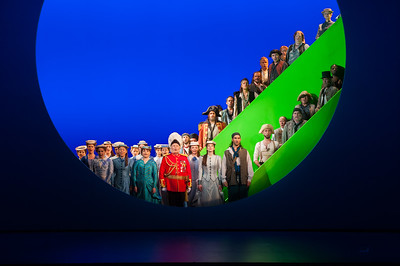
Donizetti: Roberto Devereux
Teatro Carlo Felice, Francesco Lanzillotta
DYNAMIC 37755

We have seen more of this opera recently than probably any time in the last century and it is a worthy partner to the more familiar Anna Bolena. The production is very dark – you may need a large screen and a darkened room to pick up some of the detail – but the music is well focussed throughout and Francesco Lanzillotta keeps his forces moving swiftly. Mariella Devia is a tight-lipped monarch attempting to maintain emotional control while the world falls apart around her. All the solo parts are well taken and the chorus creep about as if terrified of what might happen next.

Tango Under The Stars
Los Angeles Philharmonic, Gustavo Dudamel
MAJOR 739608

The combination of the expertise of the Los Angeles Philharmonic and the Latin enthusiasm of Gustavo Dudamel make for a glorious evening. If the audience are not quite what one might wish for in a concert hall, the outdoor Hollywood Bowl is able to absorb the extraneous noise and the applause between movements. The central work is the 2nd Guitar Concerto by Lalo Schifrin, with Angel Romero as soloist followed by four dances from Estancia by Ginastera.

For the final four pieces by Astor Piazzolla they are joined by Tango Buenos Aires who dance with a heighted intensity and highly sensuous movements which is totally captivating.

Vaughan Williams: Job; Symphony No 9
Bergen Philharmonic Orchestra, Sir Andrew Davis
CHANDOS CHAN 5180

Job, a Masque for Dancing is heard rather than seen these days, which is a pity for this is undeniably ballet music of the finest order. The combination of Job with the 9th Symphony is telling as their composition spans almost thirty years and yet the composer’s voice is immediately obvious in both. Not that Vaughan Williams had not developed over the period, so much as his own voice always shines through with immediacy. Sir Andrew Davis’ strengths as an interpreter of English music are well known and this is another excellent example of his insights and understanding.

Schubert; Works for solo piano Vol 2
Barry Douglas
CHANDOS CHAN10933

This may only be vol 2 but already this is obviously a very fine undertaking and we can look forward to the rest of the series. Here we have the Four Impromptus Op 90 and the A major Piano Sonata D959, all late works and showing Schubert at the peak of his powers, none more so than in the final movement of the Sonata which draws on earlier works yet spins a new sense of creativity which is wholly captivating.

Franz Krommer: Symphonies 1-3
Orchestra della Svizzera italiana, Howad Griffiths
CPO 555 099-2

Krommer has all but vanished from our concert halls. Though held by many in his lifetime to be valued as highly as Haydn he rapidly went out of fashion and disappeared from public performance by the end of the nineteenth century. This is one of the strange acts of fate which seem to fall on some composers for no obvious reason. These three symphonies would grace any early romantic programme and the composer’s voice is individual enough to make for a worthy place alongside more familiar composers. The difficulty, I suspect, is that the audience will not necessarily react as enthusiastically to a name on a concert list that they do not no. a pity for these are fine pieces.

William Boyce; Symphonies
Academy of St Martin in the Fields, Sir Neville Marriner
CAPRICCIO C8006

Recorded in 1993, this is a welcome reissue of a very fine recording, full of life and energy.

Dutilleux; Symphony No 2 etc
Orchestre National de Lille, Darrell Ang
NAXOS 8.573596

Henri Dutilleux is still underrepresented in our concert halls and so this new cd goes some way towards offsetting that balance. The 2nd Symphony is extrovert in its attack and detail, with splendid tone colours. This is taken up again in the three movements of Timbres, espace, movement which was revised in 1991. The sixteen short movements of Mystere de l’instant give snatches if not outbursts of creativity, which are gone almost before they can impinge.

Beneath the Northern Star
The Orlando Consort
HYPERION CDA 68132

This is early polyphonic music stretching from the late thirteenth century to the early fifteenth. The Orlando Consort explore the way musical lines were elaborated and embellished within their liturgical settings. Early pieces are often anonymous, and even where composers are named we often know little of them except for the quality of the writing. The cd is both instructive and beautifully performed.

Brahms; complete solo piano music vol 4
Jonathan Plowright
BIS 2137

The two sets of Variations on a Theme of Paganini bookend this new collection and between them come compelling readings of the Op10 Ballades and Op119 Piano Pieces. Jonathan Plowright’s approach brings a chamber intimacy to the works which is always rewarding.

Sullivan; Songs
Mary Bevan, Ben Johnson, Ashley Riches with David Owen-Norris, piano
CHANDOS CHAN 10935(2)

I wish I could feel more enthusiastic about this collection but, though a few songs catch the ear, too many are worthy but dull. Sullivan may have hated the fact that his popularity stemmed from his work with Gilbert but there is little here to match anything from Yeomen of the Guard or Mikado.

British Tone Poems Vol 1
BBC National Orchestra of Wales, Ramon Gamba
CHANDOS 10939

It is surprising how much music by familiar names is still so little known. Here we have a fine collection of British tone poems none of which I can recall ever hearing live. Ivor Gurney’s A Gloucestershire Rhapsody is Elgarian in feel but none the worse for that. Frederick Austin’s Spring and William Alwyn’s Blackdown  most capture the imagination, while Henry Balfour Gardiner’s moving A Berkshire Idyll receives its premiere recording. With Vaughan William’s The Solent to conclude the recording this is a very valuable addition to our understanding of less familiar repertoire.
Sally Burgess joins ENO Board

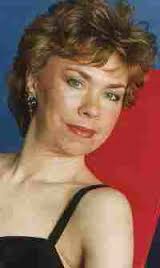
Today, 28 February 2017, English National Opera (ENO) is pleased to announce that Sally Burgess is joining the ENO Board of Trustees with immediate effect.

Highly acclaimed mezzo soprano Sally Burgess began her long and renowned relationship with ENO in 1978 as Zerlina (Don Giovanni). She has since returned to perform over 40 roles with the company, the most notable being Carmen, Octavian (Rosenkavalier) and Judith (Bluebeard’s Castle). Her distinguished career includes performances at most of the world’s major opera houses, including The Metropolitan Opera, New York; Bayerisches Staatsoper, Munich; Opera National de Bastille, Paris; The Royal Opera House, Covent Garden; and Houston Grand Opera. On the concert platform she has collaborated with many eminent conductors including Sir Mark Elder, Sir Charles Mackerras and Daniel Barenboim. Sally is Vocal Professor at the Royal College of Music and Professor at the Guildhall School of Music and Drama. She is an internationally sought after teacher of voice and stagecraft and leads masterclasses, workshops, competitions and regularly directs opera scenes across Europe, Russia and South Africa. In 2011 she was made a Fellow of the Royal College of Music (FRCM).

Commenting on the appointment, ENO Chair, Dr Harry Brunjes says, ‘I am delighted that Sally Burgess has kindly accepted our invitation to join the board. As a company we will all benefit enormously from Sally’s expertise and experience. It will be a privilege to work alongside a singer and a performer with such a deserved reputation in the opera world.’

ENO Artistic Director Daniel Kramer commented, ‘I am thrilled to welcome Sally back to ENO, and certain that she will be a huge asset to our Board. She brings with her a deep understanding of the company, its history and its values to support the artistic team with long-term strategy and planning.’

ENO’s Chief Executive, Cressida Pollock said, ‘We are all looking forward to working with Sally, and to the numerous ways in which her significant creative expertise and experience, alongside her passion for the company, will strengthen ENO’s Board.’

Sally Burgess commented: ‘I am delighted to join the Board of English National Opera, and I look forward to contributing insights gained from my experience as both a performer and a vocal specialist. ENO is a company I have performed over 40 roles with, and so I know first-hand how wonderful it is to work alongside their award winning Orchestra and Chorus as well as their exceptional production and technical teams.’

ENO: The Winter’s Tale

London Coliseum, Monday 27 February 2017

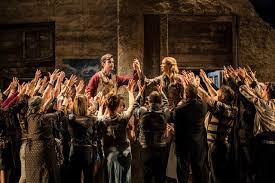
When the RSC stages The Winter’s Tale it normally runs over three hours. Ryan Wigglesworth’s new opera based on the play runs for under two hours, so we are immediately aware that this is going to be a highly focused, not to say intense, adaptation of the play – and so it proves to be. Gone are the comic characters, all of the songs and incidental music, dancing is reduced to a brief aside. The focus is entirely on the impact of jealousy in both Leontes and Polixenes.

Vicki Mortimer’s high walled setting constantly encloses and cuts off the characters from each other, and placing both Sicilia and Bohemia under military rule gives little sense of contrast in the second act. If anything, the music underlines the unifying factors rather than the differences between the two countries.

The conclusion moves away from Shakespeare. Though Hermione returns to life there is little sense of resurrection or restoration here, and the final image is uncomfortably spectral, as the dead Mamillius wanders slowly off stage.

Ryan Wigglesworth’s score mirrors this intensity of approach with music that is frequently edgy and uncomfortable. There are few lyrical moments, even in Bohemia, and characters rarely reflect on their positions, though Iain Paterson’s finely drawn Leontes is allowed two more-extended introspective moments.

Sophie Bevan makes what she can of Hermione though the trial scene gives her nowhere near enough emotional scope for us to empathise more than at the most superficial level. Samantha Price makes more impact as Perdita though sixteen years living rurally is glossed over.

The concentration of the text makes Polixenes a more important protagonist, strongly sung by Leigh Melrose. His – spoken – assault on Florizel becomes one of the strongest moments of the evening, drawing parallels with the first act in an almost identical setting.

Smaller parts are well rounded but the most interesting musical innovation comes with the chorus. There is, of course, no chorus in Shakespeare. Verdi had to interpolate choruses into his settings and Wigglesworth does the same. They are very effective, particularly the protest for Hermione, which has no place in the original but here reflects current political unease very succinctly.

Rory Kinnear’s production is masterly in its understatement and naturalism. Even in moments of high tension he manages to maintain a convincing sense of normality taken to the edge. He brings all his experience of working in the theatre to ensure that even the most unlikely events convince and that emotions are always credible. It is a remarkable debut and he will surely be asked again – and soon!

SUSSEX ALIVE

Saturday 4 March 2017 7.45 p.m.

St Michael’s Church, Lewes High Street
Directed by Andrew Sherwood


Bach Goes to Sussex

Bach – Brandenburg Concerto No.3

Peter Copley – Tango

Robin Milford – Concertino for piano and strings in E Major, Op.106
Fishing by Moonlight for piano  and strings

Soloist  Margaret Fingerhut

Bartók – Divertimento for String Orchestra

7.10 p.m. Pre-concert talk  

Peter Copley discusses tonight’s music


GARSINGTON OPERA AND COASTAL CULTURE NETWORK

As a result of Magna Vitae and Garsington Opera for All’s pioneering education and outreach work integrated with free public screenings of opera in isolated coastal and rural communities, a new online network – the Coastal Culture Network (CCN) – has been formed.  CCN aims to strengthen the network of cultural provision around the coast by bringing together coastal local authorities, cultural organisations, Coastal Community Teams and others with an interest in the role of culture in seaside locations.

Culture and the coast are inextricably linked. Always part of the English seaside attractions, in recent years contemporary arts and culture have helped to reinvigorate many coastal towns following the decline of traditional tourism.  The potential of culture to be a key factor for regeneration is now widely acknowledged and the CCN aims to build on this and drive it forward.  Projects such as Opera for All feed into the process by raising confidence and aspiration and impacting on community cohesion.

Opera for All was set up by Garsington Opera, Magna Vitae and the Coastal Communities Alliance in 2015 after a successful bid made to Arts Council England for funding, which enables a large-scale programme of education and outreach work in isolated and rural coastal communities together with free digital screenings of a performance from Garsington Opera to be run. For a period of three years, this has provided ground-breaking opportunities for communities to be involved in creating, learning about and performing opera.

Projects and free screenings will again take place this year in Skegness, Ramsgate, Highbury/Burnham–on-Sea and Grimsby  and over 1000 young people will take part in creative residencies at both primary and secondary schools.  For the students in each of the 25 schools, the experience of working alongside a team of professional artists to create and perform their own pieces in relation to the opera that will be screened (Semele 2017, Eugene Onegin 2016, Così fan tutte 2015) is transformative.  For many, it is their first experience of live professional singing and it sets confidence and aspirations soaring. The programme challenges expectation by uncovering the ingredients and foundation of opera – drama, music, story-telling and expressive emotion.

The CCN can be found within the Coastal Communities Alliance website.  Members will be able to join an online forum, communicate with other members to build partnerships, and access case studies, information and resources.  These functions will go live March 2017.

OXFORD LIEDER 2017

Gustav Mahler and fin-de-siècle Vienna will be the focus of the Oxford Lieder Festival (13-28 October 2017), exploring his influences, contemporaries and legacy. Mahler was a dominant musical personality: composer and preeminent conductor, steeped in tradition but a champion of the new. During this Festival, his complete songs with piano will be heard, inviting a fresh look at this ’symphonic’ composer and the enduring place of song in the musical landscape. His choices of texts, wider artistic influences from literature to art to nature and folk music, his Jewish background in a conservative Catholic city, his encounter with Freud, his encouragement of other composers and more will all be explored over the fortnight.

Mahler’s Vienna will also be placed in a wider context, with tradition represented in the songs of Schubert and Beethoven, an exploration of Brahms’ glorious melodic gifts, an in-depth look at Richard Strauss, and music by Hugo Wolf, Alexander Zemlinsky, Erich Korngold, Joseph Marx and others. A late-night salon will look ahead to the Second Viennese School, including several of Schoenberg’s seminal works. Study days, readings, screenings, workshops and more once again make for an exhilarating Festival that will illuminate the era.

Some of the world’s leading singers and instrumentalists will take part, including Ian Bostridge, Sarah Connolly, Katarina Karnéus, Angelika Kirchschlager, Mark Padmore, Roderick Williams, Imogen Cooper, the Doric String Quartet and members of the Orchestra of the Age of Enlightenment.

Passes will be on sale from 1 March from www.oxfordlieder.co.uk  / 01865 591276.
Full Passes: £600/£510. One-week Passes: £400/£340.

General booking opens 1 June 2017

www.oxfordlieder.co.uk

The Loves of Mars and Venus

The Weaver Dance Company with Barefoot Opera
St Mary in the Castle, Hastings, Sunday 26 February 2017


John Weaver is not a familiar name even to ballet enthusiasts but he is credited with creating the first modern narrative ballet for Drury Lane Theatre, three hundred years ago, in 1717. To celebrate this event, Barefoot Opera have combined forces with The Weaver Dance Company to recreate that occasion. In the early eighteenth century ballet was little more than an additional entertainment, or a filler between more exotic theatrical presentations, but Weaver brought together the enthusiasm and style of the French with the more popular approach of English dance to tell the familiar story of Venus and Mars.

However, there is a basic problem. Weaver wrote about the project in great detail but left behind neither the music nor the choreography, which has had to be skilfully recreated. Evelyn Nallen undertook the research on the score, devising a piece based on incidental music to plays of the early Georgian period, and Gilles Poirier recreated the choreography. All of this painstaking work came to fruition at St Mary in the Castle last Sunday evening.

When we eventually got to see the piece it was charmingly done, with Romain Arreghini a magnificently elegant Mars – mirroring the images of Louis XIV in full flow – and Chiara Vinci a gently coquettish Venus.

The trio of recorder, lute and cello made a fine sound within the welcoming acoustic of St Mary’s and it was good to hear the arrangement from Handel’s Water Music at the start of the evening.

All of the above would have been excellent in itself but there was a major problem in the organisation of the evening as a whole. The Loves of Mars and Venus lasts scarcely half-an-hour. How to make it into an evening’s entertainment? Billed simply as a ballet, we were expecting just that but in the event the presentation spent far longer giving us the historical background than it did the ballet itself. Added to this, the failure to provide any adequate PA system meant that the majority of what was said for the first thirty-five minutes went unheard. Jenny Miller came to the rescue and gave us a precis of the text from the two speakers but this was not, unfortunately, the end.

Instead of the ballet starting at this point we had yet another acted introduction from John Weaver himself. In the event we had three introductions lasting almost an hour before a performance of less than half!

This was a pity, as the quality of the music and dance was not in question, and the research involved was fully justified. John Weaver deserves the credit for what he created, but he equally deserves a more professional approach than he got on this occasion.


ENO: The Pirates of Penzance

London Coliseum, 23 February 2017

Andrew Shore as the Major General in the Pirates of Penzance, performed by the English National Opera. 7th Feb 2017, London Coliseum, Britain.

Fifty years ago every local operatic society relied on Gilbert & Sullivan for their daily bread. Today it is difficult to find individual performances which may account for the high levels of surprise and delight in the audience enjoying this first revival of Mike Leigh’s production.

By taking the work at face value – no knowing asides or updating – the comedy actually works far better, and, sung by operatic voices, the music holds its own with ease.

The casting was different enough to make for an interesting evening even for those of us who had greatly enjoyed the original outing in 2015. David Webb has a light lyric tenor which he uses intelligently as Frederic, and his slightly reserved presence is perfectly in character. Soraya Mafi by contrast is a highly excitable Mabel but one for whom the Bellinian coloratura holds no terrors. Their duet Ah leave me not to pine was genuinely moving. Ashley Riches is a wonderful cardboard cut-out as the Pirate King, all swagger and attitude, and is surrounded by a likeable group of cut-throats.

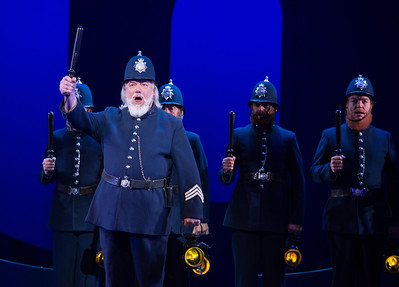
John Tomlinson as the Sergeant of the Police in the Pirates of Penzance, performed by the English National Opera. 7th Feb 2017, London Coliseum, Britain.

To have the finest Wotan of his generation as the Sergeant of Police was a gem, and John Tomlinson did not disappoint. Totally in character, as one would expect, his nuances with the text were constantly alive and apt, and his voice, needless to say, better than one would dare to expect.

Lucy Schaufer returned as a sympathetic Ruth and Andrew Shore again relished the part of the Major General.

Gareth Jones moved things along swiftly in the pit and it was good yet again to enjoy Sullivan’s score from a full orchestra not a pit band.


BBC Symphony Orchestra

Barbican Hall, Wednesday 22 February 2017

The UK premiere of Wolfgang Rihm’s Piano Concerto No2 may have accounted for the rather thin audience but those who stayed away missed one of the finest Bruckner performances I can recall in many years.

Rihm’s work fluctuates between tonal and atonal sentiments meaning that the ear is never quite at ease with the developmental line. There are many quasi-lyrical passages, and the gentler sections often come close to moving the listener but then the underlying tension works against this. The snare-drum towards the end brings a rare moment of consolidation to a work which can seem to be drifting away from us. The piano part is fiercely demanding with hardly a moment of respite for the soloist. In this capacity Nicolas Hodges was a tireless enthusiast and at times came close to convincing us that the work was greater than the sum of its parts. Lothar Koenigs brought sensitivity to many passages but could do little to enthuse us about the whole.

Bruckner’s Seventh Symphony after the interval was another matter altogether. There was superb dynamic range and consistent sensitivity towards the clarity of the score. The second movement had an Elgarian opacity which I can’t recall ever being aware of before. It was full of light and joy, with no sense of the ponderous weight that so many bring to Bruckner. The drive and enthusiasm in the Scherzo was matched by an almost playful approach to the finale.

Thankfully, being a BBC performance, it will be broadcast on Tuesday 28 February and I for one will be listening again.

St. Nicolas Pevensey secures Heritage Lottery Funding

St Nicolas Church, which celebrated its 800th anniversary in 2016, has been awarded £74,900 by the Heritage Lottery Fund. This grant, together with church generated funds, will pay for a programme of improvements that will ensure repairs to the roof and rusted windows, and a new electrical wiring and lighting system.  These will be the latest elements of a restoration programme begun in 2006, which protected the church building from the prevailing south-westerly Channel winds and storms. The next and final stage aims to repair internal rendering and finishing, which has been extensively damaged as a result of incoming damp.

As well as keeping the congregation warm and dry, the improvements will mean the church’s many visitors and the audiences to St Nicolas’ burgeoning concert programme will also be able to enjoy the church in much greater comfort.

The grant will also pay for the installation of a landmark display that describes the role of the church over eight centuries from the time when Pevensey was an important medieval seaport. An overall narrative for the church is condensed into a series of six main storylines, embraced by one overarching theme: “For eight centuries the Church of St Nicolas, patron saint of seafarers, has kept watch over Pevensey, reflecting the town’s fortunes and inspiring its community.” This will be unveiled on completion of the project in 2017.

Welcoming the announcement, Deputy Churchwarden and outgoing leader of the P16 fund raising group, George Stephens said: “The church has been on the Heritage at Risk Register for some time, and could well have had to close permanently if this application had not been successful. Having celebrated the church’s 800th anniversary throughout 2016, this grant means the church will remain for use by the community and churchgoers for many years to come.”