Inauguration of the Phoenix Grand Piano at Opus Theatre

Opus Theatre, Hastings, Saturday 9 September 2017

Opus Theatre have a new, anonymously donated, Phoenix Grand Piano which was inaugurated last Saturday with two, highly contrasted, concerts. It is difficult at this point to avoid clichés as it is a magnificent instrument, superbly responsive in touch with a wide dynamic range completely at one with the fine acoustic of the building.
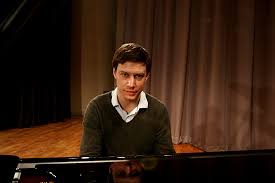
In the afternoon Anton Lyakhovsky brought us a traditional romantic programme of Schumann and Rachmaninoff. The sound he produced for Schumann’s Arabesque  was baritonal – warm and slightly hazy in impact but in perfect keeping with the work itself. There was no lack of clarity but the balance across the instrument proved here, and later in the day, to be one of its most impressive qualities. Schumann’s Op11 No1 may be less familiar but brought a greater sense of attack without any loss of finesse. The articulation of the Aria was refined before the fierce impact of the Scherzo and the lightning changes of mood of the final movement.

The second half was all Rachmaninoff, opening with two Etudes Tableaux from Op39. The complexity of the writing of No1 held no terrors for either performer or the instrument itself, maintaining clarity even at its most rapid articulation. No3 brought some gentler translucent qualities before we moved into more familiar territory with the Prelude Op23 No25 – given with a real sense of panache.

The afternoon concluded with the Corelli variations and a delicately reflective coda.
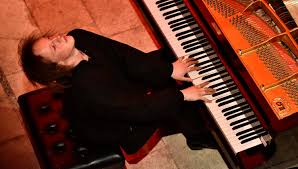
The evening brought us Oliver Poole and a total change of both mood and impact. Dressed casually and immediately creating a warm rapport as he introduced his programme to the audience, Oliver is no stranger to Hastings, having played her before (if some years ago!) and living just down the coast.

His programme was a tour do force and one of enormous contrasts. The whole of the first half was given over to Bach’s Goldberg Variations. The immediate impact was startling. Where Anton Lyakhovsky had created a romantic warmth, the Bach was crisp, clear, almost clavichord-like in its impact. I can’t ever recall a Steinway being able to match this level of contrast. The variations sparkled and danced their way through, frequently touching the sublime and occasionally those moments of spiritual enlightenment which seem to arise naturally in Bach at his finest.

This might have been enough in itself but after the interval Oliver Poole introduced us to an arrangement of scenes from Wagner’s Ring cycle. While being entirely pianistic, the orchestral impact of the arrangement was staggering. I can recall hearing versions for four hands which seemed to have fewer notes than we heard here! The Ride of the Valkyries was so intense it recalled images of Franz Liszt with smoke erupting from the piano, so hard was he driving it.

By total contrast the final listed work was Rhapsody in Blue which Oliver clearly plays for his own enjoyment – though it entranced the audience. A brief toying with the Blue Danube as an encore brought the day to a close, but Polo Piatti was totally justified in his remarks that this superb instrument could be the start of a totally new chapter in the musical life of Hastings.
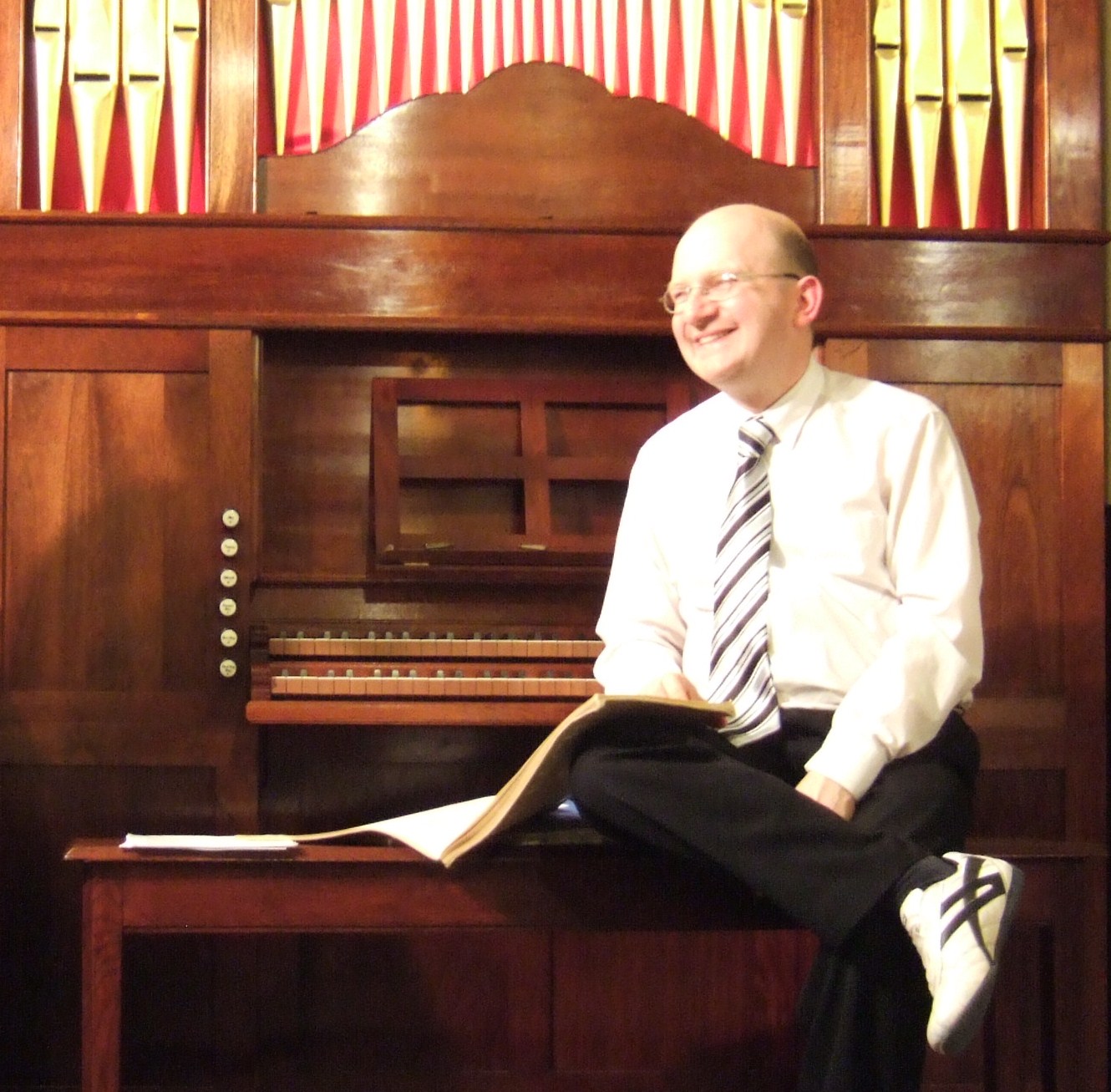


Coffee Concert;  Stephen Page at St Peter’s, Bexhill

Saturday 9 September 2017

A strong turn-out for a varied and entertaining concert, which ranged from less familiar classical works to the highly popular.

Stephen Page opened with a triumphant voluntary by Alan Viner, Lobe den Herren followed by Bach’s Chorale Prelude Wir glauben all’ an einen GottBWV680 to mark the 500th anniversary of the Reformation. His use of the cantus firmus here was in marked contrast to John Ireland’s gentle Villanella which requires a wide range of registration.

Howells’ Psalm Prelude No1 from Set1 demonstrated the English cathedral sound the St Peter’s organ can command, and this gave way to the warm tones of Pachelbel’s brief Chaconne in F minor.  Herschel’s allegro from a longer suite used echo refrains and could easily have been written for a mechanical clock.

Not that any of the above made for difficult listening but the rest of the programme was in a lighter, more familiar vein, commencing with Yon’s Toccatina for flutes and Lang’s Tuba Tune. Karg-Elert’s Chorale-Improvisation on Nun danket alle Gott needed no introduction but it was good to know the background to Fats Waller’s The Jitterbug Waltz – how many of us knew he played the organ?

As a tribute to the 40th anniversary of Star Wars we heard a brief and quiet piece from John William’s film score before Stephen Page concluded with one of his most popular works – Abe Holzmann’s  Blaze Away!

The next organ concert at St Peter’s will be given by their resident organist, Anthony Wilson, on Saturday 11 November at 10.30am.

PROM 74

Royal Albert Hall, Friday 8 September 2017

As always on the penultimate night of the world’s biggest classical music festival, the atmosphere in the Royal Albert Hall was up several notches as the capacity audience settled down and the Vienna Philharmonic filed in.

Michael Tilson Thomas (how like the fondly remembered Otto Klemperer he begins to look – same sort of charisma too) made sure we heard lush precision in Brahms’ Variations on the St Anthony Chorale. The woodwind section players were almost dancing by the time we got to the vivace in Variation 5. It’s a fine work to begin a concert with because the score (not that TilsonThomas was using one) provides so much for everyone to do. It’s almost as much of showcase for instruments as is Britten’s Variations and Fugue on a theme of Purcell aka TheYoung Person’s Guide to the Orchestra.

Then, the orchestra was slimmed down for Mozart’s piano concerto No 14 in E flat major, K449. Written in 1784 in Vienna this elegant, if shortish, work is an apt choice for a VPO concert although it isn’t one of Mozart’s most familiar concerti. Emmanuel Ax was an unshowy soloist who played Mozart’s own cadenzas with authority and lightness of touch. The dialogue between piano and orchestra, especially in the andantino middle movement was nicely balanced and it’s good to see Ax so engaged with the orchestra that he was virtually conducting from his piano stool when he wasn’t playing himself.

The advertised part of this fine concert ended with Beethoven’s Symphony No 7, as glorious and joyful as ever. Tilson Thomas’s interpretation, however, is more grandiose than frothy. His tempi, in the first three movements are gentle. He spares us those ultra-fashionable Norrington-esque hurtles in pursuit of Beethoven’s original metromome markings. The result? You could hear every delightful detail in the texture including lots of fine flute work, strong contrast between brass interjections and  woodwind rejoinders  along with the rich, but spirited string sound for which the VPO is famous. He gave us plenty of speed and lots of the prescribed brio in the allegro to round off a pretty splendid account of a popular work which manages never to sound hackneyed. I do wonder, though, about the wisdom of lining up horns and trumpets, five big steps above the strings. It means they can see and be seem, obviously. But it also means that you can hear their parts so clearly it’s as if you’re reading their music and sometimes it’s obtrusive rather than blended into the sound.

Tilson Thomas introduced the encore On Hearing the first Cuckoo in Spring as “a piece you will all know very well” – a hint that he, an American, and the VPO do not. In fact I discovered afterwards that the orchestra had never played it before. Well of course Delius is a long way from Brahms, Mozart and Beethoven in terms of both time and place but the VPO played it with tender respect and it was a fitting end to a most enjoyable concert.

Lovely to see the VPO in London again, by the way. This time I counted seven women players: four second violins, one first violin and two cellos. Things are gradually equalising but they still have a way to go. I’m sure there are plenty of eager, talented female brass and woodwind players in Austria and elsewhere just waiting for a break …

SE

Barefoot Opera: La Boheme

St Mary in the Castle, Saturday 30 September 2017

La Boheme returned to St Mary in the Castle last Saturday with new principle singers. The difference it made demonstrated both the strength of Jenny Miller’s production and the impact of the singers themselves. American tenor, Andrew McGowan, was a youthful, naïve and impetuous Rudolfo. There were no problems at the top of the voice and he brought a heady romanticism to his wooing of Mimi. For once the on-off relationship made perfect sense, and his desolation at her death was truly moving.

Lucy Ashton, who sang Pamina for us last year in Opera South East’s production of The Magic Flute, was outstanding as Mimi. Her openness of manner and honest emotions caught the complexity of Mimi’s character, and her singing throughout was finely focused and moving.

The rest of the cast may have been familiar from the earlier performance with Oscar Castellino a fine Marcello and the instrumental ensemble splendidly well balanced.

St Mary in the Castle, Friday 8 September 2017

It is easy to forget that La Boheme is essentially an intimate work. The voices may be large but the emotions are very personal. The great strength of Jenny Miller’s new production for Barfoot Opera is that it drew on these realities and made them the heart of the evening. The umbrellas and the hints of prostitution which underpin the story were very effective. Added to this was one of the finest small ensembles supporting the work.  It was a stroke of genius to include Milos Milosovic on the accordion, its gently melancholic tones being absolutely in tune with the unfolding pathos of the drama.

The majority of the cast was strongly characterised with the women being particularly impressive. Sarah Foubert as Mimi was able to combine a genuine sense of consumption with a radiant top to the voice and her act three aria was thrilling. Elaine McDaid’s Musetta was equally strongly characterised and a perfect foil to Oscar Castellino’s well rounded and persuasive Marcello.

Laurence Panter seemed miscast as Rudolfo. He had difficulty with the tessitura of the role and often seemed hesitant musically. His acting was firm and convincing throughout and it may be that he would impress more positively under other circumstances.

Mathew Thistleton’s Colline and Tim Patrick’s Benoit were both positive presences, and there can surely be few like Andrew Sparling, able to double Shaunard perfectly convincingly with solo clarinet in the ensemble. His obbligato opening to Musetta’s quando m’en vo was masterly and totally apt.

Inevitably there were some cuts, acceptable in act two given the lack of children on stage but unfortunate in act three which lost its structure at the start. Thankfully the quartet was emotionally as challenging as it should be and became the climax of the evening.

Barefoot Opera return on 11 November with Monteverdi’s L’incoronazione di Poppea.

Jonathan Miller’s classic production of The Barber of Seville celebrates its thirtieth anniversary

Opens 5 October at the London Coliseum at 7.30pm for 9 performances

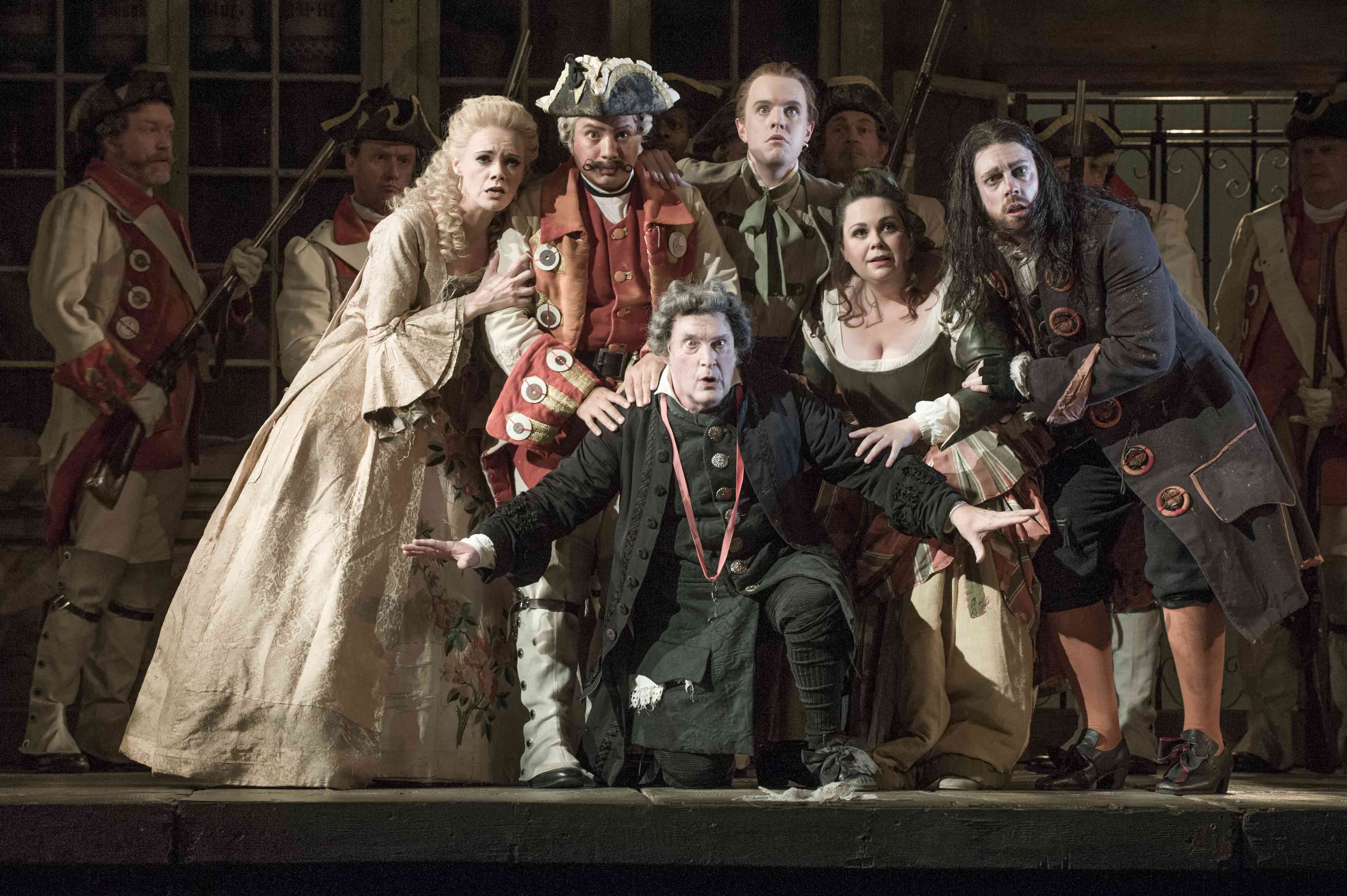
Thirty years after it first opened at the London Coliseum in November 1987, Jonathan Miller’s production of Rossini’s comic masterpiece The Barber of Seville returns to ENO for its thirteenth revival. Over the years it has become ‘a national institution’ (The Daily Telegraph) with generations of opera-goers enjoying Miller’s deft handling of this great operatic farce. For this anniversary production the original Figaro from the 1987 run, Alan Opie, takes the role of his antagonist, Dr Bartolo.

The period setting of 18th century Seville is host to a classic commedia dell’arte plot. The dashing Count Almaviva attempts to win the beautiful Rosina from under the clutches of her lecherous guardian Dr Bartolo, with the help of his barber Figaro and a series of cunning disguises.

In the title role is Australian baritone Morgan Pearse, returning to ENO after his ‘wonderfully agile’ (The Guardian) Figaro in the 2015 run. He is joined by Mexican tenor Eleazar Rodríguez in the role of Count Almaviva, also returning from his ‘dashing’ (The Sunday Express) performances in 2015.

English soprano Sarah Tynan makes her role debut as Rosina. She was last seen on the Coliseum stage earlier in 2017 in Christopher Alden’s five-starPartenope for which she was widely praised (‘dazzling’ – The Independent, ‘divine’ – What’s on Stage). Her previous roles at ENO include a ‘superbly beautiful’ (Opera Today) Romilda in the 2014 performances of Xerxes, as well as Marzelline in 2013’s Fidelio and Zerlina in 2012’s Don Giovanni.

Also making a role debut is English baritone Alan Opie as Dr Bartolo. With a significant career of highly acclaimed performances behind him (including Figaro in the original version of this production), this adds another classic character to his roster. A veteran especially of Miller productions at ENO, he has twice sung the title role in his Rigoletto (2003 and 2006). Most recently seen at ENO for his ‘outstanding’ title role in 2012’s The Death of Klinghoffer, he returns in the spring to sing Giorgio Germont in La traviata.

The role of Don Basilio is sung by Alastair Miles (‘the finest British bass of his generation’ –The Guardian) who was called ‘the ideal Don Basilio’ (The York Press) when he sang the role for Opera North in 2015. His numerous performances at ENO include the role of Alfonso in 2011’s Lucrezia Borgia.

English mezzo-soprano Yvonne Howard, ‘one of the finest singing actresses this country has produced’ (The Guardian), sings the housekeeper Berta. She has previously been seen at ENO in numerous roles including Katisha in the 2012 and 2015 runs of Jonathan Miller’s production of The Mikado. She returns in February to sing the Queen of the Fairies in Cal McCrystal’s new production of Iolanthe.

ENO Harewood Artist Matthew Durkan returns to sing Fiorello, the role with which he made his ENO debut in 2015. He was earlier seen in 2017 alongside Sarah Tynan in Partenope, widely noted for his ‘comic flair’ (The Daily Telegraph).

British conductor Hilary Griffiths makes his ENO debut after a highly distinguished career on the continent. His positions have included Chief Conductor of the State Opera, Prague, General Music Director of the Symphony Orchestra and Opera in Regensburg, and Principal Staff Conductor at the Cologne Opera.

Peter Relton returns once again after directing the 2015 run. His previous directorial engagement was launching the new Grange Park Opera with his inaugural production of Tosca (‘a remarkable achievement’- The Financial Times). The designs are by Tanya McCallin and lighting design is by ENO Head of Production Tom Mannings. The translation is by Amanda and Anthony Holden.

The Barber of Seville is chronologically the first of Beaumarchais’s ‘Figaro trilogy’. Its sequel, adapted earlier by Mozart, is The Marriage of Figaro,which will be performed by ENO in the spring, directed by Fiona Shaw.

The Barber of Seville opens at the London Coliseum on 05 October for 9 performances – 05, 10, 13, 18, 20, 25 and 30 October at 7.30pm and 07 and 28 October at 6.30pm.

500 tickets for £20 or less are available for each performance. Tickets start from £12.

Brighton Philharmonic Orchestra’s new season at Brighton Dome

The nights are drawing in and the children are back at school, but whilst for some this heralds the onset of the winter months, the Brighton Philharmonic Orchestra and its regular audience are looking forward to their new season of Sunday afternoon concerts at Brighton Dome.

An array of world-class musicians, including Melvyn Tan, Howard Shelley & Michael Collins, join the orchestra to perform popular works by Tchaikovsky, Brahms, Schubert, Rachmaninov, Haydn, Mozart and Beethoven, as well as less well-known gems by Arutunian, Ravel and Malcolm Arnold. Pre-Concert Interviews with these guest soloists take place at 1.45pm before each concert (apart from New Year’s Eve) giving you a fascinating insight into the life and career of a professional musician.

The season opens on Sunday 8th October with Conductor Laureate Barry Wordsworth at the helm, joined by exciting young Romanian pianist Alexandra Dariescu (recently named as one of 30 pianists under 30 destined for a spectacular career by International Piano Magazine) playing Tchaikovsky’s popular Piano Concerto No.1. The programme also includes Brahms’ intensely lyrical Symphony No.3 and Schumann’s dramatic overture to his opera Genoveva.

Particular highlights include a very special Remembrance Sunday concert (12 November) which opens with Bach’s Toccata & Fugue, orchestrated by the great American conductor Leopold Stokowski and familiar to many from the opening sequence of Disney’s Fantasia where Mickey Mouse shakes hands with The Conductor, Stokowski. Then comes Benjamin Britten’s emotional and technically demanding Violin Concerto, heavily influenced by the escalation of hostilities in Europe when it was written in 1939, and performed by British violinist Matthew Trusler. This is followed by George Butterworth’s evocative A Shropshire Lad, based on poems by AE Housman. This sumptuous orchestral rhapsody conjures up the rural idyll of Edwardian England that was to change forever in the First World War, where Butterworth was to lose his life in the trenches. The concert closes with Vaughan Williams’ craggy and powerful Symphony No.4, written in 1935 as the storm clouds of war gathered over Europe.

As part of the city’s festive celebrations the orchestra presents its traditional New Year’s Eve Viennese Gala with a plethora of foot-tapping marches, polkas and waltzes from the prolific Strauss family and lots of sparkly top notes from guest soprano Rebecca Bottone, returning for a second year by popular demand.

Highlights later in the season include Melvyn Tan playing Ravel’s jazz-infused Piano Concerto (3 December), Mozart’s Clarinet Concerto – a Classic FM favourite that has been used in the soundtracks of films such as The King’s Speech and Out of Africa (28 January), Howard Shelley playing Mendelssohn’s melodious Piano Concerto (11 February), and Arutunian’s fabulous showpiece Trumpet Concerto (4 March). Our season closes with Saint-Saëns’ delightful Carnival of the Animals for which the orchestra are joined by the virtuosic piano duo Worbey & Farrell, last seen in Brighton in the Fringe in 2014.

On the morning of the final concert (25 March) we will be holding our popular free Open Rehearsal for children, with a run through of Carnival of the Animals and extracts from Delibes’ comic ballet Coppélia Suite (arranged by our very own Barry Wordsworth).

Tickets are available from Brighton Dome Ticket Office (01273) 709709 or www.brightondome.org  and range from £12-£38. Students and under 18s enjoy a 50% discount, as does anyone receiving Jobseekers Allowance, Pension Credit or Income Support, whilst children can attend for just £1 as part of a Family Ticket. Tickets for the Pre-Concert Interviews are £3.75.

Discounted parking is available for all BPO concerts at just £6 for up to five hours (from 1pm-6pm) in NCP Church Street Car Park, just a couple of minutes’ walk from Brighton Dome.

For full details of the whole season see: www.brightonphil.org.uk


Prom 64

I heard the Royal Concertgebouw Orchestra on their home turf in Amsterdam in June so it was a real treat to catch them on their first Proms outing since 2009, only a few weeks later – this time with their chief conductor, Daniel Gatti – and the choice of programme, definitely not mainstream, was interesting too. Wolfgang Rihm, born 1952, and Anton Bruckner are not obvious bedfellows but in combination they provided quite a showcase for this fine orchestra.

Like most people in the hall, I was hearing Rihm’s In-Schrift (loosely translated as Inscription), premiered in 1995, for the first time. It requires a chamber size orchestra without upper strings but includes six percussionists and six trombones, two of them bass trombones. The starring role belongs to the percussionists who at one point lead a magnificent quasi-cadenza on five side drums. Mesmerised by the sheer excitement of it, I was also glad that I didn’t have to count for the entries in such an episodic work full of tempo changes. I was almost relieved to see Gatti counting the bars with his fingers for the percussionists as they reached the turning point in their big moment. There’s a lot of finely nuanced dialogue in this piece as it works through its many moods and tensions. The principal flute, who led the orchestra for this piece, for example, has a lot of interplay with trombones, woodblocks and tubular bells (5 sets). If you want drama in music, there was no shortage of it here.

After an interval to digest the impact of the Rihm, we were back to a more conventionally configured full orchestra, although Gatti splits his violins and puts his double basses behind the firsts. Bruckner’s unfinished ninth symphony in D minor (homage to Beethoven, he said) is not one of his best known works. Written at the very end of his life, it feels like an autobiographical retrospective which works well in three movements – two slow ones sandwiching a contrasting scherzo and trio.  Gatti, who conducted this without a score, coaxed a sound from the orchestra which managed to be both crisp (those repeated chopping down bows in the middle movement) and velvety with a pleasingly warm brass sound, suitably plangent in the first movement and like melted chocolate in the adagio. Clearly a charismatic musician, Gatti sometimes beats time clearly and at others reduces his hand movement to a minimalist, understated twitch. He is, presumably, communicating with his eyes which, of course, the audience can’t see. At 65 minutes this is a very long, concentrated work and although Gatti ensured that it held the attention and was pretty moving, it might have been better to have cut some of the repeats, especially the one at the opening of the third movement.

Susan Elkin

Flamenco at Kino-Teatr

Kino-Teatr, St Leonards, Sunday 28 August 2017

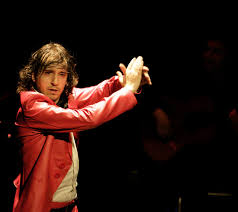
The only word which comes to mind in trying to sum up Jesus Olmedo’s flamenco show is immersive. We were tipped in at the deep end, without explanation, introduction or any sense of where the journey was going. It was at once thrilling and wonderfully challenging.

Unless we happened to be highly informed on flamenco style and content – which one has to admit was unlikely on a bank holiday weekend in Hastings – we simply had to go along with what we were experiencing, but it was well worth the effort.

To describe briefly our journey. A solo guitar plays quietly, becoming more complex in rhythm and emotional impact as it progresses. A man – Jesus Olmego – dances solo accompanied only by his own castanets until he eventually draws in the guitar and bass. The woman sings a melody which seems to lie somewhere between a composed song and a free improvisation. The clapping builds between the dancers becoming ever more complex.

Jesus Olmego sings and gradually draws the woman to dance until suddenly she takes over and is leading the group and driving the pace forward, her footwork a riot of cross rhythms and accents.

The second half opens with the dancers together, with the woman leading on the castanets.

She sings after this – the refrain a lo querido being the only words to impinge – before a longer guitar improvisation which includes a veritable game as rhythms are passed around and mirrored.

At the end of the evening Jesus Olmego danced a linked series of shorter pieces, each appearing to have a different emotional context, while the complexity of the dance steps became almost hedonistically absorbing.

Had we learned anything about flamenco? Possibly not. Had we experienced flamenco? Certainly, and it was for us to reflect on that experience. Was it worth it? Absolutely.

The encore was unexpected. The guitarist, who had played so well throughout the evening, suddenly sang and danced himself. It was a different more guttural approach but entirely in keeping with an evening which reminded us of the origins of flamenco even as it brought us one of the finest modern interpreters.

The Ragged Trousered Philanthropists

Opus Theatre, Hastings, Saturday 26 August 2017

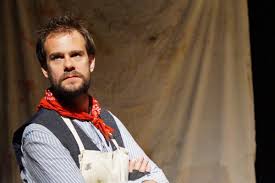
Robert Tressell’s The Ragged Trousered Philanthropists came back to Mugsborough last weekend – or rather Costal Productions brought their staging of Tressell’s masterpiece to Opus Theatre for two performances. A packed house was taken through the devious vicissitudes of the aristocracy and capitalist bosses as they sought to keep the workers in their place. Owen Hutchings brought us a deeply committed Frank Owen who tries to convince his fellow workers that they have the ability to control their own destiny if only they would accept it, but the long opening scene makes it all too clear why the revolution is taking so long to come, when too many of the workers are their own worst enemies.

Although on one level this is essentially a polemical work, it more than justifies its place within the theatre when it draws inevitably parallels with modern day situations. While there were references to Amber Rudd and Brexit, they were not really necessary in the light of the on-going refusal of people to take responsibility for their own lives through joint action rather than blaming others for the problems which surround them. The regular depression of wages is a constant theme throughout the play yet is still a relevant cause a century later.

The eight actors play a wide range of parts between them and it took a little time for these to establish themselves, as did the level of voices within the auditorium which tended to fade in the opening scenes. However, once we came to the brilliant analysis of the relationship between capital and labour, superbly choreographed by Owen Hutchings, the play moved to another level.

It was a long evening and not everyone returned after the interval, which was a pity for they missed the unfolding of an argument which is yet to reach resolution. It was telling that the political speeches towards the end did not need updating, for they were as crass as most tub-thumping is at election time. In the end, Frank Owen is obviously dying of consumption, brought on through his work, and the other painters are living on lower wages even where they are in work. Any current concerns about over meticulous Health & Safety regulations only need to witness the death of the elderly worker to realise that thankfully we are a world away from there.

The evening gave us much to contemplate and a sound basis for developing a greater political awareness – which is just what Robert Tressell would have wanted.


Baroque Chamber Music

St Nicolas Pevensey Saturday 12 August 2017

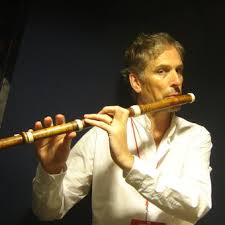
The Bats may not have been in the belfry but their protected status has meant that the planned restoration work at St Nicolas, Pevensey, has had to be delayed. The accruing benefit has resulted in the church being available for a summer concert from regular visitor baroque flautist Neil McLaren and baroque violinist Jane Gordon.

Their concert opened with a sonata for both instruments by Telemann. With the sun still streaming through the clerestory windows the opening Dolce seemed a perfect reflection of the gentle warmth of a summer evening. The Largo flowed with simple grace before the rapid dance rhythms of the final Vivace with its hints of hurdy-gurdy from the violin.

JS Bach’s Suite in A minor for solo flute has been adapted by Neil McLaren himself to fit the four movements written specifically for flute into the more familiar structure of a suite for solo instruments. In this case he used the opening Prelude and closing Gigue from the second suite in D minor BWV1008 for cello to telling effect. The Prelude pierced through – at times almost uncomfortably aggressive – before relaxing more into the fluidity of the Allemande and Corrente. The Sarabande is a complete contrast, its sense of yearning and sadness always to the fore. The jollier Bourree Anglaise led to the more extrovert tones of the final Gigue but the intense intimacy of the work is never really lost. Telemann’s Canonic Sonata in D concluded the second half with its hints of pastoral rhythms and formal dances.

The second half opened with one of Bach’s greatest works, but one which is probably not as familiar as it should be. The D minor Partita for solo violin ends with the great Ciaccona which is not only a monumental climb for the performer but also a highly demanding call for the listener. The long opening set of variations twist and turn their way through the most frightening of forms before suddenly emerging into the uplands of the major key variations and a sense of paradise beyond the strife. But Bach does not leave us there. He brings us back to the reality of earth but this time reflected in the knowledge that we have glimpsed heaven even if we are not there yet. It is a masterpiece as great as anything else by Bach and was subtly and wonderfully crafted by Jane Gordon.

It was, of course, difficult to follow but CPE Bach’s brief Duo for flute and violin brought the evening to its official close with the slightly tongue-in-cheek dance movements returning a smile to all. As an encore they gave us a brief movement from Rameau’s Les Indes Galante. Let us hope that the bats don’t keep them away for too long.