Brighton Philharmonic Orchestra

Brighton Dome, Sunday 2 December, 2017


Elgar’s In the South, written in 1904 and the oldest work of the afternoon, was a resounding opener in this all twentieth century programme. Barry Wordsworth dug out plenty of nostalgic silkiness, especially in the impressively clear string sound. He exploited the big rit just before the end too, so that it rang out with real Elgarian grandiloquence.

Ravel’s piano concerto written nearly thirty years later is, of course, a complete contrast. The opening and closing movements in particular often sound like Gershwin crossed with Shostakovitch. Melvyn Tan is a most engaging performer, eyes and body turned to the conductor and orchestra all the time and his left foot beating time in the jazzier Bolero-like sections – every inch a team player. He has a way of striking the keys rhythmically thereby reminding us that the piano is actually a percussion instrument. The middle movement in 3/4 with its long song-intro from the piano and then the duets with horn and cor anglais was beautifully lyrical – as was Tan’s encore: Liszt’s Bells of Geneva. Ravel, Tan told the audience, studied Liszt intensively and would almost certainly have played this piece.

Barry Wordsworth pointed up all the mournful but tuneful melancholy in the opening section of Rachmaninov’s Second Symphony highlighting the similarities to Tchaikovsky’s 6th Symphony and the Russian-ness of it all. Then came the scherzo, at a nippy enough tempo to provide all the requisite fireworks and contrasts. To make this symphony work, you really need to milk Rachmaninov’s beautiful melodies for all they’re worth and that’s just what the conductor did in the last two movements. The finale, for instance, has a lot of lush string work but in this performance it was enjoyably joyful rather than heavy – serious music with a spring in its step.

Congratulations to BPO’s cor anglais player who worked very hard in this concert both in the Ravel and the Rachmaninov. She provided some especially attractive solos.

Susan Elkin


English National Opera to perform Acis and Galatea and Paul Bunyan for the very first time as part of ENO Studio Live

English National Opera (ENO) will perform Handel’s Acis and Galatea and Britten’s Paul Bunyan for the first time as part of its outside work series. ENO Studio Live forms part of ENO Outside which takes ENO’s work to arts-engaged audiences that may not have considered opera before, presenting the immense power of opera in more intimate studio and theatre environments.

Acis and Galatea (June 2018) will be directed by Sarah Tipple and performed at ENO’s historic rehearsal studios, Lilian Baylis House. ENO Studio Live launched in May 2017 with the UK premiere of Jonathan Dove’s The Day After, performed for the first time in a new choral version, and performances of Gilbert and Sullivan’s Trial by Jury. The initiative showcases emerging talent from the UK opera and theatre worlds as well as championing ENO’s own in-house talent and young directors. Paul Bunyan (September 2018) will be directed by Jamie Manton and will be ENO’s first collaboration with Wilton’s Music Hall.

The choice of these two productions celebrates the integral role that both Handel and Britten have played in the company’s history. For decades ENO has developed its reputation as ‘the house of Handel’ (The Sunday Telegraph) and, since its production of Semele in 1970, the company has performed 12 different operas by the composer. In 1945 Sadler’s Wells Opera (which became ENO in 1974) gave the world premiere of Benjamin Britten’s Peter Grimes, and Britten’s music has been at the heart of the company ever since. In 2018, the year which marks fifty years of opera in residence at the London Coliseum, ENO will perform four works by Benjamin Britten: A Midsummer Night’s Dream, The Turn of the Screw, Paul Bunyan and War Requiem.

ENO’s Artistic Director, Daniel Kramer, commented:

‘It was truly inspiring to see our whole company pull together earlier this year to create the two productions that launched our ENO Studio Live series. We are so proud of the exceptional talent that we have at ENO, and I delighted that these next two productions will enable us to continue to celebrate young directors and designers while supporting some of the UK’s most exciting emerging singers.

‘Following the tremendous critical and audience response to Jamie Manton’s production of The Day After this summer I am particularly proud that Jamie is returning to work with the company and with our award-winning chorus on Paul Bunyan at Wilton’s Music Hall.

‘The music of Handel and Britten has played a vital role in ENO’s history, and constitutes part of the very DNA of our company. I am looking forward to the company’s first performances of these two works in the inspiring hands of two such impressive up-and-coming directors. Opera has the unique power to move and inspire people in a way that almost nothing else can, and it is very exciting to have the chance to share this with our existing and new audiences not only through our productions at the London Coliseum, but also in these intense and intimate settings.’

Maidstone Symphony Orchestra

Mote Hall, Maidstone, 2 December 2017

The Flying Dutchman overture – always a good warm up piece for both audience and orchestra – got us off to a strong start with its energetic opening. Brian Wright ensured that we enjoyed all that Wagnerian brass and busy string work and the slight roughness in the more exposed section didn’t matter much.

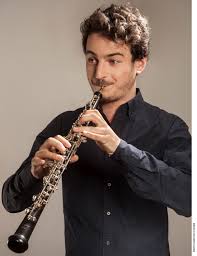
Then it was on to Strauss’s sparky, melodious 1946 Oboe Concerto. There’s an elfin quality about Olivier Stankiewicz, a Frenchman, both in his playing and his appearance. The mature Strauss understood exactly how to exploit the instrument whose small reed allows for few breaths and long phrases and Stankiewicz gave us a lot of lyricism and seamless creamy sound especially in the beautiful Andante. Brian Wright is, as ever, very good at supporting soloists and here he achieved an elegant balance between orchestra and oboe.

Ralph Vaughan Williams’s vibrant Second Symphony is an aural portrait of London hailing from just before the First World War. It’s a work of many moods and modes, requiring large forces and it’s good to see a battery of young percussionists playing, among many other things, several sorts of cymbal. By now the orchestra was totally in its stride and the precision of the muted strings beneath the horn and trumpet in the ethereal minor key melody in the Lento was a delight. So was the resolute string sound in the Nocturne. And the control in the very evocative epilogue, as everything dies away to silence at the end, was a great credit to the conductor.

Two other players deserve a special mention. Ben Knowles, principal viola, had a lot to do. Vaughan Williams loved the viola and gives it solo spots in his second symphony as well as leading more than once with the viola section. There’s a nice viola passage in the Strauss too. And it all came off with aplomb in this concert. Knowles well deserved the special front-of-stage acknowledgement Brian Wright gave him at the end. Second, full marks to the harpist, Jane Lister, who substituted at the eleventh hour for a player who had mistaken the date. She raced in with her harp five minutes before the concert was due to start and went on to do a grand job.

This was a charity concert attended by High Sheriff of Kent, George Jessel DL, in his ceremonial velvet and frills. It supported the High Sheriff’s charity the Royal Agricultural Benevolent Institution, which, he told the audience before the concert, looks after farmers and farming families who have fallen on hard times.

Susan Elkin

Hastings Philharmonic: Stabat Mater

Christ Church, St Leonards, Saturday 2 December 2017

Marcio da Silva is not one to avoid taking a risk. At a time of year when most are settled into comfortable Christmas music with mulled wine and mince pies he chose to present an evening made up of two settings of the Stabat Mater. No matter how beautiful, and they certainly are, to have serious music for Easter at this time of year was a challenge – but one which certainly paid off. The often austere musical lines and the close setting of the texts, make demands on the listener which are then repaid with the levels of concentration and attention to detail.

The first half was given over to Scarlatti’s version of 1723. In many ways a straightforward setting of the poem, it treats each verse as a separate musical item, concentrating on the emotional impact of the text. Only by the time he gets to the 13th of the 20 sections does he start to combine them and uses the 16th and 17th verses as recitative before the confident enthusiasm of Inflammatus et accensus.

Pergolesi’s more familiar setting seems not only more emotionally involved but also sets larger sections of the work to create extended musical structures, particularly in the second part of the poem where the singers often work together rather than as individual voices.

We are used to Marcia da Silva as a fine baritone but here he was singing counter-tenor for the first time. While this is obviously not his normal range, and there were times when the sound was not as precise as we have come to expect, the intensity and dramatic edge were impressive throughout.

Soprano Emily Armour was given more lyrical settings, with occasional coloratura passages to delight the ear, her voice amply filling the large spaces of Christ Church.

Petra Hajduchova moved effortlessly from keyboard to harpsichord, producing apt support for the voices, along with the two violins and cello.

Two weeks until Hastings Philharmonic’s traditional Christmas Concert, and the new-year will bring us a Tango Night and Schubert’s Winterreise.

Hastings Philharmonic: Pergolesi/Scarlatti Stabat Mater

This will be a rare opportunity to hear Marcio da Silva sing counter-tenor.

Hastings Philharmonic Baroque – 7pm,  
2 December 2017 at Christ Church,
Silchester Road St Leonards TN38 0JB,

featuring Emily Armour, soprano, Marcio da Silva countertenor, Petra Hajduchova on Harpsichord, violins Eleanor Harrison and Ellen Bundy, cello Philip Collingham. tickets  £15/£12.50 concessions (Under 16 £5). https://www.musicglue.com/hastings-philharmonic/events/2017-12-02-stabat-mater-christchurch

WNO: Russian Revolution

Apollo Theatre, Oxford, 28-29 November 2017

It was a pleasure to see both of these productions back in the repertoire and so well presented. The link may have been a little tenuous but the experience of the individual works was never in doubt.

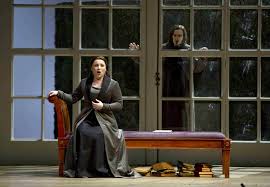
James Macdonald’s approach to Eugene Onegin becomes increasingly challenging as it goes on. We have little real sympathy with Tatyana in her letter scene, as she seems emotionally limited no matter how extrovert she claims to be, but by the end it is Onegin himself who troubles us as he loses all sympathy in a welter of self-flagellation.

This narrative is carefully constructed and set within the three large choral scenes which are expertly handled by the WNO chorus. The mistakes in the choreography were either brilliantly planned to look naturalistic or were covered in a highly professional way by the respective chorus members. Either way it was a delight.

Natalya Romaniw, as Tatyana, is actually Welsh despite her Ukranian name and matures intelligently as the evening progresses. The voice is never in doubt but her reaction to Onegin seems, on reflection, unnecessarily harsh. He does not come over as arrogant in the opening scenes even if he is a fish out of water. She is at her best in the final act where – like Trollope’s Lady Glencora – she has learned how the world works and actually rather likes it, even if she has a moment of self-doubt.

Nicholas Lester’s Onegin is suave from the start but seems, psychologically, to absorb all the worst traits of Lensky once he has killed his friend. In the final act we are led to believe for a moment that Lensky is still alive but it is actually Onegin, now tousle haired and unshaven. He has had a total meltdown, and if he was out of his depth with the peasants at the start he is even more so now with the true aristocracy. No such problem for Tatyana who has taken to the life as a duck to water.

Jason Bridges is a finely sung Lensky but one whose naivety lets him down to say nothing of failing the excellent Olga of Claudia Huckle.

Of the large cast Liuba Sokolova particularly impressed at Filipyevna, and though Miklos Sebestyen only has the one aria as Gremin he certainly made the most of it – setting the seal on Onegin’s fate with deft simplicity.

Ainars Rubikis handled his large forces with skill from the pit and was not afraid to allow the sentimentality to take over when needed.

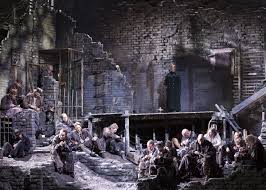
The following night brought us to the darkness of Janacek’s From the House of the Dead in David Pountney’s moving production of 1982. It is as stark as ever and if anything even more relevant in the light of refugee camps and the rise of right-wing parties. The narrative is concerned with prisoners telling their own stories – a reality of many camps where the only way to remind yourself you count and are human is to retell your story, no matter how bleak or evil it may appear to be.

We learn very little of Goryanchikov, who appears to be the only real political prisoner, and the only one who is freed at the end. In Ben McAteer’s characterisation he is at once sympathetic but also a total outsider to the rest of the prisoners.

Alan Oke’s Skuratov tells of his love for Luisa – an affair which comes to nothing – and in the final scene Simon Bailey’s Shishkov insists on giving all the grizzly details of his marriage.

Nothing is comfortable in the work, though there are numerous moments when light seems to break through; none more so than the end when the eagle is released – a sign of hope even when the prisoners themselves have little or none.

Tomas Hanus drove the score strongly. The opening prelude was particularly impressive setting the emotional state of the work, but there are no easy moments. The stage design by Maria Bjornson is as effective as ever and strongly lit by Chris Ellis.

Hastings Early Music Festival 2017

Friday 24 & Saturday 25 December at Opus Theatre
Sunday 26 December at Kino teatr
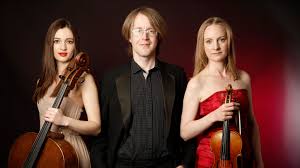
The first Hastings Early Music Festival brought a wealth of fine musicianship as well as encouraging an enthusiastic following for all three events across the weekend.

Friday night’s concert given by the Rautio Piano Trio may have lain just outside the normal parameters of early music but served as an engaging context for the rest of the weekend. Introducing the three piano trios by Mozart, Haydn and Beethoven, the members of the trio drew links based on letters from the composers, the visits they made to each other and their friendships across the years at the end of the eighteenth century.

They also drew our attention to the development of the Piano Trio itself, pointing up the growing importance of the cello, mellifluously played by Victoria Simonsen, as one moves from the near simplistic bass line from Mozart to the warm cantabile of Beethoven’s flowing melodies.

They opened with Mozart’s trio in C major KV548, the first Allegro driven by the piano. Though there is more scope for Jane Gordon’s solo violin as the work progresses it is essentially all built around Jan Rautio’s muscular piano playing.

The balance shifts in Haydn’s G major Trio Hob XV:25, the gently flowing legato line of the Poco Adagio particularly impressing and the jaunty, almost raunchy, Presto  bringing the first half to a fine climax.

After the interval we heard Beethoven’s Eflat trio Op70No2. Here the balance was exemplary. If the acoustic in the Opus is on the dry side it helps to clarify and accentuate the sound, giving it an added immediacy. The final Allegro moved us securely into the romantic period, with its complexity both of texture and structure – we have come a very long way from the gentle simplicity of Mozart’s trio earlier in the evening.  As a brief, romantic, encore we heard a delightful Nocturne by Ferdinand Hiller, who himself bridges the time between Haydn and Wagner.

We were now ready to dive back into the heady excesses of the eighteenth century on the following evening, opening with a brief Prelude to Act V of Purcell’s The Fairy Queen performed by the full HEMF Baroque Ensemble.  This was followed by Winter from Vivaldi’s Four Seasons, and highlighting the Festival Director, Jane Gordon, as solo violinist. So familiar is the work that it is all too easy to ignore the fact that this is effectively a virtuoso concerto for violin, and one which she carried off with considerable aplomb and impressive ornamentation. The Largo was taken at a more rapid tempo than might be expected but reflected the bleakness of the setting, to say nothing of one of the coldest nights so far this winter.
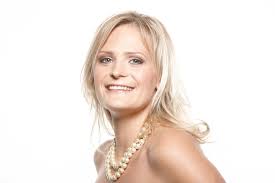
Soprano Charlotte Beamont joined the ensemble to sing the gentle but plaintive O Let Me Weep from Purcell’s The Fairy Queen followed instantly by a jaunty chaconne with violin obbligato.

The first half ended with a return to Vivaldi and his familiar Nulla in Mundo- though on this occasion we heard the whole work including the excessive and wonderful coloratura of the final Alleluia.

After the interval we moved to Bach and Handel, opening with an arrangement of one of Bach’s orchestral suites for Flute and strings. Flautist Neil Mclaren played through the Overture and then gave us a brief introduction to his flute which is based on a 1730 German model and one which he bought without even playing, knowing how good it would be and how perfect for eighteenth-century scores. They then played the six dance movements which make up the rest of the suite with a very slow and introspective Sarabande and a sprightly concluding Badinerie which seemed to defy the B minor setting of the whole work.

Charlotte Beamont returned for three vocal items to conclude the evening. Lascia ch’io pianga was the popular aria from Handel’s Rinaldo followed by the even better known Rejoice Greatly from Messiah.  In both the ornamentation was subtle and always apt.

The concert ended with the final aria from Bach’s Cantata BWV209, drawing on all the players across the evening for a warmly uplifting conclusion before we went out into a very cold night.
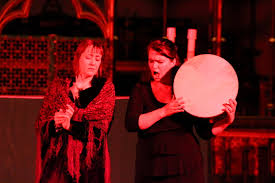
The final event of the Festival was held on Sunday afternoon at Kino Teatr where The Telling presented a programme of medieval carols, interspersed with readings. Where the previous two evenings had been carefully structured to lead us through and give us a deeper insight into the music we were to hear, the approach from the two singers and instrumentalist  was immersive and at times somewhat confusing. With no translations or explanations, no matter how beautiful the singing, we had no idea what we were listening too or the potential differences between the settings. More confusing still were the readings. Where all the music was medieval, the first reading was Laurie Lee’s experience of singing carols at the Big House in Slad in the early part of the last century. Only the brief extract from Gawain came close the period of the music. Kaisa Pulkkinen’s harp playing was most enjoyable but it would have been even more fascinating to know why she used two very different portable harps. There was some familiar music along the way but it could have been so much more enjoyable if we had understood more, rather than simply sitting back and indulging ourselves.

Maybe this will be part of a learning curve for next year. As a first festival this has been immensely impressive and plans are already in hand for next year. Jane Gordon has to be thanked and congratulated – starting anything for scratch is difficult and getting this far so quickly shows a level of professionalism and stamina which should take her far.

Tenors Unlimited

Internationally acclaimed operatic trio Tenors Unlimited, the ‘Rat Pack of Opera’ will be performing Christmas charity concert at Opus Theatre Hastings on Friday 8th December 19:30 in aid of local charity The Little Hands & Art with local choir Guestling-Bradshaw C.E Primary School

The internationally acclaimed operatic trio Tenors Unlimited, the ‘Rat Pack of Opera’, will be performing a Christmas charity concert at the Opus Theatre, Hastings on Friday 8th December 19:30 in aid of local charity The Little Hands & Art. They will be joined by local choir Guestling-Bradshaw C.E Primary School. The group is currently touring the UK and will touring the USA and the UK next year. Jem Sharples, a member of the group, is from Hastings.

Jem Sharples from Tenors Unlimited who lives in Hastings says “We’re delighted to be performing in my home town and hope as many people as possible attend to support The Little Hands & Art, which is such a worthy cause. This will be a special Christmas concert with lots of favourites.”

Tickets cost adults £13; children under 16, £7. To buy tickets, visit www.tenorsunlimited.com (also available from Waterfalls, Hastings and Hastings Tourist Office, Muriel Matters House, Hastings.)

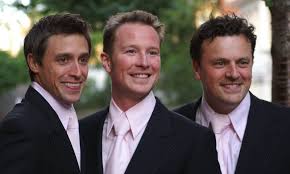
Tenors Unlimited – Paul Martin, Jem Sharples, Scott Ciscon – will be performing Christmas favourites such as “Oh Holy Night”, “Silent Night”, “Have Yourself A Merry Little Christmas” and “Hark the Herald Angels Sing” as well as diverse and fun songs from their current theatre tour “From Venice to Vegas”. This will include ‘Nessun Dorma’, “Can’t Take My Eyes Off You’ and songs written by the group themselves.

Tenors Unlimited has performed alongside such notables as Sting, Lionel Richie, Beyoncé, Hayley Westenra, Simply Red and the Royal Philharmonic Orchestra to name a few. During 2017, they have been playing to sell out shows in the USA and Bermuda and are currently touring the UK. See footage of their performances https://www.tenorsunlimited.com/media

Local charity The Little Hands & Art (formerly known as Hands around the World) was born after the tsunami in 2004 which struck Thailand. The charity raised money for children caught up in it and who lost everything. The charity bought a mobile art unit which provided art therapy for distressed children and continues to help other children from deprived areas or in stressful situations. The charity continues to provide food and medicines for poor families and supports an orphanage. More information: http://bit.ly/2ikZEa6

Guestling-Bradshaw C.E Primary School Junior Choir has performed at concerts and events in Hastings, performed at Hastings Music Festival and was runner-up in the 1066 Choir Competition last year.

For over ten years, Scott Ciscon, Paul Martin and Jem Sharples have entertained audiences throughout the world.  Using talents honed in their previous solo careers in opera and theatre, they bring their own blend of wit, charm and vocal arrangements to their performances. Alan Titchmarsh OBE said “21st century tenors, great fun, great voices and a great evening.” Tenors Unlimited sang at the memorial service for football legend Sir Bobby Robson and sang live at Wembley Stadium at the FA Cup final.

Jem Sharples from Tenors Unlimited says “We perform a wide repertoire of all music so there is sure to be something for everyone.”

Their latest album “The Journey” can be purchased online from their web site www.tenorsunlimited.com via iTunes, Amazon and GooglePlay.

For more information about the trio and other tour dates in the UK, visit www.tenorsunlimited.com

SOUTHBANK CENTRE INTERNATIONAL ORGAN SERIES 2017-18 2 – ANNE PAGE

ROYAL FESTIVAL HALL 21 November 2017

A large audience gathered for this latest instalment in the series which deliberately presents different aspects of the organ repertoire by performers who are experts in their particular field. For this concert Anne Page brought her experience and research to present an interpretation of the complete Art of Fugue by JS Bach.

On this occasion I took advantage of the pre-concert talk in which Anne Page was in conversation
with the curator of the RFH organ, William McVicker, about the work and different opinions about what instrument it was written for and the enigmatic way in which the published work ends. This was a fascinating talk, which could have gone on much longer, with excellent musical illustrations from the RFH’s organ scholar David Thomas. It certainly helped me in my appreciation of the music which followed.

Throughout the evening Anne Page demonstrated her commitment and understanding of this music and its relation to other genres, notably the French style of organ music from the likes of de Grigny, whom Bach admired. Her well chosen registrations and her decision to emphasise different interpretations to group the movements made for a very cohesive and immersive experience. The ease with which lines were performed on the pedals was very impressive. Clear delineation of voices (by registration) and careful articulation in each fugue made it possible to appreciate the structures and to attempt to follow some of the thematic material, although at times this was not easy.

The craftsmanship, mathematical genius and beauty of this music is without doubt. This organ is a wonderful vehicle for it. Anne Page’s knowledge, commitment, concentration and overall musicianship was impressive throughout. I found myself, at times, completely drawn in by the music. Unfortunately for this listener the overall experience was just too much. As the programme notes mentioned, the composer would not have envisaged a complete performance such as this, and for me, and I suspect others, despite wanting to enjoy the totality of this music, it didn’t really work.

Perhaps elements of the talk could have been interspersed with the music, or some contrasting music inserted partway through. I certainly would have welcomed some relief from what became a rather  cerebral and overwhelming experience. After the concluding “unfinished” movement (with a realised ending by Paul Binski) the evening ended with a beautifully understated rendition of Bach’s last composition, dictated during his final illness, Vor deinen Thron tret ich hiermit.

The next concert in the series is on 26th February – a varied programme from Daniel Cook.

Stephen Page


DVDs / CDs November 17

Wagner: Die Walkure
Salzburg Easter Festival 2017
Staatskapelle Dresden, Christian Thielemann
UNITEL 742808

Those of us who have been attending Wagner performances now for over half a century will recall Gunther Schneider-Siemssen’s massive settings from the 1960s – none more so that the Solti Ring Cycles at the Royal Opera House.

This new release is a strange hybrid. To commemorate the fiftieth anniversary of Herbert von Karajan’s opening of the first Salzburg Easter Festival with Die Walkure they have recreated Schneider-Siemssen’s sets but then added in new costumes and a new production. The second and third acts work better as the world of the gods sits more comfortably within the vast ring. Not so the first act where Peter Seiffert’s finely sung Siegmund sits rolling a cigarette before calling out to his father, very much at odds with the heavily stylised setting, which has no doors or sense of the domestic about it, dampening the intimacy of the music.

Thankfully Thielemann and his orchestra are in magnificent form and the end of act one thrills, as to many other key moments. Anja Kampe is an engaging Brunnhilde and a fine foil for the slippery Wotan of Vitalij Kowaljow. Christa Mayer’s Fricka has more to do in this production than is often the case and is only too happy to see Siegmund killed.

In the end, the compromise works, though it might have been even more interesting to have reconstructed and original production as an entity rather than in part.


Wagner: Siegfried
Hon Kong Philharmonic Orchestra, Jaap van Zweden
NAXOS 8.660413-16

This is proving to be the finest Ring cycle currently available and I can’t wait for next year’s Gotterdammerung. It is excellently sung throughout and Jaap van Zweden’s conducting is light and flexible – just what the score needs and all too often fails to get. There are many magnificent moments. I particularly enjoyed Falk Struckmann’s Fafner, who hints at the lumbering stupidity of the giant even as he roars out his contempt for Siegfried. Matthias Goerne adds the Wanderer to his earlier Wotan, with a world-weary edge which is most convincing. Valentina Farcas is a sprightly woodbird and both dwarves are incisive and nasty. At the heart of the work, Simon O’Neill brings authority to the title role as well as flexibility to the musical line which always pleases. For this recording to be available on a bargain priced label makes it all the more worth snapping up.


Lehar: Schon ist die Welt
Munchner Rundfunkorchester, Ulf Schirmer
CPO 777055-2

This was the last major work from Lehar and the most operatic. The second act is effectively through-composed, a fact which did not go down too well with some of his followers who preferred a more conventional operetta format. There are some lovely melodies however and more to enjoy here than might at first seem obvious. It is certainly worth a second hearing.

The only minor flaw is that the dual casting means you need to have an idea of the story line to ensure you know which character you are supposed to be listening to at any one time!


Silver Voice
Katherine Bryan, flute, Orchestra of Opera North, Bramwell Tovey
CHANDOS CHSA 5211

While there is much to enjoy here and some very fine playing I am unsure just who the audience are for this recording of operatic arias arranged for flute. The tunes range from Gershwin to Mozart and are all instantly recognisable, but am I simply being snobbish to suggest that if I wanted operatic arias I’d rather have them sung rather than played here as what comes close to background music rather than a cd I would deliberately sit down to enjoy.


Debussy: Preludes Book 1 & 2
Angela Brownridge, piano
CHALLENGE CC72727

A full recording this, with both books of Preludes plus L’Isle joyeuse. What impresses is the range and delicacy which Angela Brownridge brings to the recording, meaning that we can indulge individual pieces but equally experience the books as a whole, moving from one emotional encapsulation to another. She seems to create links with ease, enticing us even when the content is complex and challenging.

A fine recording with hopefully many more to follow.


Arturo Benedetti
ORFEO C 943171B

This recording dates from 7 August 1965 and was recorded live at the Salzburg Festival. Arturo Benedetti is at the height of his career at this time, and here performs Busoni’s arrangement of Bach’s Chaconne aus Partita BWV1004 and Beethoven’s Sonata No3 in C major Op2 No3. The quality of the recording is not an issue, and the quality of the playing radiates throughout. it may now seem a dated approach to the scores, in terms of what we have come to expect from current pianists, but the magnificence of the sound is never in doubt.


Shostakovich: The Gadfly – complete original film score
Deutsche Staatsphilharmonie Rheinland-Pfalz, Mark Fitz-Gerald
NAXOS 8.573747

The Gadfly is best remembered today for the longer arrangement of Youth though the score as reconstructed here has a good deal of music which is equally impressive. It also draws on the full orchestral resources Shostakovich required for the film – including church bells, organ, guitars and mandolin – which are absent from the normal orchestral suite. There is also an added bonus in the inclusion of The Song of the Counterplan from the score of that name.


Mahler: Symphony No 5
Bayerischen Rundfunk symphonieorchester, Mariss Jansons
BR KLASSIK 900150

Maris Jansons finds the joy inherent in this score and brings it out time after time, lurking even in more sombre moments. The familiar Adagio has a warmth to it which carries us easily into the romp of the finale.  As with his other Mahler cds, this benefits from being a live recording with the added sense of atmosphere and tension.