Sussex Day
Celebrations
at
Catsfield Village Hall
Church Road, Catsfield TN33 9DP
with
Village Voices
Melodies from the Catsfield Manuscripts
on
Saturday 16 June 2018 7.30pm
Retiring Collection Refreshments

This 9th Signum CD by Joseph Nolan celebrates the Parisian organ tradition and is recorded on the organ that Durufle knew so well, St Etienne du Mont. Presented here are Suite, Op 5 by Durufle alongside movements from Vierne’s Symphonies 5 & 6 as well as Fantomes from the 24 Pieces de fantasie, Op 54. Durufle’s transcription of Tournemire’s Improvisation sur le Te Deum opens the disc and David Briggs’ substantial Le Tombeau de Durufle concludes the recital. The name of the CD is inspired by Woody Allen’s film Midnight in Paris. It is easy to imagine being shut into the church through the night luxuriating in this evocative music.
(There is a mistake on the back cover insert – the last item plays for much longer)
David Briggs has developed a reputation as a fine improviser, working with a range of material and producing some impressive, varied and well structure music. Here we have another collection of some of these one-off events, all from last year. The first, recorded at Cambridge is in the traditional French Catholic tradition – Suite Improvisee dans le style du Grand Siecle. This is followed by the three movement Triptyque Symphonique Improvisee sur deux themes. A shorter piano Improvisation in the style of Beethoven leads to the final Symphonie Improvisee en quatre mouvements recorded on the Luzern organ. It is very interesting to hear the way that Mr Briggs develops his material as well as his use of each instrument to bring colour and variety. It is also good to know that these “live” events have been preserved for future listening.
This series has reached volume 20. Although this music is very worthwhile and is performed and recorded to the highest standards I continue to wonder at the value of these extended “complete” series, apart from for reference.
This 18th Century music written for courtly celebrations reflects the importance of hunting and dancing in the recreational life of the aristocracy. A varied selection of such music includes Divertimento in E flat major and Sonata in D major alongside 3 concerti for various wind & string combinations.
This is a very interesting disc of unaccompanied choral music from two composers born in different countries in the same year, 1890. They have left numerous works but few for unaccompanied voices and this release collects those works together. The title of the CD alludes to the fact that Martin’s Mass was not made public until 40 years after composition. The forces involved (double choir) mean that it has not been heard that often and recordings are always welcome. Alongside Martin’s Mass for two four-part choirs we hear his Songs of Ariel and Martinu’s Four Songs of the Virgin Mary and Romance from the Dandelions.
It’s a bit like buses… Here is another recording of Martin’s Mass for Double Choir. This time it is bookended by works from contemporary composer James MacMillan – Ceclila Virgo, Children are a heritage of the Lord, Miserere, Hymn to the Blessed Sacrament, Bring us O Lord God, Data est mihi omnis potestas & concluding with the now very familiar (but still striking) O radiant dawn. This programme also works very well.
This is a very interesting and enjoyable release. Psalm-settings by this 16th Century Franco-Flemish composer from his Psalm collection, Dodecacorde, are paired with hymn settings of the same psalms from the Calvin Psalter. Beautifully sung in French under Edward Wickham’s direction, this collection takes its title from Psalm 23.
Here is a good selection of songs from Italian twentieth century composer Ildebrando Pizzetti, showing something of the drama and emotion with which he sets the texts of a variety of authors, exploring themes of life and death, love and spirituality. Full texts and translations are included in the informative booklet.
Another long-running “complete” series ends with Volume 15, comprising the remaining original works of Karg-Elert,the major work here being Kaleidoscope, Op 144, a four movement suite lasting just under 20 minutes. Alongside this are some of his transcriptions of well-known classics including Handel’s Harmonius Blacksmith and the Pastorale from Bach’s Christmas Oratorio.
Despite my reservations about some “complete” releases here is one that is very welcome. In a neatly packaged box set these 6 CDs provide excellent recordings of all 20 sonatas played here on this well-known but little recorded organ by Roger Sayer. This works as a useful reference but with the sonatas arranged as they are these are CDs that can be enjoyed in their own right.
Priory has released some very interesting series over the years, not least the Great European Organ series which reached its 100th, and final, CD a little while ago. The label has recently embarked on a new series combining accomplished organists with great cathedral organs and selected music by Bach. The intention is to make available something of the experience of Bach played on the organs of the English cathedral tradition as a contrast to recordings made on historic and modern “authentic” instruments. This new project began with a recording from Durham and here now moves to Salisbury with an enjoyable selection of Preludes & Fugues.
The next release in this series has a selection of chorale preludes, transcriptions from various works by Ian Tracey, the Trio Sonata No 1 in E flat, and bookended by two larger works, Fantasia in G and Prelude & Fuguein G major, BWV541. Ian Tracey, long associated with the cathedral plays half the programme on the main organ, whilst David Poulter, until recently the cathedral’s subsequent Director of Music, plays the Lady Chapel instrument. It is lovely to have both organs featured together on one CD, highlighting the differences but effectiveness of this pair of Willis organs. Altogether this is a varied and enjoyable programme.
Stephen Page
Broadcaster and historian Jonathan Foyle leads Heritage Open Day at St Nicolas, Pevensey
Dr Jonathan Foyle, renowned architectural historian and presenter of the award-winning BBC TV programme “Climbing Great Buildings”, will be a special guest at St Nicolas, Pevensey’s Heritage Open Day on Saturday 12 May. Jonathan will give a talk about the appeal of England’s parish churches and then lead an afternoon of painting, drawing and conversation in and around the 800 year old Grade 1 listed building.
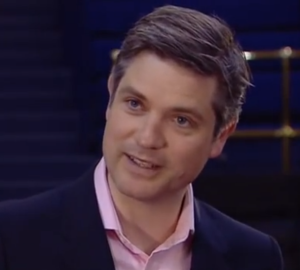
The Open Day, funded by the Heritage Lottery Fund as part of the £250,000 St Nicolas Restoration Programme, will open at 11.30am with an organ recital of church music from different historical eras. This will be followed by a bell ringing demonstration, with an opportunity for novices to have a go – no experience needed! At 2pm, Peter Harrison, Curator of Pevensey’s Court House Museum, will explain the importance of Pevensey as a seaport when the church was built in the early 13th century. Jonathan Foyle will then describe the national context at that time, which saw the English Church struggling under the turbulent reign of King John.Jonathan Foyle commented “I often draw for TV programmes, and find it a great way of interpreting buildings visually. I look forward to members of the local community joining me to celebrate their cultural heritage and engage with the architecture of St Nicolas Church through their artistic endeavours, whether or not they are experienced in drawing and painting.”
Churchwarden Simon Sargent said “We are delighted that Dr Jonathan Foyle is able to join us for this special day to celebrate the 800 year history of our newly restored church. We are very grateful to the Heritage Lottery Fund for helping to make this happen, and for contributing to the cost of a number of attractive new displays about the history of St Nicolas and the village which it has served for so long. The Open Day is free of charge and we hope that the varied programme will appeal to people of all ages.”
Royal Festival Hall 24th April 2018
Having been thwarted by adverse weather conditions for the last recital it was especially good to be back in the Royal Festival Hall for this occasion.
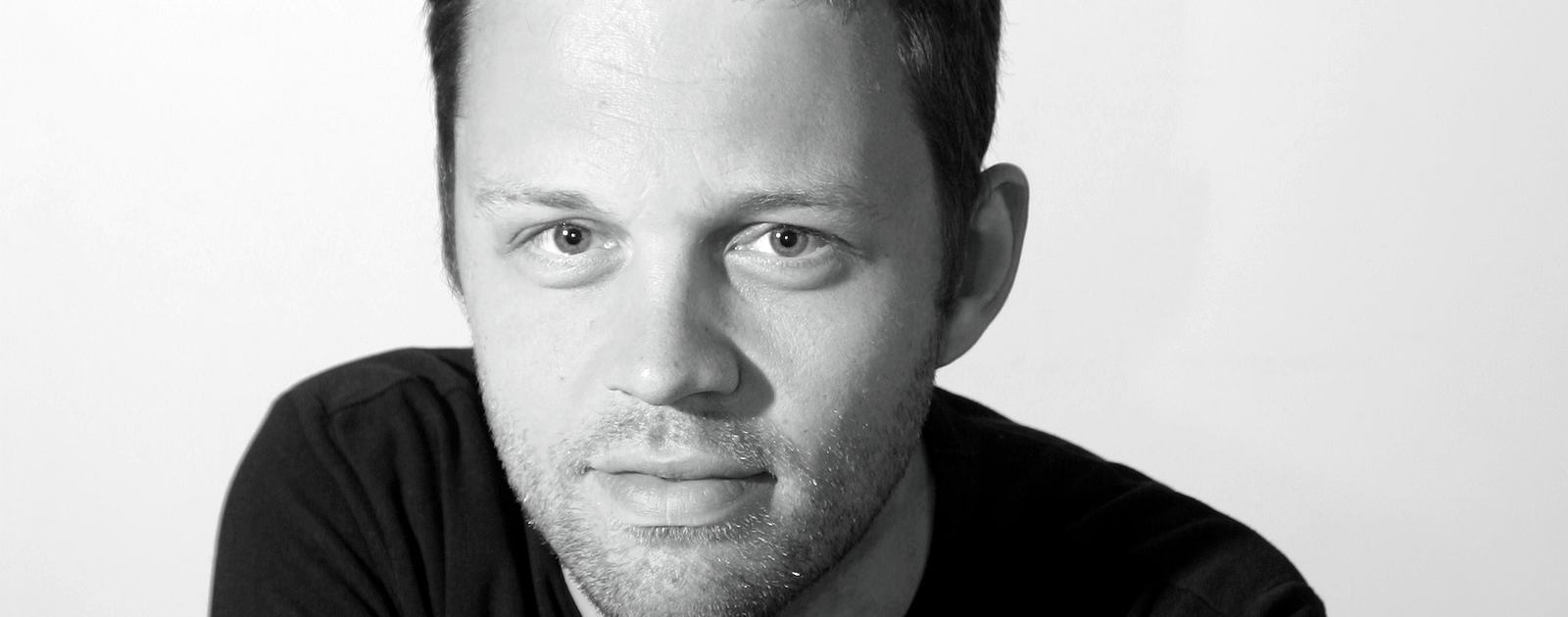
William Whitehead’s programme contained items that may be regarded as Bach- inspired as well as just a little from the master himself.
A wonderful example of the ‘fantastic style’ of his teacher Buxtehude, Nicolaus Bruhns’ Praeludium in E minor opened the preceedings with flair as loud florid outbursts contrasted with more contained introspective moments. This served as an excellent introduction to a short but key section of the evening’s recital.
William Whitehead has been curating The Orgelbuchlein Project, which is now almost complete. A number of composers have been approached to produce their own treatments of the planned for but never completed remaining chorales of Bach’s book. Two of Bach’s short chorale settings were played between premieres of Errollyn Wallen’s Ach, was ist doch unser Leben?, Kalevi Aho’s Herr Gott, erhalt uns fur und fur and Thierry Escaich’s Gott Vater, der du deine Sonn. The composer of the first of these was present with us for the performance. The widely diverging styles and the contrast with Bach’s settings made for a very special listening experience, emphasising the ongoing tradition of composers throughout the centuries adapting and re-working these carriers of the Christian faith.
Two movements from Schumann’s 6 Fugues on the name BACH followed and Parry’s Fantasia & Fugue in G brought the first half to a close in grand style.
The second half contained just one work – another large scale Fantasia & Fugue – on ‘Ad nos, ad salutarem undam’. This tour de force was followed up with a beautifully contrasting encore – Elegy by Parry, freshly rediscovered and about to be published.
A well-constructed and engaging programme, played with apparent ease and made all the more approachable by the occasional controlled introductions and explanations by Mr Whitehead – a feature I have often hoped for at these concerts. Humorous mention was also made about the lack of the organist’s “catwalk” – an earlier staging malfunction necessitating the evening’s performer to make a shorter (and easier) entrance from console level.
The next concert in this series opens the 2018/19 season with Stephen Cleobury and other musicians in a programme of Howells & Vierne on Wednesday 19th September.
Stephen Page
Following its recent move to make new releases available on Apple Music from street date, on 20 April 2018, Chandos became the latest independent classical music label to join the ranks of Apple Music Curators. Chandos’ Curator’s page has been launched with three main strands of playlists, including one dynamic playlist, expertly curated to showcase Chandos’ extensive catalogue range in its usual high sound quality.
As a pioneer of the album ‘series’, Chandos will as Apple Music Curator be curating three playlist series. ‘The Sound of’, ‘Introducing’, and ‘Rediscovering’ will encapsulate what Chandos does best, bringing less well-known composers and compositions to the forefront of classical music. Of course, music that has been loved by generation after generation will play a part in the playlists, too. ‘The Sound of’ will be a series of themed playlists based around certain moods, activities, or situations: perfect accompaniments to everyday life. Exclusive to Apple, the dynamic playlist ‘The Sound of Classical’ will take centre stage in this series, regularly updated with Chandos’ newest and most exciting recordings as well as the best of Chandos recordings from the last three decades. Other playlists within this series will include ‘The Sound of Piano’, ‘The Sound of Nature’, ‘The Sound of Relaxation’, and more. ‘The Sound of’ series will not only make it easier for regular Chandos listeners to discover new music but also easier for Chandos to introduce classical music to budding listeners.
Chandos’ ‘Introducing’ playlists will centre round Chandos’ artists to bring their recordings into the spotlight. Beginning with Chandos’ most popular artists, such as Jean-Efflam Bavouzet, the Bergen Philharmonic Orchestra, and Tasmin Little, playlists covering a range of their music will make it easier for listeners to discover, in one place, new repertoire played by their favourite musicians. The ‘Rediscovering’ series will be an exploration of Chandos’ extensive catalogue, the playlists curated around recordings of the more neglected areas of classical music, on which Chandos prides itself.
Examples of this series will be ‘Rediscovering British Composers’ and ‘Rediscovering Chaconne’, this last a playlist based around Chandos’ early music label. New playlists will be added to all three series throughout the year, and current playlists will be regularly updated. Whether you are already a lover of classical music or you think you could be, Chandos Apple Music Curator will have a playlist for you. You can find the Chandos Curator profile here: https://itunes.apple.com/us/curator/chandos/1358876178
White Rock Theatre, Saturday 21 April 2018
The contrast between intimate encounters and public celebrations was well caught in Fraser Grant’s production of Eugene Onegin for Opera South East. Eschewing large scale sets or naturalistic lighting he focussed on the key relationships that are at the heart of the narrative. This puts a much higher level of responsibility on the soloists who were vocally up to the challenge even if the nuances of their relationship s did not always flower as one might have expected. Kristy Swift’s Tatiana was at her best in the earlier acts, the letter scene being particularly impressive in its emotional outpouring and gauche naivety. She showed more maturity in act two but the final scene proved problematic. Seven years have passed and she is now married into the aristocracy, but when she meets Onegin again she goes to pieces rather than drawing on the strength she has acquired over the intervening years. It is a deeply feminist scene where the heroine proves to have the staying power even at the expense of her emotions, but this interpretation let Onegin off the hook.
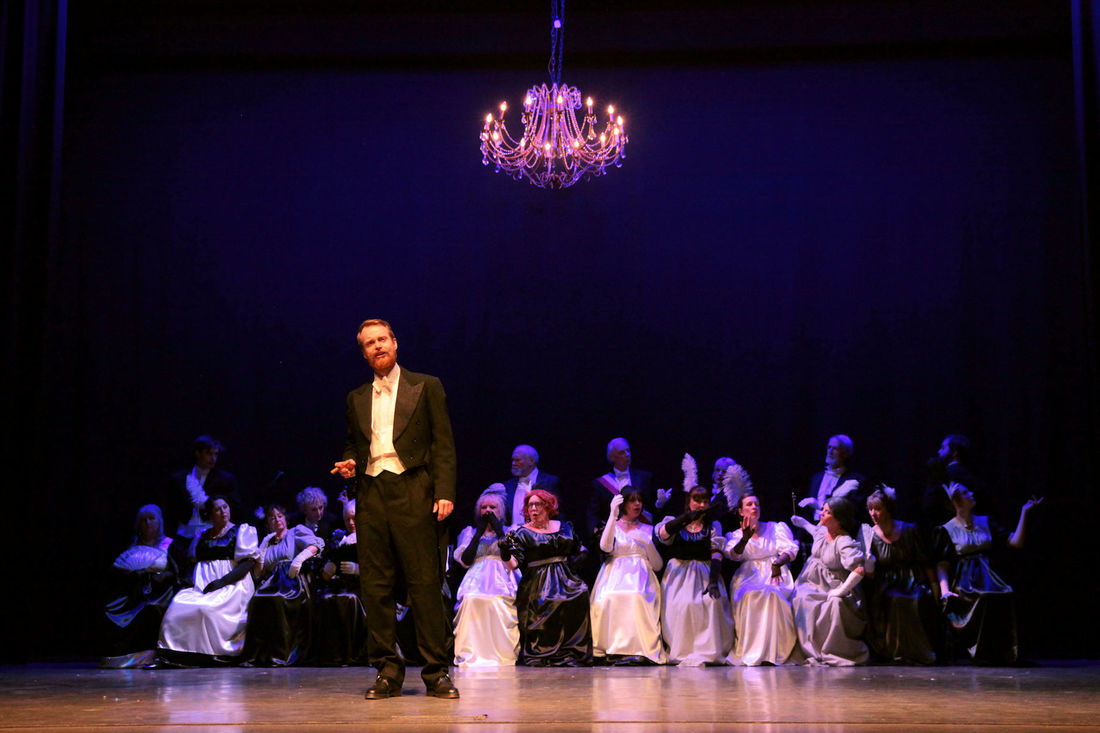
Rene Bloice-Sanders was a fine Onegin, a remote aristocrat in the early scenes and gentler than is sometimes the case with the gushing Tatiana. The death of Lenski is the point of no return and in the final scene his constant physical assault on Tatiana was uncomfortable to watch.
Though Jonathan Cooke sang Lenski with authority he does not have an obvious Lenski voice and at times the sound was tight and forced. This was dramatically interesting but not the smooth legato the music seems to call for.
Smaller parts were cast very much from strength with Felicity Buckland a splendidly vibrant Olga, Karen McInally a beautifully characterised nurse and Jack Naismith a cleanly articulated Zaretski. The company was also lucky to have David Woloszko as a magnificent Gremin. He may only have one aria but it can steal the show.
Opera South East does have a problem with its chorus – not with the sound so much as with the balance. Having so few men made all of the choral scenes one sided. This was not so much of a problem with the peasants in the opening act but meant that the dancing for Tatiana’s party never really happened and the final ball was changed into a solo ballerina. This was an intelligent compromise but undermined the structure of the opera which hangs, for its social context, on the three key dance scenes.
The orchestra under Kenneth Roberts were on good form, with some strong solo work. It was particularly interesting to note the occasional harp and similar added effects from Nigel Howard.
NEW OPERA BASED ON AWARD-WINNING BOLAÑO NOVEL
PREMIERES AT GARSINGTON OPERA THIS SUMMER
On 5 July 2018 Garsington Opera stages its first festival world premiere. Based on award-winning novel The Skating Rink by Chilean author Roberto Bolaño, the opera tells a thrilling tale of jealousy, political corruption and passion.
Set in a seaside town on the Costa Brava, the production will feature live figure-skating and an exceptional cast. The story of The Skating Rink is told by three narrators, revolving around Nuria, a beautiful young figure-skating champion. When she is dropped from the Olympic team, Enric, a besotted civil servant, pilfers public funds and builds her a secret practice rink in a deserted mansion. Nuria has affairs and the plot soon spins into blackmail, bad faith and treachery; the skating rink becomes a crime scene.
Leading British composer David Sawer, whose previous operatic work includes From Morning to Midnight (ENO 2001), has composed a score which is full of character, drama and beauty, drawing on Spanish and Latin American styles, set to a libretto by award-winning playwright Rory Mullarkey. David Sawer said: “Immediately what grabbed me about the book was its structure. The fact that it is a story told from multiple viewpoints; that there isn’t just one linear narrative, that there are interlocking stories and that the events are told from different perspectives…that was very interesting for me, musically. There are lots of different themes in the narrative. What I think I’ve written is almost like a filmstrip, which will come to life when it is staged.”
Performances: 5, 8, 10, 14, 16 July 2018 (Start time 6.50pm)
Tickets: 01865 361636 or www.garsingtonopera.org
CAST AND CREATIVE TEAM
St Mary in the Castle, Saturday 14 April 2018
Was this the largest audience for a Hastings Philharmonic event, even allowing for the Christmas concerts? It certainly felt like it and the ovation which greeted the end of the Tchaikovsky was whole-hearted and certainly deserved.
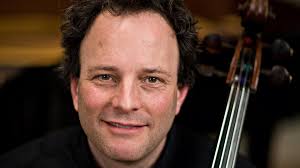
The first half was given over to Elgar’s Cello Concerto with Richard Lester an intense and moving soloist. Without excessive rubato or dwelling on the potential melancholy of some of the writing he created a narrative which was holistically pleasing. Yes there is a melancholy which comes close to depression in the opening movement, and the work often returns to the potential bleakness of life, but at the same time there is much that reflects the opposite mood. The final movement had a jaunty air to it, reflecting on Falstaff rather than Gerontius, so that the whole was uplifting and life-affirming rather than the sentimental wallow which can too easily slip into place.
As is often the case at St Mary’s, the soloist was almost uncomfortably close to the front row and there was a sense of intimacy throughout which larger venues simply cannot reproduce.
If the Elgar had eschewed the overtly emotional, Tchaikovskly’s Fifth Symphony had it in bucketfuls. After a slow sombre opening – and tempi throughout tended to be on the slow side – the brass let rip and it was obvious we were in for a thrilling ride. The long horn solo at the start of the reflective second movement was beautifully crafted by Anna Drysdale, and Marcio da Silva’s control of the opening dynamics made the brass intervention all the more dangerous. The third movement seemed almost out of place within this world of romantic sentiment and brash aggression, but gave way to a finely paced finale, which opened with near-Sibelius like mystery before we tumbled helter-skelter into the closing onslaught.
The young players who make up Hastings Philharmonic Orchestra are proving to be among the most exciting ensembles to be heard anywhere. For how long Marcio da Silva can keep them together before they are snapped up by other national and inter-national orchestras is anybody’s guess. For the moment let us be grateful we have them here and look forward to the Verdi Requiem at the White Rock on 5th May – which deserves to sell out, so get your tickets quickly!
Opus Theatre, Hastings, 13 April 2018
When Polo Piatti launched Opus Theatre not many could have imagined that we would have a series of concerts by some of the finest young pianists in the world today. Thanks to the acquisition of the Opus Phoenix grand piano and sterling support both from Phoenix and other philanthropists, to say nothing of the willingness of professional pianists to perform in smaller venues to smaller audiences, Nicholas McCarthy gave the first recital of the new season – setting an exemplary standard for the series as well as instant rapport with his audience.
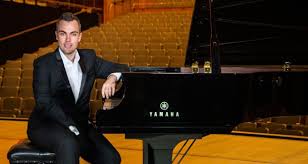
This would normally be more than enough to excite an audience but when one realises that he has no right arm and that all the works we heard were given with left hand only, the outcome is extraordinary.
In very relaxed fashion he led us through the world of piano compositions for left hand – ranging from Brahms’ amazing arrangement for Clara Schumann of Bach’s Chaconne in D to the lovely anecdote of Fumagalli’s left hand only arrangements as he preferred to use his right to hold his cigar!
The range of works tended towards the romantic, with richly effective compositions by Richard Strauss, Felix Blumenfeld and Scriabin, but included Bach. The suites for solo cello are easily adapted for left hand, and the Prelude from the first cello suite was particularly effective and beautifully phrased. There was also a new commission from Nigel Hess – a delightful and deeply atmospheric Nocture.
Nicholas McCarthy had opened the concert with an arrangement of Rachmaninoff’s Springwaters and ended with his own adaptation of the same composer’s familiar Prelude in G minor. Looking at the original score it should not be possible to reproduce the composer’s torrent of notes with one hand but this is exactly what Nicholas McCarthy does, and what’s more makes it seem so easy. Such is the professionalism of the finest artists.
Anton Lyakhovsky will perform tonight, Saturday 14 April, and next week end brings Sunny Li and Oliver Poole. All details on the Opus Theatre website www.opustheatre.co.uk