Holy Trinity Lunchtime 2014: 1

Wednesday 4 June

The new season was launched by young pianists Natalie Molloy and Isobel Richardson. They opened and closed the concert with a duo, to the slight confusion of those with programmes as neither work was listed. The opening was an arrangement for piano duet of a movement from a Mozart Sonata, and the concert closed with a powerful rendition on Grieg’s In the Hall of the Mountain King.

Between these we heard Isobel Richardson play works by Brahms, Schubert and Chopin. It became clear she favoured the heavier romantic music and Brahms’ Rhapsody Op79 No2 was particularly moving.

Natalie has very impressive articulation and demonstrated this with aplomb in works by Rachmaninoff, Chopin and Debussy whose Prelude pour le piano proved to be deft and delicate as well as showing the darker side of Natalie’s playing.

They drew the main part of the concert to a close with two brief but less familiar pieces by Poulenc.

Their solo works were played from memory – an enviable feat but one which can cause the odd slip of fingers or fudge in the harmony of more rapid passages. It was noteworthy that the two duets had no such problems.

Next week Wednesday at 1.10pm Gary Marriott and Duncan Reid.

Bexhill Festival of Music

dlwRoyal Philharmonic Orchestra,

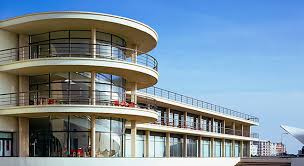
De La Warr Pavilion, 1 June 2014

Billed as The Great Classics this was certainly an evening of very popular classical music and was enthusiastically received by a packed house.

Brian Wright, almost lost behind the piano, opened with Mendelssohn’s Overture to A Midsummer Night’s Dream. The balance proved to be better than expected, given that few of the orchestral players were raised up and most were well behind the proscenium arch. This did have the benefit of highlighting the cellos, and upper strings, bringing a greater sense of immediacy and bight.

Sibelius’ Finlandia was a fine contrast, allowing us to experience the throaty growl of the brass even if we could not see them. The horn section was rather lost here in terms of impact, though they seemed brighter in the Dvorak. As previously, the forward positioning of the strings made us far more aware of the throbbing ostinato from the violas and second violins during the familiar central melody.

Tom Poster brought a warm virility to Grieg’s Piano Concerto, with a clean attack and lightning changes of mood. The first movement cadenza was fierce and formidable. The hall’s close acoustic made the second movement seem pleasantly warm and at times the soloist convinced us of the nobility of the melodic line. The fire we had experienced in the opening movement carried over into the finale, but included a moving cello solo, along with much fine solo playing.

After an extended interval – the hall’s bars are not really up to a full house – we heard Dvorak’s Symphony No 9. While this is always known as the New World Symphony, on this occasion it was the Bohemian melodic strands which stood out both in the opening movement and the charming dances of the third. Throughout, Brian Wright drove the piece at a fast pace, bringing with it real excitement as well as some exemplary solo playing from the brass and woodwind.

Given the enthusiasm created, let us hope the event can be repeated next year.

WNO: Faith

moses und aronPerhaps the most pertinent article in the programme book to accompany the Faith performances this summer was by Karen Armstrong who argued perceptively on the difference between faith and belief. The two operas which WNO are currently staging – to be joined shortly by two versions of Edgar Alan Poe’s Fall of the House of Usher – are both deeply concerned with the dichotomy which any religion faces of making practical decisions on the basis of spiritual or numinous understanding.

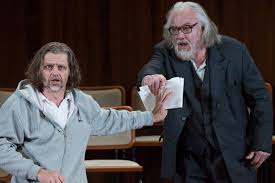
Schoenberg’s masterpiece Moses und Aron has waited far too long for another professional staging in Britain. We were at the first performances at the Royal Opera House in 1965 in the staging by Peter Hall under Sir Georg Solti, and they made an indelible impression. Thankfully the new staging by Jossi Wieler and Sergio Morabito, while radically refocussing the work in the modern world, manages to maintain the spiritual complexity of the composition and the constant dilemma for both Moses and Aron.
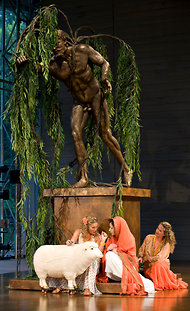
moses und aron 2

Where a conventional staging might have given us a more ethereal visual image we are here presented with a strongly naturalistic world within which any spiritual forces will have to fight for acceptance. John Tomlinson’s magnificently troubled Moses is constantly out of place with his tantalising glimpses of the unseen god – a god whom the more practical Aron wants to accept but at the same time wants to make more easily accessible to the people around him. Sacrifices, action, prayers and hymns are far easier than trying to deal with an unseen, undetectable, omnipresent god.

While Moses is present the action remains focussed on the tight dialogue between Moses and Aron. However, as soon as he leaves to meet with god, the situation rapidly falls apart.

In the second act Aron gives in to the demands of the people and shows them a film. We only get to judge its content through the lengthy reactions of the chorus. I doubt if the chorus have ever been as challenged as they were here, but their responses, individually and collectively were utterly convincing. The worship of the golden calf becomes an excuse for a breakdown in any moral authority. It is as if, with no strong leadership, they are incapable of maintaining any moral authority for themselves.

Schoenberg was unable to complete the planned third act and the work ends with Moses great cry of despair as he realises he will never be able to turn his vision into words – or words which can have any practical reality.

Mark Le Brocq took over at short notice as Aron, and his finely honed characterisation, together with a virile but lyrical approach to the score made for an exceptionally convincing reading. The large number of smaller parts were all cast from strength and the chorus was on better form that I can recall. The score is extremely difficult but they sang it as if it were the easiest operetta.

Lothar Koenigs maintained a tight grip of the many groups involved, particularly the off-stage forces, and the whole was so smooth one had to recall how difficult a work this actually is to bring off.

I would love to think we might see it again.
nabucco

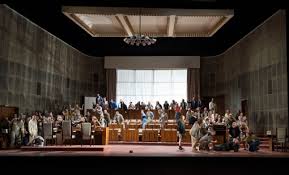
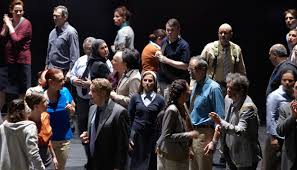
The following night was the first night of a new production of Nabucco. Rudolf Frey had made a good job of Maria Stuarda last year so there was nothing to prepare us for the staging we actually experienced. I felt sorry for the many strong soloists whom WNO had drawn together. For much of the evening, if you closed your eyes, the music was fine. Open them and things could go very nastily awry, even if one was not reduced to outright laughter – as happened to some around me.

An empty black box was gradually peopled by a chorus in modern dress who wandered aimlessly about until the singing started. It was unclear who they were or where they were. According to the normal narrative line they were Hebrews, but there was little indication of this. A few men wore kippahs but most did not. There was even one obviously Muslim women who drew attention to herself by walking with a limp – but she disappeared after the interval.

Once we got to Babylon the vast stage area was surrounded by gold lame curtains, and when Abigaille became enthusiastic about gaining the throne, the stage looked like something out of Britain’s Got Talent. Singers frequently walked around carrying chairs for little apparent reason. Wherever possible, the director opted for the most obvious of clichés, with Nabucco as a South American dictator and the spies all carrying ammunition slings.

In addition the lighting was deliberately expressionist, switching drastically to change the point of focus, all of which was distracting to the action and particularly to the music.

Xian Zhang conducted with flair and brought considerable enthusiasm to the pacing of the evening, and the chorus were as good as they had been the night before for Moses und Aron. Kevin Short was a strong Zaccaria though the hand-jive did not suite him. Robyn Lyn Evans has a fine lyrical tenor for Ismaele but was required to perform like Brad from the Rocky Horror Show and Mary Elizabeth Williams was a confusing Abigaille. The voice is large and powerful but her mannerisms became annoying and her insistence on turning everything into a comic act meant we had no sympathy for her at the end and her death scene went for little.

Hopefully the two Poe settings will bring us back to the fine standards of Moses und Aron and we can quietly overlook Nabucco.

May CDs

dowland

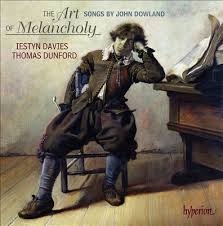
The Art of Melancholy; songs by John Dowland

Iestyn Davies & Thomas Dunford

HYPERION CDA68007      76’33


These songs, and the incidental lute music, are so compelling I would suggest ensuring you are not feeling depressive when sitting down to listen. The beauty of Iestyn Davies voice coupled with the sensitivity of Thomas Dunford’s discreet accompaniment is compelling throughout. Listen to Flow, my tears as an introduction to over an hour’s heady indulgence.


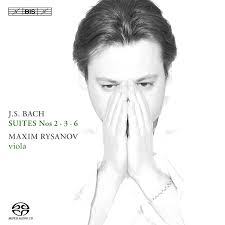
bach violaJ S Bach: Suites 2, 3, 6 for cello

arranged for viola

Maxim Rysanov, viola

BIS BIS 2033        64’49


The cello suites work remarkably well in these arrangements for viola. As expected the higher passages in particular benefit from the change, but Maxim Rysanov’s technique brings weight and authority to the lower passages and the whole is convincing throughout.


orpheo

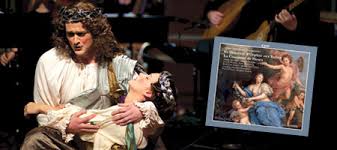
Marc-Antione Charpentier: La Descente d’Orphee aux Enfers

Boston Early Music Festival

CPO 777 876-2   79’11


Where later composer’s brought human emotion to bear upon the Orpheus myth, Charpentier uses it as a hook to hang some of his most delightful melodic compositions. This, with the addition of La corunne de fleurs makes for a very enjoyable recording.


16 vine

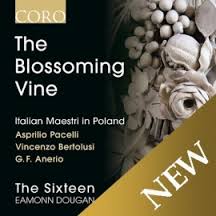
The Blossoming Vine: Italian Maestri in Poland

The Sixteen

CORO COR 16123              61’48


I doubt if many of us could name any 16th century Polish composers but this second disc makes a very good case for the quality and range of liturgical music being produced in Poland in the later part of the 16th century. In reality the composers are Italian but working in the court of King Sigismund III, but they brought a new freshness and vitality to the country and to its musical life.


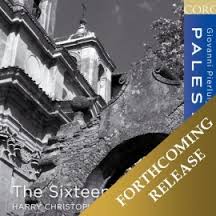
palestrina 5

Palestrina Vol 5

The Sixteen

CORO COR 16124              63’52

available from 2 June 2014

This fifth CD in the Palestrina series brings us the Missa Iam Christus Astra Ascenderat, three of the Song of Songs setting and a range of smaller liturgical works. The Song of Songs settings, dedicated to Pope Gregory XIII are particularly appealing and would make a good starting point for anyone new to the series.


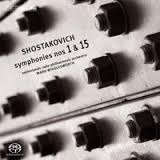
shost 1 & 15

Shostakovich Symphonies Nos 1 & 15

Netherlands Radio Philharmonic Orchestra, Mark Wigglesworth

BIS 1643               79’15


An interesting combination, these symphonies span most of the composer’s working life, the first dating from 1925 and the fifteenth from 1971. Mark Wigglesworth uses the combination not only to draw the obvious contrasts between them but, hearing them side-by-side, the many traits which, even over such a long period of time, are essential to the composer himself and his musical life.


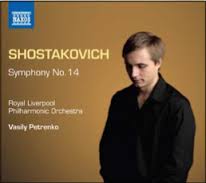
shost 14

Shostakovich Symphony No 14

Royal Liverpool Philharmonic Orchestra, Vasily Petrenko

NAXOS 8.573132


Shostakovich seemed to have some difficulty deciding just how to structure his 14th symphony. Originally planned as an oratorio, it was finally completed as a song cycle for two soloists, strings and percussion. A paean to humanity and protest against early death, the mood is sombre throughout and often acerbic, both strands being finely held throughout by soloists and the over-arching control of Vasily Petrenko.

Garsington Opera; the future


  • 2015 collaboration with the Royal Shakespeare Company of abridged version of Shakespeare’s A Midsummer Night’s Dream with Mendelssohn’s incidental music.
  • From 2017 Philharmonia Orchestra to join Garsington Opera for one opera production every season

As the curtain goes up on Garsington Opera’s 25th anniversary season, Douglas Boyd, artistic director, is delighted to announce two major developments. In 2015 there will be a collaboration with the Royal Shakespeare Company of an abridged version of Shakespeare’s A Midsummer Night’s Dream with Mendelssohn’s incidental music and from 2017 the Philharmonia Orchestra will join Garsington Opera for one opera production every season.

THE PHILHARMONIA ORCHESTRA AND GARSINGTON OPERA

Garsington Opera continues to develop as a major summer opera festival and will form a partnership with one of the world’s great symphony orchestras, the Philharmonia Orchestra, initially for five years, which will enhance the artistic quality and reputation of the company. Garsington Opera is also committed to the Garsington Opera Orchestra, which will focus on baroque, classical, Italian and chamber works, whilst the Philharmonia Orchestra will enable larger-scale works to be performed.

David Whelton, Philharmonia Orchestra, Managing Director said:  Creative partnership is at the beating heart of the Philharmonia’s artistic approach, and the opportunity for us to collaborate with one of the most forward-thinking opera festivals in the UK is tremendously exciting.  We are absolutely delighted to be a part of Garsington Opera’s future, and look forward immensely to working together with Douglas Boyd and the Garsington creative team to bring extraordinary new productions of the larger scale 19th and early 20th century repertoire to audiences at Wormsley.”

2015 AND THE RSC

For the first time Garsington Opera is working on a joint project with the RSC with performances at both Wormsley and the Royal Shakespeare Theatre, Stratford. It will be a rare opportunity to see an abridged version of Shakespeare’s A Midsummer Night’s Dream performed by members of the Royal Shakespeare Company, under the creative guidance of Gregory Doran, Artistic Director of the Royal Shakespeare Company, illuminated with Mendelssohn’s enchanting incidental music, played and sung by the Garsington Opera Company and Orchestra, conducted by Douglas Boyd.

RSC Artistic Director Gregory Doran said “A Midsummer Night’s Dream is one of my favourite Shakespeare plays, so I am delighted to be able to stage this bespoke version incorporating speeches from the play along with Mendelssohn’s gorgeous score.  It was one of the first pieces of music I heard in childhood and inspired my lifelong love of Shakespeare.  This is a very exciting new collaboration with Garsington Opera, and I hope will appeal to lovers of theatre and music alike.”

The 2015 season will also feature three new productions – Mozart’s Così fan tutti  conducted by Douglas Boyd and directed by John Fulljames, Britten’s Death in Venice conducted by Steuart Bedford who conducted the world premiere in 1973, and directed by Paul Curran and Strauss’ Intermezzo conductor Jac van Steen, director Bruno Ravella.

Douglas Boyd said: I am thrilled that we are collaborating with two such highly acclaimed international companies.  These are exciting developments which reflect our ambitions to continue to grow artistically as an international summer opera festival. 

2016

Douglas Boyd will conduct a new production of Tchaikovsky’s Eugene Onegin directed by Sir Michael Boyd, David Parry conducts Rossini’s L’Italiana in Algeri directed by William Tuckett and Tobias Ringborn conducts Mozart’s Idomeneo with Tim Albery directing.

THE FUTURE

Two world premieres are planned for 2017 and 2018; an Opera for All following on from the success of Orlando Gough/Richard Stilgoe’s community opera Road Rage, and a new work within our main season.

Recent from Resonus

Jean –Philippe Rameau: Pieces de Clavecin

Steven Devine, harpsichord

RESONUS RES 10131       79’27    

Steven Devine is playing a modern reproduction by Ian Tucker of a double-manual harpsichord by Andreas Ruckers of Amsterdam made in 1636. The three Suites recorded here range from the early 1706 Suite in A minor which is strict in its approach to classical style if not overly severe, to the 1724 Suite in D where the movements have programmatic titles.

Steven Devine’s approach is muscular and the sound large and often bold.


Ciaccona: works for harpsichord

Guillermo Brachetta, harpsichord

RESONUS RES 10126       64’28

This is Guillermo Brachetta’s first solo album though he is already familiar from his work with Fantasticus. There is a wide range of works here, including Chaconne’s by Storace, Blow, Bach and Couperin. Such is the vigour of the chaconne as a musical structure that there is no sense of  the recording palling with repetition – every work is a delight in itself.


Daniel Purcell: The Judgement of Paris

Spiritato & the Rodolfus Choir, Julian Perkins

RESONUS RES 10128       78’46

Despite the work of Henry Purcell and others in the mid seventeenth century, English opera by 1700 was in a poor state and it was against this background that a competition was held to try to revive the genre. The accompanying booklet gives a fascinating insight into the difficulties involved, and Daniel Purcell’s entry did not, in the end, win. However its new text by William Congreve and its heroic story line made it popular and certainly well worth the effort of this fine new recording. As we delve ever further into the great number of works sadly ignored we realise what a fantastic wealth of works we possess, yet sadly overlooked. This splendid recording should justify the continuing search for the lost and overlooked.


Peter Warlock: Choral Works

Blossom Street, Hilary Campbell

RESONUS RES 10129       56’33

Blossom Street are a choir of young voices and this comes over very clearly in the freshness of this lovely recording. Many of the pieces are being recorded for the first time and there are very useful background notes by Adam Binks. For those of us who only know Warlock from a few familiar works, this is a very valuable addition to the repertoire.


Baroque Opera Live

vivaldi

Vinehall School Theatre, Robertsbridge, 24 May 2014

Linda Grace had drawn together a strong team who gave us a wide range of baroque music, much of it unfamiliar but none the less welcome.

She opened with Un certo non so che from Vivaldi’s L’Atenaide and closed with Juditha’s Agitata infido flatu from Juditha Triumphans. Though Vivaldi’s operas are slightly more familiar to us thanks to Garsington Opera’s revivals, it was good to hear from works that have yet to receive a fully staged modern performance.

Baroque oratorio frequently has the same emotional impact as its operatic counter-part and we sensed this in Lin Wescott’s singing of Zerfliesse, mein Herze from Bach’s St John Passion and a fiery Why do the nations? from Richard Woodall.

Tenor, Robin Green brought us Purcell’s I loved fair Celia and a stirring Fairest Isle as we moved into the English baroque. Alongside these vocal items, Tim Willsone played Marcello’s oboe concerto in D minor and a mellifluous flute accompaniment in Vivaldi’s Sol da te, mio dolce amore.

Works attributed to the baroque often prove to be nothing of the kind, and Cindy Gilham slipped in a delightful Se tu m’ami which actually dates from the late 19th century.

Perhaps the most stylish performance of the evening came from Hiroshi Kanazawa who gave us a secure and very moving account of Cara Sposa from Handel’s Rinaldo. The simplicity of approach and sensitivity to the musical line was very impressive.

Throughout, accompaniment had been provided by Duncan Reid and Nigel Howard. A Roland digital harpsichord was used occasionally but most items were accompanied on the school’s Bosendorfer. It is a very fine instrument, but it is hardly baroque!

Brighton Festival: Elias String Quartet

elias

All Saints Church, Hove, 23 May 2014

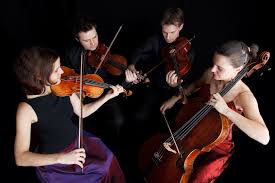
As this year’s Brighton Festival draws to a close, so the Elias Quartet bring their Beethoven cycle to a successful and very gratifying conclusion. As with previous evenings, each concert covers a wide range of Beethoven’s string writing, on this occasion moving from Op18, via The Harp, to Op 130 and the Grosse Fuge.

The vast spaces of All Saints seemed a little intimidating for the intimacy of Op18 though the pp passages carried well. The Elias’ approach to Op18 No4 was to look forward rather than take a nostalgic view of Haydn’s writing, and the Andante was clearly linked to the first symphony. The Menuetto had an unexpected urgency about it, searching for something it never quite found. As such this made a very good bridge into Op74 The Harp.

The virility of the writing was much to the fore here, with the cello soaring beautifully at the end of the first movement. The Adagio unfolded seductively and had the gentlest of endings before the passion of the Presto and a fine viola solo as it moved towards the wistful conclusion.

With Op130 we were into a different world altogether. No problem here with the acoustic. It was almost as if the volume had been turned up so that we hear each part with greater clarity. After the intensity of the opening movement, the Presto came as a pleasant relief, immediately supported by the warmth of the Andante. The dance metre of the fourth movement was not overplayed, keeping it closer to the warmth of the earlier movements. The magnificent cavatina   was breathtakingly beautiful, a hint of melancholy throughout acting against any possibility of sentimentality.

The final Grosse Fuge brought the evening, and the series, to a triumphant climax. Beethoven makes severe demands upon both the players and the listeners in this work, but the rewards for all are amply worth the efforts on both sides of the stage. The warmth of the response was fully justified.

The quartet are recording all the Beethoven quartets for release later in the year. Those of us who attended the live performances will need no other encouragement to buy them as soon as they are available.

Maidstone Symphony Orchestra: Ravel & Gershwin

Tom PosterMote Hall, Maidstone, 17 May 2014

Arriving at the Mote Hall in daylight, with no need to avoid muddy puddles or half-hidden pavements, it must be the end of the season – and what a season it has been. The range of works we have heard and the quality of the soloists has yet again demonstrated the vigour and talent of the orchestra as a whole and the dynamic strength of Brian Wright’s leadership.

The final concert brought us firmly into the early twentieth century with the upheaval of jazz and ragtime, which seemed to permeate all of the works we heard. Ravels’ Suite, Mother Goose served as a gentle hors d’oeuvre with the piquancy of Laideronnette a highlight at its heart.

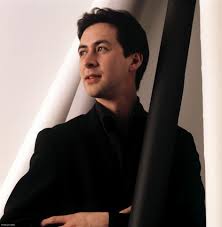
The benefit of the flat floor is that it allows for the rapid placement of the piano and how pleasing to see and hear a full grand Schimmel. Pianist Tom Poster obviously relished the range of tonal qualities he could coax from it and his performance of Gershwin’s Rhapsody in Blue was masterly and absorbing. Brian Wright took a somewhat relaxed approach to the opening pages – there was no hint of the Big Band here, rather the heady influence of jazz on a committed classical composer. Time and again individual soloists tried to break free into ragtime or jazz riffs, only to be gently contained within the orchestral format. The tension was compelling and the overall effect highly exciting.

If Ravel’s Bolero is somewhat over-familiar then hearing live can come as something of a shock. Ravel’s orchestration is very sensitive and looking at the orchestra one is aware of the tiny moments of support given by individual instruments, moments which go unheard when simply listening to a CD or worse still on the car radio. I noted the harp in the very early sections, plucking individual notes and then, later, the upper wind doing the same. Each adding, little by little, to the texture we are experiencing. That the orchestra has such accomplished musicians is a tribute to them and this whole evening drew on their strengths.

After the interval Tom Poster returned for Ravel’s Piano Concerto. Possibly the least familiar piece in the programme, the quieter, introspective passages were particularly impressive with a lovely section for piano and harp. The brass came into their own later in the work, seeming to be warming up for the following Gershwin. The jazz elements, always latent across the evening, exploded in the last movement bringing the whole to a joyous conclusion.

As an encore Tom Poster played his own wistful arrangement of Gershwin’s Someone to watch over me.

The evening, and the season, came to a brash conclusion with Gershwin’s An American in Paris. Brian Wright found an effective balance between the sentimental and the raucous, encouraging his players to give of their all.

They will be back in October for the start of a five concert season for 2014-15, and tickets are already on sale. If you can’t wait until then, Brian Wright and Tom Poster will be opening the Bexhill Arts Festival at the De La Warr Pavilion on Sunday 1 June.

PS The Mote Hall is obviously not a concert hall which has advantages and disadvantages. On this occasion – a hot evening – the roof was opened to let out the hot air which was pleasing. However the lighting seemed to be in the hands of the work experience student and was about as unsubtle as one could imagine! 

ENO: Cosi fan tutte

cosi

London Coliseum, 16 May 2014

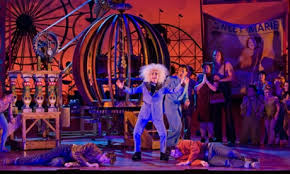
The most recent WNO production of Cosi set it in a run-down seaside town and boarding house. It was not particularly gripping though it rarely upstaged the music. ENO has gone one further. Phelim McDermott sets his production in an American fairground and motel, and does his utmost to undermine any subtlety that Mozart and Da Ponte are attempting to create.

The overture is swamped by the belly laughs and applause from the audience as various members of the skills ensemble pop out of a box and hold up flash cards. This sets the tone for a very uneven evening. The producer seems to have no trust in either librettist or composer. Dorabella’s Smanie implacabili is made to seem like a joke – as if her emotions are not serious – and Fiordiligi’s Come scoglio is reduced to farce by a constant coming in and out of doors. By turning any aria into situation comedy the psychology of the character is deeply undermined. Ferrando is allowed to sing un’aura amorosa without interruption but this was a rare moment of calm.

Having created a situation in the overture where the audience are encouraged to react, the evening was constantly being halted by applause. Many years ago now Sir Peter Hall at Glyndebourne developed a Mozartian style which allowed the action to unfold almost breathlessly, flowing through arias and recitatives without pause and so maintaining the impact of the narrative line. Here, unfortunately, any excuse for a laugh was highlighted and the interaction of characters left to fend for themselves. If one removed the extraneous detail there was little of any consequence happening on stage.

There were occasional good ideas. Using the magician’s cage for the end of act one was at least logical and amusing. Used within a tighter context it would have been even more effective. However, with so little character development, by the time the end came we were indifferent to the outcome as we had not be drawn to care about these people.

That the singers managed to cope so well was a tribute to them. Kate Valentine and Christine Rice made a well contrasted pair of sisters but were never allowed to develop their individuality with any subtlety. Marcus Farnsworth was a bluff Guglielmo but Randall Bills sounded rather tight at the top of the voice, though this may have been first night nerves. Mary Bevan’s Despina was turned into a chalet maid but she seemed born for better things. Her singing and acting was almost too intelligent for her situation.

Roderick Williams is a consummate performer and has the potential to be one of the finest Don Alfonso’s. He certainly sang the part with humour and panache, but the Sportin’ Life style characterisation was inappropriate throughout.

The orchestra under Ryan Wigglesworth seemed to be on form, even if timing was often adrift between stage and pit.

One noteworthy point to conclude. The surtitles were off on this evening and we all had to concentrate on what we actually heard rather than respond to the words floating above. As such, reactions were far more concentrated on what was actually taking place, and the diction from all concerned was impressive.