BPO Summer Season 3

rob lane

Brighton Unitarian Church, Sunday 10 August 2014

Recent works by Rob Lane formed the heart of the third summer concert last Sunday the first of which, Evocations, was commissioned by the Brodowsky Quartet in 2012. Dedicated to Rosalind Kelly, the work shifts across a number of musical memories as if the listener is recalling a distant if elusive past. The strongest section is the central dance motive, finely focused in contrast to much of the rest of the work, which often seems to be just beyond our grasp. It would be worth hearing again if only to unpick the obviously sensitive internal connections.

Three poems by Sylvia Plath formed the second item by Rob Lane and were here being given their first performance. Edge is by far the most successful setting, its simpler lyricism seeming closer to the text and a more direct emotional experience for the listener. Mirror has an angularity to it which distances us from the text, possibly intentionally as the mirror itself seems devoid of emotion. A gentle waltz underpins Morning Song though its warmth rarely moves into the vocal line.

The instrumental setting for these songs was almost inaudible at times given the power of Katie Thomas’ voice. This was a problem throughout the afternoon, affecting the concluding Mozart. When she sang more quietly or in the lower register the voice was pleasing, but in the upper register and at greater volume the intensity of sound was simply uncomfortable and often painful. I am sure her voice would be fine in a far larger venue, but within the close confines of the Unitarian Church it needed reigning back to maintain comfort for the audience.

The afternoon had opened with a warmly spirited reading of Mozart’s Hunt Quartet K458, and concluded with his Exsultate Jubilate, which was enjoyable for most of the time, given the concerns noted above.

Prom 31

A Saturday Prom which lived up to expectations. Opening with a brash account of Berlioz’ overture Le corsair – the brass at their flamboyant best and a real sense of French style – the main work in the short first half was Elgar’s Sea Pictures. It is difficult to realise that for many years they were not performed complete and that a latent snobbishness surrounded Elgar’s choice of texts. What is unquestionable is that the texts are superbly reflected in Elgar’s settings and the sense of brooding melancholy whose constant images of death haunt the whole work. To take individual songs of context is to ignore the underlying narrative. No such problem here of course and Alice Coote is a renowned interpreter of the cycle. Her hushed, often parlando style heightens the dramatic impact of the text and allows us to sense the tensions which lie below it. There was a unexpected ominous weight to sections of Sea Slumber-Song with the bass gong overawing the orchestra. By contrast the simplicity of In Haven which can too easily seem naïve, was here a bastion of faith. There are pre-echoes of Peter Grimes in Sabbath Morning which Mark Elder caught with ease, and the operatic style of Alice Coote’s diction suited his approach well. All of these strengths came together in the Swimmer where mysticism and emotional turmoil unite to focus on the need to subsume all. A wonderful reading.

The second half opened with the London Premiere of Helen Grime’s Near Midnight. She is associate composer with the Halle orchestra and the work was written for them. There is a constant edginess to the score and an underlying tension which frequently explodes from within the overall calm and fluidity of the writing. Percussion is used to provide a liquid base for other sections of the orchestra rather than aggressive attack or power. Though the style is highly personal and there is a real sense of voice, in terms of comparison this leans more towards the impressionistic world of Ravel than more recent composers. A CD of her works is promised for later in the year.

The concert concluded with Beethoven’s 3rd Symphony, the Eroica. Mark Elder draws on all of his experience with original instrument bands to give us a reading that is light, fluid and yet has real bite and terrific edge, particularly from the brass and wind. There was nothing ponderous about the Marcia funebre which constantly radiated hope. In the Scherzo the horns even managed some gentle ornamentation which was highly effective. The finale was brisk, business-like and impressively structured. The Halle may know this music very well but it never ever sounds as if they are not delighted to be playing it for us.


Prom 29

A capacity audience enjoyed a programme of the well-loved and the not so familiar presented by the BBC Philharmonic under the energetic baton of Gianandrea Noseda. Both soloists gave committed performances  whether soloing or blending with the rest of the orchestra.

The recent commemorations of the start of the 1st World War provided the setting for the first piece of the evening. Written mid-conflict, in 1916, Alfredo Casella’s Elegia eroic, is an emotional tour de force. The music speaks of death from the outset and moves from  brash brass to more plaintive strings and woodwind, finally dying away to nothing. There are some remarkable effects, particularly in the most restrained passages. Some of this sound world is similar to Holst. There are allusions to the Dies Irae and an Italian patriotic song. Highly effective and emotive, this piece should be better known.

Benjamin Grosvenor took centre stage for Chopin’ s Piano Concerto No 1 in E minor (1830) . This popular young musician was greeted with huge applause and proceeded to give an assured and convincing performance of this well known Piano Concerto. Throughout there was great rapport between piano and orchestra. During the concerto we saw something of the enthusiasm of the conductor, demonstrated in his dance-like direction.

This was also the case in Cesar Franck’s Symphonic Variations for piano &orchestra (1885). This piece shows how the concept of variation developed from its earliest beginnings with distinct sets of variations to a more cohesive structure which develops aspects of the material as a whole. In both pieces Benjamin Grosvenor’s playing was superb and his manner refreshingly modest.

The evening ended with a spirited performance of Saint-Saens’ Symphony No 3 in C minor (‘organ’). The popularity of this piece is beyond doubt and the evening’s performance was exciting and very well received. David Goode had great command of the RAH organ from the subtle first entrance of deeply resonant pedals and soft accompaniment to the majestic chords that always cause some in the audience to jump at the beginning of the final movement. Although I really enjoyed this performance I do wonder why another symphonic work featuring the organ could not have been substituted considering this piece featured in the Proms last year and to my knowledge is the only outing for the organ in this year’s programme. That aside, this was a thrilling conclusion to a highly enjoyable and varied evening of first class performances.

SP

CDs August 2014

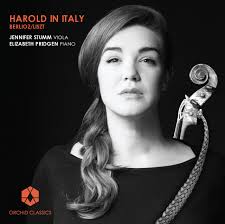
stumm

Berlioz: Harold in Italy arr Liszt

Jennifer Stumm, viola; Elizabeth Pridgen, piano

ORCHID CLASSICS ORC 100044    57.43

If Harold in Italy is familiar to us, the Liszt pieces which are included are certainly rarities which make this an intriguing release. The artists use Liszt’s arrangement for viola and piano of Berlioz work and integrate into it 4 of Liszt’s own which reflect the mood of the Berlioz. Anyone coming to this for the first time could easily think of this as a piece in its own right, so convincing is the organisation of the parts. While there is a wide dynamic available to the performers, the concentration necessary for the listener creates an intensity which carries them through easily to the climax in Liszt’s Schlaflos! Frage und Antwort.
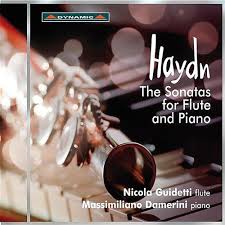
 

haydn flute

Haydn: Sonatas for flute and piano

Nicola Guideiit, flute; Massimiliano Damerini, piano

DYNAMIC CDS 7698         58.01

Delightful as this recording certainly is, there is something uncomfortably old-fashioned about it. Only the clarity of sound pronounces it as digital, for the approach owes nothing to our understanding of authentic instrumentation or style. Both instruments are modern in both sound and technique. As such the listener may find something of a dichotomy when listening to what is actually very sound music-making.
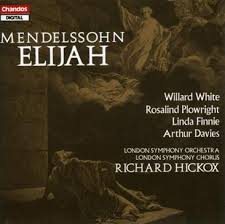
 

elijah

Mendelssohn: Elijah

London Symphony Orchestra & Chorus, soloists, Richard Hickox

CHANDOS CHAN 241-48             66.03; 65.21

This is a reissue of the recording made in 1989 and is a very welcome addition to the library of recording which Richard Hickox made. Willard White is an outstanding Elijah and is joined by Rosalind Plowright, Linda Finnie and Arthur Davies, all at the peak of their powers. The recording is full bloodied and within a warm acoustic.
 

moses cd

Schoenberg:  Moses und Aaron

EuropaChorAkademie; SWR Sinfonieorchester Baden-Baden und Freiburg, Sylvain Cambreling

HANSSLER SACD 93.314

Welsh National Opera has recently demonstrated yet again the importance of this masterpiece by Schoenberg , and so it is good to welcome a new release which enables us to the study the work outside the context of the opera house. Even in its incomplete state, it is a totally convincing stage work and musically satisfying. It is only a pity it is so rarely revived. Franz Grundheber and Andreas Conrad are convincing protagonists and Sylvain Camberling holds the whole together with a dramatic intensity that does not over-power the mystical quality of so much of the writing.
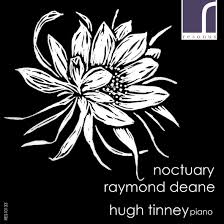


noctuary

Raymond Deane: Noctuary Books 1 & 2

Hugh Tinney, piano

RESONUS RES 10133       47,25

Noctuary was inspired by drawings by the composer’s wife, the artist Renate Debrun and are performed by Hugh Tinney in his debut recital for the label. A Noctuary is a diary of the night-time and these pieces, commissioned by the performer, all relate to the night or reflections during the night. Duskiss has a seductive sense of ominous silence while, by contrast, …hitherandthithering… skitters and rushes headlong at us. The drawings which provoked the pieces are included in a detailed booklet. The composer celebrates his 60th birthday this year and has recently published a memoir.
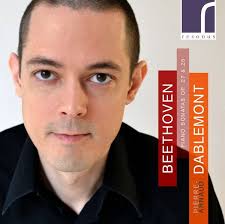


dablemont

Beethoven: Piano Sonatas Op 27 & 28

Pierre-Arnaud Dablemont

RESONUS RES  10135      62,18

Pierre-Arnaud Dablemont couples one very familiar work – the Moonlight sonata No14 – with two slightly less familiar ones, No13 Quasi una fantasia and No15 Pastoral. In so doing he demonstrates not only the way Beethoven is stretching and experimenting with the structure himself but also the way the performer brings his own innovative approach to interpretation. This does not mean that he takes an outlandish approach but more that his lightness of touch and gentle romanticism is very easy to accept and indulge in. I particularly enjoyed the delicacy of the opening of the Moonlight sonata, bringing a freshness to the movement as if it had been cleaned of layers of unnecessary pontification.

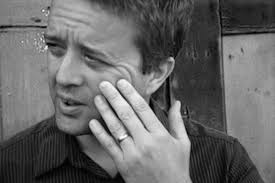
 

Richard Jones directs ENO’s first new production of The Girl of the Golden West for 50 years

girl of golden

Celebrated opera director Richard Jones returns to ENO to direct the first of two productions this season, following his ‘rapturously received’ (Daily Telegraph) success with Handel’s Rodelinda in February 2014. This new production of Puccini’s ‘American’ opera set in the Wild West during the Californian gold rush will be ENO’s first for 50 years with the great British soprano Susan Bullock making her stage debut in the title role. Leading the ENO orchestra and all-male chorus, experienced opera conductor Keri-Lynn Wilson makes her British debut.

Richard Jones collaborates with designer Miriam Buether to create a stark and claustrophobic setting, highlighting the desperation and sacrifice felt by the community of miners who live there. Costume designs reflective of the period are by Nicky Gillibrand. The translation is by Kelley Rourke, whose translation for ENO’s The Elixir of Love was praised as it ‘goes all out to capture the vernacular of the time and works rather brilliantly’ (Daily Telegraph). Lighting designer Mimi Jordan Sherin and choreographer Lucy Burge complete the creative team.

Canadian conductor Keri-Lynn Wilson makes her UK operatic debut. She previously conducted the opera in Montreal in 2008.

Leading the cast of outstanding singers is British soprano Susan Bullock who makes her stage debut as Minnie. She previously sang the role in concert at the 2010 Edinburgh Festival with the Daily Telegraph describing her performance as ‘tremendous’

British tenor Peter Auty makes his debut in the role of the bandit Dick Johnson. Peter’s professional musical career started at the tender age of 13, when as a choir boy at St Paul’s Cathedral he was chosen to sing ‘Walking in the Air’, the theme to the 1982 animated film of The Snowman.

American bass baritone Craig Colclough makes his European and role debut as the Sheriff Jack Rance. He started his career at LA Opera before joining Florida Grand Opera’s Young Artist Studio. In 2012 he became a Filene Young Artist at the Wolf Trap Opera company. He has also performed with Arizona Opera.

British tenor Graham Clark and Richard Roberts share the role of Nick.

Making their ENO and role debuts are young British tenor Sam Furness as the miner Joe, British bass Nicholas Crawley as the miner Larkens and Anglo French baritone Charles Rice as the miner Handsome.

The Girl of the Golden West opens at the London Coliseum on Thursday 2 October for 9 performances – 2, 10, 15, 22, 24, 27, 30 October at 7.30pm, 18 October and 1 November at 6.30pm

Pre-performance talk, 15 October 5.45-6.30pm £5/£2.50 concessions

Opening Thursday 2 October 2014, 7.30pm at London Coliseum (9 performances)

A co-production with Santa Fe Opera


All Saints Organ Concert

4 August 2014

Tom Bell & Richard Brasier

A varied and original programme of music was enjoyed by a responsive audience for this, the 5th concert of the series. Both performers are excellent ambassadors for the organ. They  combine skilled playing and good understanding and command of the capabilities of the Willis together with down-to-earth, interesting explanations of the music.

The programme was made up of four duets, a piece that required one of the pair to act as assistant and solos from both performers.

The first duet was a set of 19th Century Variations by Adolf Hesse. It was presented with some contrasting registration and set the evening off to a very good start. The second duet was a complete contrast – Martyrs by Kenneth Leighton, written in 1976. This was an exciting demonstration of cross rhythm and a good showcase for the depth of texture and contrasting lines possible in an organ duet – and of virtuosic playing from both performers. A section from one of Samuel Wesley’s organ duets saw a return to a more conventional sound world (although Wesley is  not without his own quirks). The final duet was John Rutter’s Variations on an Easter Theme which treats “O Filii et Filiae” in a number of ways including some jazz-inspired moments.

Solo items were two contrasting pieces from Richard originally written for mechanical clock. The first, a beautifully mellow registered but at times very involved Adagio by Beethoven. The second was the well-known grand Fantasia by Mozart, in an arrangement by W.T.Best. I wonder if the clock played this piece on the hour, every hour! Both pieces were very well executed.

Tom’s pieces were both contemporary offerings. Tom’s passion for contemporary organ music is infectious and it is so good to be able to hear this music live as part of the Hastings organ series. I personally would love to hear much more included in these programmes. Martin Bussey’s Three Border Studies paint a musical picture of 3 ancient abbeys – Jedburgh, Dryburgh & Melrose, with their own character represented in the structure, texture, rhythm and melody of each piece. The most contemporary piece was a world premiere performance, given in the presence of the composer. Inspired by Ligeti’s organ work it is described as “a very gradual transformation of timbre”. It is entitled (organ piece) by John Aulich. It involves very light touch playing as well as skilful manipulation of the drawstops and placing of chopsticks (!) on the keys to allow sounds to be sustained for long periods but allowing the performer to carry out further manipulation. The piece ends with the blower being switched off allowing the sound to die away as the various harmonics become more audible.

This was a well crafted programme, designed to entertain and inform. Both performers had a natural rapport with the audience and demonstrated an excellent understanding and control of the Willis. This was their first joint performance and it is to be hoped that they will develop their repertoire of duets. I also hope that we will see more of them together in Hastings in the future.  SP

Prom 24

Prom 24

Monday 4 August 2014

It is difficult for us today to realise that Vaughan Williams’ Fantasia on a theme of Thomas Tallis was found as confusingly modernist as its contemporary masterpiece, Mahler’s 9th Symphony. Bringing the two works together for a Prom without an interval was a challenging but highly successful piece of programme planning.

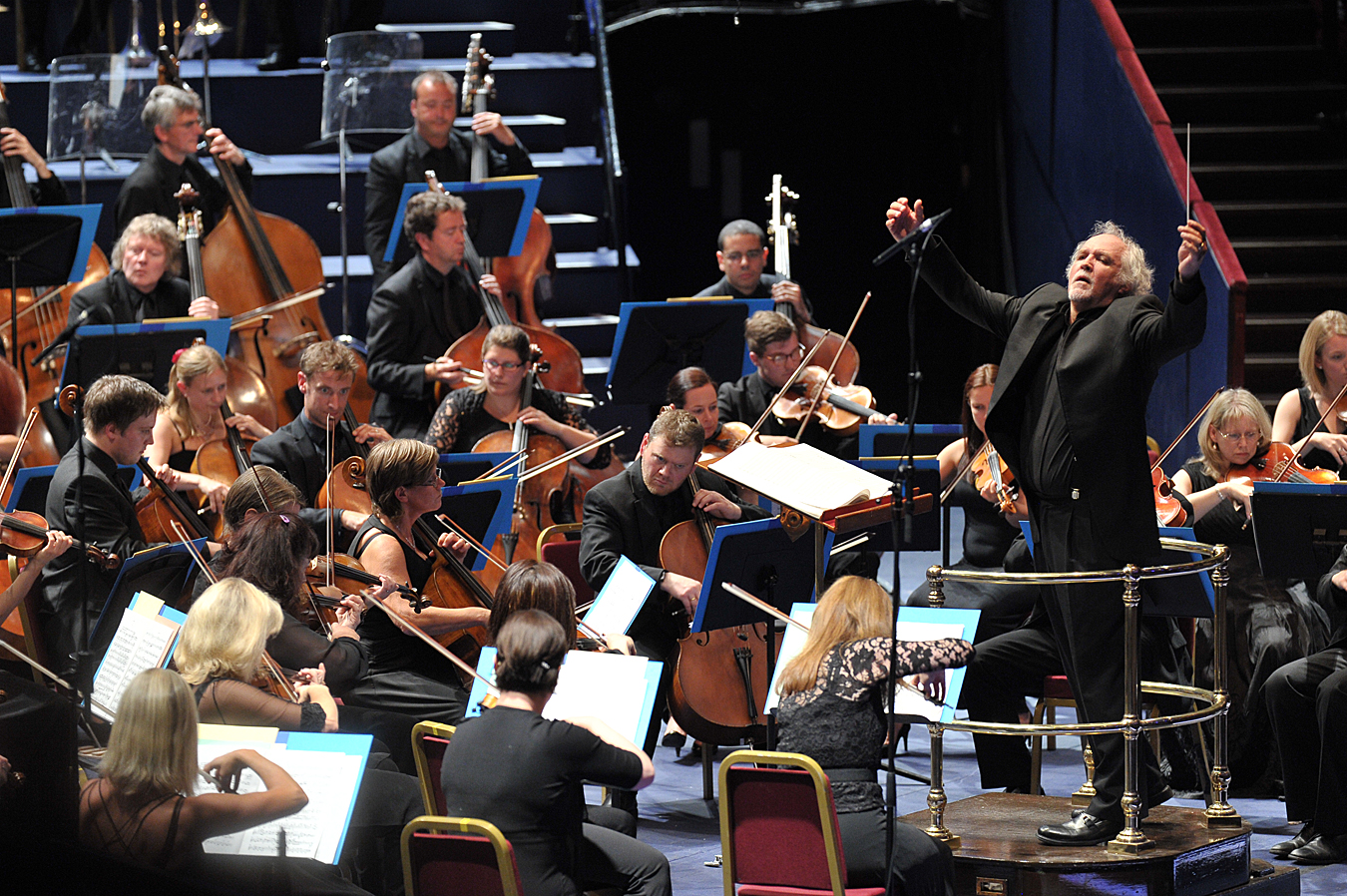
Donald Runnicles’ approach to both works was deceptively subtle. The Vaughan Williams had great clarity and distance, but retained a coolness throughout, resisting any gush of romanticism. The separate placement of the ensemble above the rest of the orchestra, and the clarity of the quartet within it, both ensured that we were constantly aware of the dynamic tensions the composer creates. It was a fitting preparation for the Mahler.

Donald Runnicles’ created a seamless inevitability in the opening movement, not so much pessimistic as fated – at times almost heroic – with a lovingly spun out final section. The Landler was slower than usual and somehow more refined. No smell of the countryside and cow-pats, though the waltz section had a diabolic edge to it. There was fire in the third movement but no raw edges which can galvanise this score in other hands. It was not until the last movement that we could fully realise the way he was shaping the whole. The glowing, almost lush, string unfolding of the finale was breath-taking, bringing a quite but positive sense of hope to the whole. The final bars, combining resignation and yearning, were as beautiful as one could imagine. If the audience had been rather noisy at the start – the coughing around me nearly drowned out the opening bars – they were far more attentive by the end.

Oxford Lieder Festival 2014

THE SCHUBERT PROJECT
BRINGING SCHUBERT’S VIENNA TO OXFORD

10 October – 1 November 2014

Many of the world’s greatest musicians arrive in Oxford this October to take part in The Schubert Project – the UK’s first complete performance of Schubert’s songs, and a world first in the scope of a single festival. Around this unparalleled body of work – some 650 songs by the age of just 31 – the city of Oxford will be buzzing with other Lieder Festival events planned to illuminate the songs and bring to life the world that Schubert inhabited.

The Festival is launched with a stellar cast of tenors and baritones (John Mark AinsleyJoshua EllicottJames Gilchrist,Daniel Norman / Neal Davies, William DazeleyStephan LogesChristopher Maltman) joined by mezzo sopranoSarah Connolly for songs, partsongs and the exquisite serenade, Zögernd leise (10 Oct).  In more than 60 concerts, singers include Sir Thomas Allen (25 Oct), Ian Bostridge (16 Oct), Christiane Karg (21 Oct), Susan Gritton (26 Oct),Dietrich Henschel (17 Oct), Robert Holl (28 Oct), Wolfgang Holzmair (30 Oct), Sophie Karthäuser (11 Oct), Angelika Kirchschlager (29 Oct), Jonathan Lemalu (1 Nov), Mark Padmore (24 Oct), Christoph Prégardien (19 Oct),Maximilian Schmitt (28 Oct), Sylvia Schwartz (11 Oct), Birgid Steinberger (11 Oct), Kate Royal (13 Oct) andRoderick Williams (15 Oct), alongside emerging stars including Allan ClaytonAnna Lucia Richter, Martin Haessler, Christoph Pohl and many others. They will be joined by the world’s leading pianists, including Thomas AdèsEugene Asti, Imogen CooperJulius DrakeBengt ForsbergGraham JohnsonMalcolm Martineau, Roger Vignoles &Justus Zeyen. In addition, the Orchestra of the Age of Enlightenment, the Doric String Quartet and the Schubert Ensemble will be performing key chamber works.

The Bodleian Library will show several Schubert manuscripts; the Ashmolean Museum will host live music events and a specially-devised audio guide; there will be four performances of  a new play by Iain Burnside; Schubert’s sacred musicwill resound around college chapels; the Botanic Gardens will collaborate on a study event looking at Schubert’s relationship with nature; a pop-up theatre will recreate a famous Schubert gathering; and local restaurants will feature Viennese food and wine. Masterclasses, talks and workshops abound, and the Festival will stretch to all corners of the city from Christopher Wren’s Sheldonian Theatre and Europe’s oldest concert hall – the Holywell Music Room – to the contemporary settings of the O’Reilly Theatre, the Phoenix Cinema and the recently-restored Ashmolean Museum.

ENO’s Xerxes returns to the Coliseum

xerxes

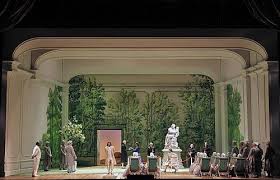
Nicholas Hytner’s critically-acclaimed 1985 production of Xerxes, the oldest production in ENO’s repertoire, returns this season with an all-British cast reinforcing ENO’s “unrivalled reputation as the world’s leading house for Handel” (The Sunday Times).

Winner of the 1985 Olivier Award for outstanding new production, Xerxes features spectacular designs by David Fielding with lighting by Paul Pyant evoking Vauxhall Pleasure Gardens in the 18th century.

Michael Hofstetter leads the ENO chorus and orchestra following his successful house debut conducting Peter Konwitschny’s La traviata in 2013.

Over the past 29 years, the title role of Xerxes has been played by some of the world’s most outstanding mezzo-sopranos including Ann Murray in 1985 and 1988, Louise Winter in 1994 and Sarah Connolly in 1998 and 2002, whose international career was launched by the role. For this revival, internationally renowned mezzo-soprano Alice Coote sings the title role for the first time.

Counter tenor Andrew Watts plays Arsamenes. Soprano Sarah Tynan sings the role of Romilda. Sarah was an ENO Harewood Artist and later became an ENO Company Principal, a position she held until 2007. In their first Handelian roles ENO Harewood Artists Rhian Lois and Catherine Young are Atalanta (Romilda’s naughty sister) and Amastris (Xerxes jilted fiancée) respectively. Rhian has recently played Adele in Christopher Alden’s Die Fledermaus in September 2013 and First Niece in David Alden’s critically acclaimed revival of Peter Grimes in January 2014. Catherine took part in ENO Baylis Opera Works programme in 2009-2010, and in September 2010 became an ENO Harewood Artist. She made her professional debut with ENO in June 2011 as Hippolyta in Britten’s A Midsummer Night’s Dream.

Bass Neal Davies sings the role of Ariodates, Romilda’s father. Previous roles for ENO include Kolenaty in The Makropoulos Case in 2010. He has also sung at The Royal Opera House, Welsh National Opera and Lyric Opera of Chicago. Baritone Adrian Powter plays Elviro, Arsamenes’s servant.

Xerxes opens at the London Coliseum on Monday 15 September for 6 performances – 15, 20, 24, 26 September and 1, 3 October at 7.00pm.

David Pountney is awarded the Austrian Cross of Honour

David Pountney

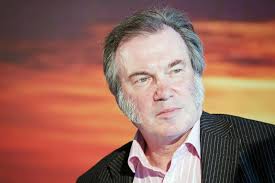
Welsh National Opera’s Chief Executive and Artistic Director, David Pountney, has been awarded the Austrian Cross of Honour for Science and Art, First Class. He was presented the award by the President of the Republic Heinz Fisher in a ceremony which took place in the opening of the Bregenz Festival.

The award honours Austrians and foreign leading figures who have “distinguished themselves and earned general acclaim through especially superior creative and commendable services in the areas of the sciences or the arts” and is conferred by the Federal President.

This year marks David Pountney’s last year as Artistic Director of the Bregenz Festival, a position he has held since 2004

David Pountney says, “It is a great honour to be recognised by a State which has such an astoundingly rich cultural inheritance. I have worked on various Austrian stages from the Wiener Staatsoper to Linz whose new opera house opened with my production of Philip Glass’s new opera “Spüren der Verirrten” last year, but my main focus has been on the Bregenz Festival where I made my debut in 1989, and have enjoyed 10 marvellous years as Intendant since 2004.”

David Pountney has already been made a Commander of the British Empire and a Chevalier in the French Ordre des Arts et Lettres and was last year presented with the Cavalier’s Cross of the Order of Merit for his contribution to the promotion of Polish culture.