
Author Archives: Admin
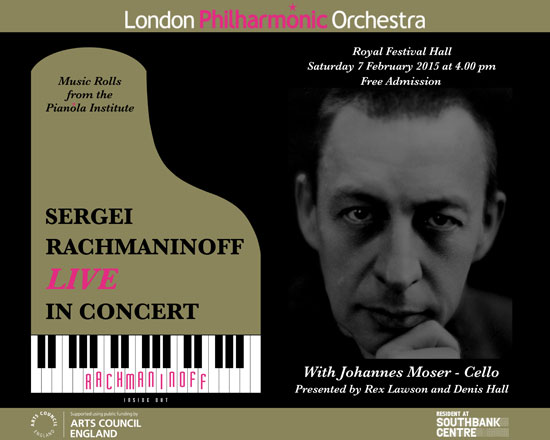
SERGEI RACHMANINOFF Live!!
Royal Festival Hall 7 February 2015
Rex Lawson(pianola ), Johannes Moser (cello), Denis Hall (presenter)
Q) How is it possible for a pianist who died over 70 years ago to appear “live” in concert?
A) When that pianist was a prolific recorder of piano rolls.
This free matinee concert was presented by the Pianola Institute. Whilst some may take issue with the “live” billing it was an enthralling experience to hear the two Steinway pianos come alive with the playing of such a master composer-pianist. On entering the main auditorium the audience was greeted by the unusual sight of two “pull-up” pianolas in front of the Hall’s two Steinway grand pianos, and a similar “pull-up” reproducing instrument waiting to be substituted for the second half.
The concert showed something of the range of rolls that were produced and the differences between the two main systems of recording and reproduction. To explain this very basically “ordinary” pianolas simply allow the pitch and rhythm of the performance to be played back, with the pianolist expertly controlling dynamics and speed whereas the more sophisticated reproducing piano captures these details on the roll and everything is played back without the need to reinterpret.
We heard solo pieces of both types as well as hearing an accompaniment roll played together with live cello from soloist Johannes Moser in two movements from the Cello Sonata, Op 19. Johannes’ playing was superb but sadly, at times, was a little eclipsed by the sound of the piano. The conclusion to the concert was a rendition of the 2nd movement of Piano Concerto No 2 with Rachmaninoff’s solo played on the reproducing piano and Rex Lawson controlling the pianola with a transcription of the orchestral part. A lot of skill is involved in matching the orchestral part to the solo – it was fascinating to watch the performance.
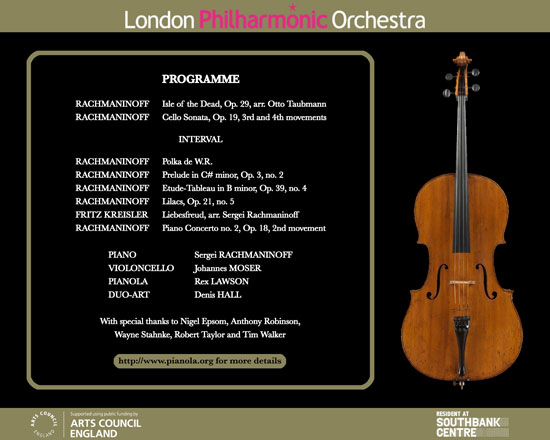
The programme began with The Isle of the Dead. The length of the piece necessitated the loading of two rolls over two pianolas. Rex moved from one to the another to make for a swifter “join”! There was also lighter music including Polka de W.R. and Rachmaninoff’s concert arrangement of Kreisler’s Liebesfreud.
There were anecdotes, a humorous poem & background information on the various systems of recording and playback. There was some explanation of the way modern MIDI technology has been utilised to enable rolls to be transcribed from one commercial and incompatible system and played back on another. I would have liked slightly more explanation as to how the reproducing piano had been adapted to be played back in a less conventional way. The enthusiasm and expertise of the two presenters was evident throughout.
This was a very good introduction to the world of pianolas and reproducing pianos but also an entertaining and immersive musical experience in its own right. Congratulation to all involved. I hope it will have helped to raise the profile of this musical genre and that there may be similar future events. SP
Brighton Philharmonic Orchestra
The Dome, Brighton, Sunday 8 February 2015
On paper this appeared to be a very pleasant classical Sunday matinee. A sandwich of symphonies with a piano concerto in between should have worked well but the actual choice of works proved more problematic. Unless the listener has a very keen ear for orchestration the three works could easily have flowed into one continuous stream of easy listening.
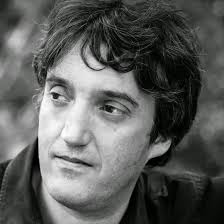
The afternoon opened with Haydn’s Symphony No83 La Poule. Thomas Carroll brought a lightness of touch with clipped rhythms in the first movement and a gently melancholic feel to the Andante. Anthony Hewitt was a very relaxed soloist for Mozart’s Piano Concerto No27 with its familiar final movement. The Steinway piano seemed rather too hard in the opening movement but the soloist eased into his playing and the finale was delightfully wistful and delicate.
Schubert’s Fifth Symphony may have been written over twenty years later but looks back to Mozart far more than to the innovations of Beethoven. Only the occasional challenge within the Andante helped us to realise when it was actually composed.
Over the afternoon the wind had very little to do apart from strengthen the tutti passages, except for a few fine phrases in the Schubert. As a result the matinee slipped past without any really arresting moments and was noteworthy – certainly from where I was sitting – for rather more gentle snoring than is usual. Possibly the most exciting moment was the highly professional dispatch of the piano during the interval.
If we had heard Haydn’s Surprise Symphony rather than La Poule we might have been more attentive to the fine playing that was in evidence.
The Mastersingers of Nuremberg
ENO, 7 February 2015
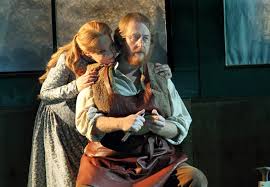
Wagner’s The Mastersingers of Nuremberg has long had a special place in the heart not only of ENO audiences but also of the company itself. It was Mastersingers that first brought the Sadlers and Wells companies together in the mid-sixties for the first time and launched the series of Wagner performances under Reginald Goodall which in many ways created the company we know today.
Despite the rumbles we hear of behind the scenes, the standards that were set back then are more than obvious is this most recent production under Edward Gardner and Richard Jones.
First seen over five years ago at WNO, the production seems lighter now, more subtle both in its characterisation and musical weight. The drama unfolds swiftly and inevitably, with constant concentration on the text and the interaction of character. Not that this should in any way imply that there is a problem with the musical standards. This is one of the finest sung and played performances I can recall with all parts drawn from strength; but Wagner himself intended that the text should lead the hearer not simply the beauty of the musical line, and it does so with sharp clarity. It is one of the few times where having the surtitles in addition to the opera being sung in English really pays off.
Given that everything in Mastersingers hangs on the quality of the Prize Song Gwyn Hughes Jones’ Walter is totally convincing. His Now begin in Act One gave us a hint of what was to come but few Walter’s have the stamina to carry this level through to the end. No problems here; the Prize Song came over as fresh and lyrically mellifluous, a truly convincing winner.
The relationship between Sachs and Beckmesser is also a surprisingly subtle one. It is quite clear that they are close and that the upset is an aberration in their friendship, which, one suspects, will be quickly healed. Iain Paterson’s jovial Sachs is confused by his feelings for Eva and his quiet tear in act three is one of a number of gentle indications of his depths of feeling for her. Andrew Shore’s Beckmesser may be a stickler for regulation but he is a more complex and likeable character than is frequently the case. James Creswell is a noble Pogner and Rachel Nicholls shines as Eva – but as already noted there are no weaknesses in the casting.
The final scene, and in particular Sachs’ narration can be a stumbling block for producers today but Richard Jones circumvents this by letting the whole cast step out of character to point us, as the front cloth does, to the importance of German art and thinking, which Wagner himself intended.
With so much quality on stage it would be easy to overlook the importance to the whole of Edward Gardner’s deft handling from the pit and the enthusiastic brilliance of the choral singing.
How anybody could even think of seriously criticising a company that can create productions of this quality is – well – Mad!
Deborah Warner directs the world premiere of Tansy Davies’s groundbreaking first opera for ENO, inspired by the events of 9/11
Opening Saturday 11th April 2015, 7.30pm at the Barbican (8 performances)
Critically acclaimed opera and theatre director Deborah Warner directs the world premiere of British composer Tansy Davies’s highly anticipated first opera. With a libretto by Nick Drake and conducted by contemporary music specialist Gerry Cornelius, Between Worldsforms part of a series of major British operas premiered by ENO, the next world premiere being February 2017.
Between Worlds is a sensitive, spiritual and uplifting journey inspired by the events of 9/11, addressing one of the most significant events of the twenty-first century and bringing the universal operatic themes of tragedy, loss, courage, healing and love into a contemporary context.
The opera focuses on the relationships and emotions of the people at the very centre of the tragedy. It tells the story of six individuals whose days start normally but end in the most devastating of circumstances. Trapped high up in the World Trade Center, they are forced to face the inconceivable possibility that they may never see their loved ones again. Nick Drake’s libretto has been partially inspired by first-hand accounts and messages sent on the day of the tragedy and released by WikiLeaks in 2009.
ENO has had significant success staging new operas written by living British composers. In May 2014 Pierre Audi directed the world premiere of Julian Anderson’s first opera, Thebans,at the London Coliseum. Joanna Lee’s first opera, The Way Back Home, received its world premiere in an ENO co-production with the Young Vic in December 2014, directed by Katie Mitchell.
Deborah Warner returns to ENO and the Barbican following her recent five star productions of Death in Venice (London Coliseum) andThe Testament of Mary, starring Fiona Shaw (Barbican Theatre).Her ‘electrifying’ (Bachtrack) new production of Beethoven’s Fideliorecently opened the 2014/15 La Scala season to great acclaim.
Composer Tansy Davies’s distinctive sound-world has been described as possessing a ‘rare power to remind listeners of their own inner freedom’ (Guardian). Her work has been commissioned and performed by many significant international ensembles and orchestras, including the London Sinfonietta, the BBC Concert Orchestra and the BBC Symphony Orchestra. She received a Paul Hamlyn Award in 2009 and was nominated for a South Bank Sky Arts Award in 2010.
Maidstone Symphony Orchestra
The Mote Hall, Maidstone, 31 January 2015
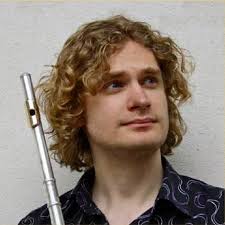
Flautist Harry Winstanley may have been introduced as local boy makes good but there is nothing remotely domestic about his international reputation or his technical prowess. Nor is he limited to performing. The first half of the concert was built around two substantial and challenging works for flute and orchestra, the first of which, Paul Taffanel’s Fantasy on themes from Weber’s Der Freischutz had been orchestrated for this performance by Harry Winstanley himself. It is a sensitive arrangement, thinning out Weber’s orchestra so as not to overwhelm the soloist but retaining just enough brass to allow significant impact in climaxes. The work opens with Agathe’s Leise, leise fromme Weise and wends its way through to Annchen’s Einst träumte meiner. On the way the flautist indulges in increasingly elaborate ornamentation like a Bel-canto Diva on a benefit evening. It was intoxicating and hugely enjoyable. Prior to this we had heard the overture to Der Freischutz where the horns had excelled themselves though the piece never really caught fire.
Carl Nielsen’s Flute Concerto is equally demanding of the soloist and makes even more demands of the audience. There is a constant tension between the soloist and the orchestra which changes moment to moment in emotional intensity and melodic invention. At one time the flautist seems to be trying to calm the orchestra whereas at others they seem to be forcing him to go into areas his gentle, almost naïve musical line clearly does not want to pursue. The introduction of the snarling trombone at the end leaves us with a lurking doubt as to just how seriously we should take the work. Maybe we should just sit back and enjoy it and not worry about the journey?
After the interval we were in much safer territory with Dvorak’s sixth symphony. The influence of Brahms is obvious throughout but this is Brahms with a smile on his face and the Czech folk influence is never far from the surface. The brass are very exposed but proved themselves more than worthy of the challenge with ringing fanfares at both ends of the work. There is a gentle optimism in the slow movement which was supported by rich string playing and occasional darker moments passed quickly as the woodwind bring back the sunshine. The scherzo was furiously driven like a whirling folk dance throughout and brought us to the melodic delights of the finale, Brian Wright maintaining a lightness and sense of joy throughout.
The next concert on 21 March brings us the Elgar Violin Concerto with a change of soloist. Bartosz Woroch returns to play for us in place of Ulf Hoelscher.
LPO in Brighton
The Dome, 17 1 15
It may have been a dull winter’s evening but the music spoke of light and energy throughout, with a richly romantic combination of late nineteenth century works.
One the benefits of hearing operatic overtures in the concert hall is the greater clarity it brings to the score and none more so than the Prelude to Humperdinck’s Hansel und Gretel. This is post-Wagnerian writing at its best, with the melodic lines sliding effortlessly around each other to create an enveloping cocoon of sound. Rory Macdonald’s crisp approach and clarity of line meant that the counterpoint was clear throughout and the subtle shifts in mood pointed without being over-extended.
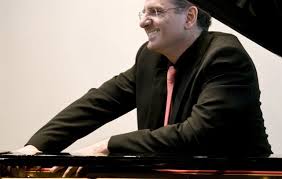
Lambis Vassiliadis’ approach to piano playing reminds one of the stories of Liszt with its explosive dynamism and authority. His approach to Chopin’s Second Piano Concerto was virile throughout with the left hand often hammering out the chords to a point where one wondered if the instrument could take the weight. And yet there was nothing unmusical about the performance; it was totally convincing and inspiring. If Rory Macdonald had seemed to be taking a very precise approach to phrasing in the opening section, Lambis Vassiliadis created a continuous gentle tension with his use of rubato and rapid changes of mood. Long passages would build to heady climaxes only to disappear into thin air.
He gave us a lengthy Lisztian encore which was even more dazzling technically and left the piano needing a rub-down and a rest. (I later found that this was Liszt’s Reminiscences of Norma)
The sense of the open air which had been evident in Hansel und Gretel returned with Dvorak’s 8th Symphony. Breathing light and a sense of the joy of life throughout, it allowed us to hear some very fine solo playing along with the warm intensity of the strings. If tempi were on the fast side, the symphony never seemed rushed, rather there was a delight in the ability to spin musical lines with such ease. The splendid trumpet solo which opened the final movement led to a set of variations with real bite and attack, at whose heart was the gentle cello melody which seemed to encapsulate the joy of the whole.
A splendid evening of exceptional music-making.
One observation to add in passing. When I go the Brighton Philharmonic concerts nobody ever applauds between movements and the coughing is kept well under control. Last night there was applause throughout and coughing was often uncomfortably obvious. Does Brighton really have two different audiences for classical concerts?
DVDs & CDs JANUARY 2015
DVDs
PURCELL: THE FAIRY QUEEN
ENO, NICHOLAS KOK
ARTHAUS 100201
With a new production by Peter Sellars of The Indian Queen due later this year, a reissue of David Poutney’s 1995 production of The Fairy Queen is timely and will make for a fascinating comparison. Poutney delights in the overt theatricality of Purcell’s vision making the whole constantly stimulating and engaging. When one adds to this a cast which includes Yvonne Kenny, Thomas Randle and Richard Van Allan, and the sprightly orchestral approach under Nicholas Kok it can hardly fail.
VERDI: DON CARLOS
ORCHESTRA & CHORUS TEATRO REGIO TORINO, GIANANDREA NOSEDA
OPUSARTE DA 1128 D
I suspect that this production was far more impressive seen live than it is here in close up on DVD. The massive sets impress from a distance but close to reveal that the columns do not touch the ground and, because of their massive bulk, are still on stage for the external scenes which need to breath. The same is also true of the singers. While the voices are sound throughout, there is often little eye contact between characters and rather too many shifty glances towards the pit. This is a pity for simply listening to the score is pleasurable. For once it might have been better to release this as a CD rather than a DVD.
CDs
THE ROMANTIC VIOLIN CONCERTO – 18
PHILIPPE GRAFFIN, ROYAL FLEMISH PHILHARMONIC, MARTYN BRABBINS
HYPERION CDA 68005 65’47
Following this series has been immensely enjoyable if only for the discovery of so many totally overlooked compositions which prove to have real merit. Jongen is probably best remembered today as a composer of organ music and certainly it is his organ compositions which are most frequently heard. The violin concerto was written following a visit to Bayreuth in 1899 and while it does not have strong Wagnerian overtones the high romantic is an inevitable reflection of the influence of the composer on the younger man. The other rarity is the Rapsodie in E minor by Sylvio Lazzari, also a Wagnerian and one who picks up the more lyrical, free-flowing impulses of the master. Anther valuable recording.
SIR CHARLES VILLIERS STANFORD -THE COMPLETE ORGAN WORKS 2
DANIEL COOK, organ of Durham Cathedral
PRIORY PRCD 1106 71’37
Whether as a reference work or a recording just to enjoy this is a very good CD. Daniel Cook’s performances on the Durham Willis / Harrison & Harrison are excellent. This volume includes the Fantasia & Fugue in D minor, 6 preludes & postludes Set 1 & Sonata No 3 as well as some shorter works.
THE BRITANNIC ORGAN VOL 9 – Welte’s US organists and Edwin Lemare
ORGAN ROLLS of Edwin Lemare, Samuel Atkinson Baldwin, Clarence Eddy & others
OEHMS OC848 69’01 & 74’57
The Britannic was the sister ship to the Olympic & the Titanic. It was originally intended to have a Welte reproducing organ installed on board. Due to the outbreak of the 1st World War the organ was never installed. It was only during restoration work in 2007 that evidence was found to prove this was the organ originally intended for that ship. It is now housed in the Museum fur Musikautomaten, Seewen, Switzerland. This volume (the first I have heard) is a fascinating record of this instrument and the recording technology of the day which allows us to still experience the playing of these organists in such a live way. The music consists of lighter & more substantial organ music and transcriptions. There is a wide range of colour and mood, with some brasher registrations contrasting with beautiful flutes and light tuned percussion.
CD1 includes musc by Bossi, Friml, Buck & Saint-Saens. Alongside mostly lighter music is Guilmant’s Sonata in D minor. The music on this CD is recorded by the American organists who recorded for Welte. CD2 is entirely recorded by the celebrated Edwin Lemare. Alongside further music by Guilmant , Rheinberger and others are movements from Lemare’s own works. It ends with his transcription of Saint-Saens’ Danse macabre. There is an extensive booklet with interesting photographs and information on the organists and composers. Presumably earlier volumes contain more information about the organ itself. A fascinating insight into times passed.
JEAN-PHILLIPE RAMEAU – PIECES DE CLAVECIN Vol 2
STEVEN DEVINE, harpsichord
RESONUS RES10140 66’44
This is volume 2 of a 4 CD set of the complete keyboard works of Rameau, released at the end of 2014, the 250th anniversary of the composer’s death. This CD features Book 3 of Rameau’s Pieces de Clavecin. The book consists of 2 Suites –in A minor/ major and G major/minor.
The music is expertly performed by Steven Devine on a copy by Ian Tucker of a 1636 Ruckers double manual instrument. Volumes 3 & 4 are due for release later this year. As with previous Resonus releases there is a PDF booklet to accompany the recording.
JOURNEY TO ALDEBURGH: YOUNG BRITTEN
CHAMBER DOMAINE, conductor & violin THOMAS KEMP
RESONUS RES10139 62’42
Having just worked my way through listening to a large Britten CD set I was fascinated by the contents of this CD. It is an interesting programme of world premiere recordings and other rarely heard music written by Britten as a student and at the beginning of the Aldeburgh Festivals.
The music is performed by Chamber Domaine, an ensemble with a growing reputation for the championing of 20th & 21st century repertoire, with its leader and violinist Thomas Kemp. It begins with an arrangement for 12 instruments of his tutor, Frank Bridge’s There is a willow grows aslant a brook. There are also works for solo piano, violin and piano and piano trio as well as the original version of his Sinfonietta, Op 1. If you would like to discover some “new” Britten then this disk is an obvious place to look.
HAYDN: SONATAS AND CONCERTOS
ANNE-MARIE MCDERMOTT, ODENSE SYMPHONY ORCHESTRA, SCOTT YOO
BRIDGE 9438A/B 70’15; 70’09
Five sonatas and the piano concertos in D major and G major (H XVIII 11 & 4) make this a bargain collection of fine works and equally fine playing. The cadenza in the final concerto was especially composed for Anne-Marie McDermott by Charles Wuorinen and creates a pleasing link between the original composition and the performance today on modern instruments.
SP/BH
Hear Rachmaninoff LIVE
Award winning director Mike Leigh makes his operatic debut with the Gilbert and Sullivan classic, The Pirates of Penzance
Opens Saturday 9 May at 7.30pm at London Coliseum (14 performances)
Broadcast live in cinemas across UK and Ireland, and selected cinemas worldwide, as part of ENO Screen on Tuesday 19 May at 7.30pm
Acclaimed film and theatre director and Gilbert and Sullivan aficionado Mike Leigh makes his operatic directorial debut at ENO with a new production of The Pirates of Penzance, Gilbert and Sullivan’s popular farcical comedy. Featuring swashbuckling pirates, flat footed policemen, razor-sharp satire and memorable melodies, this sparkling new production promises to be the theatrical and musical event of 2015.
ENO’s international reputation for working with exciting directors from across a wide range of artistic disciplines has offered a fresh perspective and unique approach to our productions. Film and theatre director Mike Leigh is the latest artistic talent to apply his skills to the world of opera. Previous directors ENO has worked with include Terry Gilliam, Anthony Minghella, Benedict Andrews, Rufus Norris, Carrie Cracknell and Fiona Shaw.
ENO has a long history of performing Gilbert & Sullivan with Iolanthe, The Gondoliers, Patience, The Pirates of Penzance and The Mikado having all been part of the Company repertoire. ENO’s “bright and sharp” (The Guardian) production of The Mikado has become a true audience favourite having been revived 13 times in 28 years.
Leigh is a lifelong fan of the quintessentially English musical duo. He wrote and directed the 1999 BAFTA winning film Topsy Turvy(starring Jim Broadbent as W.S. Gilbert and Allan Corduner as Sullivan) which explored their turbulent relationship leading up to the premiere of The Mikado. He is President of both the Sir Arthur Sullivan Society and the W.S. Gilbert Society and has contributed to The Cambridge Companion to Gilbert and Sullivan. Fresh from success with the film Mr Turner, starring Timothy Spall as the artist J.M.W.Turner, Leigh has had a long and successful career which began in the theatre in the 1960’s as both a playwright and director. His plays include Bleak Moments, Abigail’s Party, Ecstasy, and most recently, Grief at the National Theatre.
Olivier award-winning designer Alison Chitty has previously collaborated with Mike Leigh on Life is Sweet, Naked and Secrets and Lies. She will design the set and costumes. Lighting is by Paul Pyant with choreography by Francesca Jaynes.
British baritone Andrew Shore is renowned for his character roles and is a superb singer and actor. He makes his role debut as Major-General Stanley. He has performed numerous roles for ENO, most recently the twin cameos of Benoit and Alcindoro in La bohème, and will appear as Beckmesser in The Mastersingers of Nuremberg in February 2015.
British tenor Robert Murray takes on the role of Frederic the pirate apprentice. His previous roles for ENO include Nanki-Poo in The Mikado, Tamino in The Magic Flute, Don Ottavio in Don Giovanni and Idamante in Idomeneo.