ENO: Carmen

London Coliseum, 20 May 2015
'Carmen' Opera Performed by English National Opera at the London Coliseum, UK

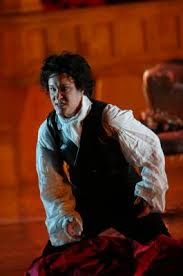
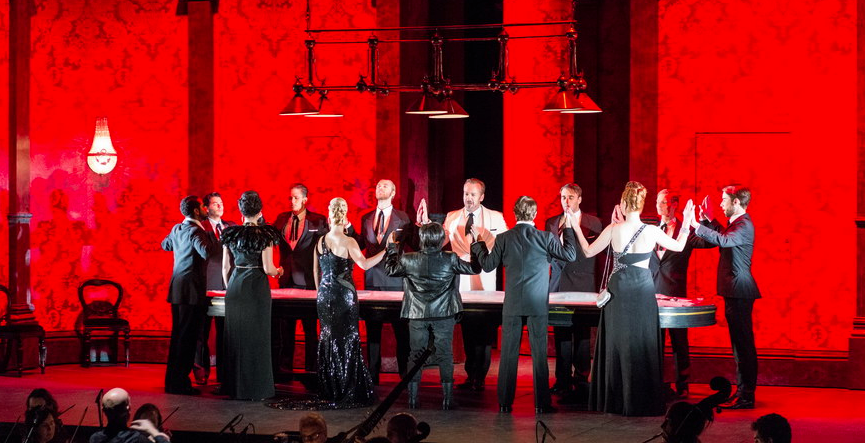
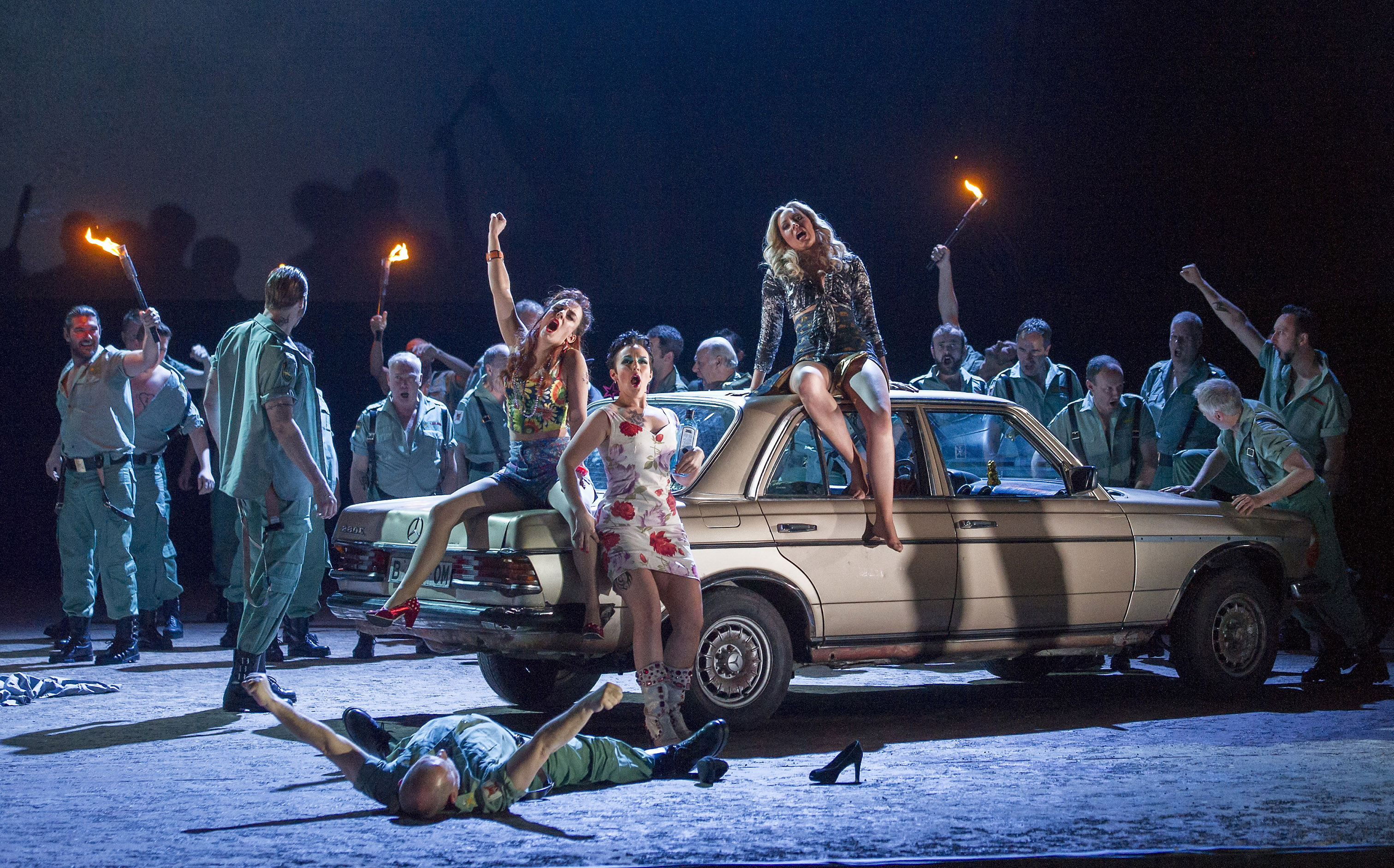
Calixto Bieito’s approach to Carmen is a world away from the tourist image of Spain and there’s not a flamenco dancer in sight. Instead we are at a nebulous crossing point somewhere in the late 1970s, surrounded by low life and dropouts living by the skin of their teeth. Even Escamillo is an alcoholic and obviously near the end of his career.

While this works well for much of the time it has a number of problems, not the least of which is the translation which often seems at odds with the action, but more importantly the score which is frequently optimistic and romantic when what we are witnessing is shabby to say the least. Moreover the characters do not compensate as they seem to know the world that they inhabit is going nowhere.

For much of the time this works well and the erupting sensuality and vulgarity are in keeping with the action, but there are too many occasions when we are left wondering why. In the opening scene the massed forces of soldiers impress but there is nobody else on stage; there is nobody for them to look at passing by .In fact they could be as abandoned in the desert as Lillas Pastia seems to be.

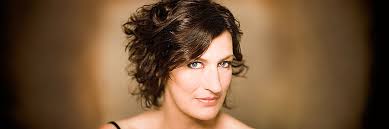
Thankfully the characterisation and singing more than compensate. Justina Gringyte is a blond bombshell of a Carmen, almost the opposite of what one might expect, but there is nothing amiss with the intensity of her singing and the sensuality she brings to it. If she seems hard-bitten then this is the way life has made her. Eric Cutler cuts a fine soldierly figure as Jose and has the strong upper register to match. Given that Eleanor Dennis is required to be extrovertly flighty as Micaela there is little reason for Jose to say no to Carmen.

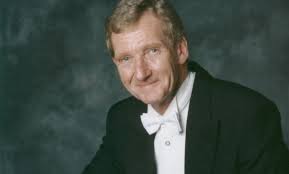
Smaller parts are strongly cast and the chorus are strongly focussed throughout. Under Sir Richard Armstrong the orchestra plays with flair and often with an extravagant edge which works well even if it is at odds with what we are seeing.

The production can be seen in cinemas on 1 July.
CBSO: Parsifal

Birmingham Symphony Hall, 17 May 2015

a nelsons

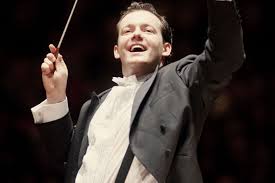
Andris Nelsons may be leaving CBSO soon but he is going out with a flurry of wonderful performances, none less surely than this Parsifal. He brings a dramatic urgency to the score which maintains a level of unexpected tension throughout. Where complaints are often made about long dull narrations, here every word has impact, particularly in the capable hands of Georg Zeppenfeld’s youthful Gurnemanz. We were encouraged to hear the dialogue as if for the first time and when this is added to the freshness and clarity of the orchestration it was frequently revelatory. Not that the evening seemed rushed. If anything the Grail scenes themselves, the moments of revelation, acquired a genuinely timeless quality in contrast to the angst of the earlier scenes.

To the outstanding playing of the CBSO can be added Simon Halsey’s choral direction for the CBSO Chorus. Where opera companies often need to double the chorus to make an impact there was no problem here in the cutting edge of the men as they assault Amfortas for failing to reveal the Grail or the horror of their gasp at Titurel’s body. The lower women’s chorus was placed on stage with the upper chorus in the top gallery, adding a clarity and immediacy to the sound. The flower maidens were as good as I have ever heard them in fifty years. (I heard my first Parsifal in Bayreuth in 1965!)

Soloists were all outstanding, with lyrical qualities to the fore, and legato lines one would expect of Verdi rather than Wagner. Burkhard Fritz has the stamina for Parsifal and a nobility of presence which carries him through. There was a wonderful moment at the end of Act One. As he was dismissed by Gurnemanz he stopped as he heard the Alto voice from above and turned towards it. He was aware, at last, of his destiny which makes sense then of his demands to be crowned in Act Three. I don’t recall ever seeing this done on stage.

Mihoko Fujimura has reserves of energy which allow her to colour the voice to meet the dramatic needs of Kundry, deep and pained in act one but seemingly lighter and more seductive in the early scenes of act two. It was a pity that she had a habit of fidgeting with her score when not singing which was slightly distracting.

James Rutherford was an unusually youthful Amfortas which again makes the whole question of his seduction more credible and he brought real pain to both of his narrations. Paul Whelan’s Titurel, sung from the organ gallery, added to the intense gloom of the opening of the Grail scene.

There was a standing ovation at the end and while I am never quite happy with the practise I fully understood it on this occasion. Even at a time of many great Wagner performances which we are privileged to attend this was outstanding.

MSO: Tchaikovsky & Shostakovich

Mote Hall, Maidstone, 16 May 2015

Brian Wright

Shostakovich’s Leningrad symphony is a challenge for the most professional of orchestras and it was a fitting tribute to a fine season that Maidstone Symphony Orchestra was able to field so many musicians with such a high level of professionalism – let alone the six percussion players exposed across the back like a revolutionary firing line.

Brian Wright created a secure sense of ensemble even when the score was at its most dynamic, not to say bombastic, allowing the changes of mood to flow with ease while maintaining the dramatic tension which underpins the whole score. Even the more reflective moments – with some splendid solo playing from the woodwind – are held in check by the sense of the fight to come. There was a dance-like quality to the opening of the second movement, which can easily become plaintive rather than supportive, and the rustic rasp of the clarinets added to the impact here. The third movement, with its strange wind choir gives way to a lyrical flute solo to take the edge off the angst before the gradual build to the fury of the climax. The two brass sections were demonstrably up to the challenge and flared with thrilling impact. That there were empty seats in the house for such an impressive performance was almost beyond belief. If this had been in London or Birmingham it would not have happened.

The evening had opened with Tchaikovsky’s first Piano Concerto with Alexandra Dariescu as soloist. While it was very enthusiastically received by the audience I have to admit to some doubts – though not about the technical skill of the performer. The Schimmel piano did not seem to be a good choice of instruments for the venue. It was consistently over-loud and there were many times when the soloist appeared to be trying to make it even louder, as if she was not aware of the balance from the point of view of the audience. While the work calls for a bravura approach, which she certainly gave it, there are also many lyrical passages which call for a more introspective touch if only to give a balance to the more extravagant and extrovert writing. This balance was too often missing and there was a sense of trying to push the music forward at a faster rate than it wanted to go. Brian Wright was a sensitive accompanist here, keeping with the soloist even when she took over the tempi and moved it more rapidly that the tempo the orchestra had set. I understand that she has played the work frequently in recent months, including recording it with the RPO. It will be interesting to hear when the recording is released if it shows a greater level of sensitivity. I suspect it will do so, and I hope it may encourage her to look again at the score to re-assess her approach.

The new season opens on Saturday 10 October with another all Russian programme, with works by Khachaturian, Rachmaninov and Rimsky-Korsakov. Season tickets and single performance now booking on www.mso.org.uk


Bliss: Morning Heroes

BBC Symphony orchestra and chorus

Barbican Hall, 15 May 2015

A Bliss

With all the commemorations for the First World War I cannot recollect any recent performance of Sir Arthur Bliss’ Morning Heroes, first heard in 1930 as a memorial not only to the dead as a whole but in particular to his own brother, and a reflection on his own suffering on the Somme. With its striking choral settings, pitched somewhere between The Kingdom and Belshazzar, and its sumptuous orchestration you might have expected a large number of choirs to have taken it up but it appears not to have happened. All the stranger when one considers the impact of the work in the concert hall.

Perhaps it is the need for a strongly focussed orator? Here the BBC had marshalled the services of Samuel West, whose incisive and virile tones proved to be ideal for the passages from the Iliad and the more introspective notes of Wilfred Owen. The choral setting is demanding but not over-complex, allowing the text to carry with ease. Unlike Britten, Bliss is constantly aware of the allure of warfare. For all that men die, they are attracted to the bombast and pageantry of the build-up, and the excitement of attack. It is the women for whom there is great sensitivity, whether it be Andromache in the opening section or the poignancy of the warrior’s wife in Li Po’s Vigil.

Sir Andrew Davis has a deep commitment to British choral music and proved this yet again, convincing us that this is a work which can stand alongside any of the great works of the twentieth century.

This would have been enough for most listeners in itself but the concert had opened with two works by Berlioz. The Royal Hunt and Storm from The Trojans is familiar, but rarely in concert do we have the privilege of a full chorus for the height of the storm. It was splendid!

S Connolly

Then came La mort de Cleopatre. Is there anyone better in this work today than Sarah Connolly? I recall Janet Baker singing it many years ago with electrifying impact but this was in another league altogether. It also proves that a great singer can simply stand and sing to convey the intensity of the score, without any need for histrionics or semi-staging. Her careful crafting of the text, the sense of emotional melt-down, was impeccably controlled to the point where she dies before our eyes – a moment of real pathos and great beauty.

The concert is available via the Iplayer for 30 days but given the quality I would hope the works will be released on CD for posterity – they certainly deserve it.


Being Both

The Dome, Brighton, 14 May 2015

a coote

Alice Coote is a familiar figure on the opera stage and has been particularly successful in Baroque Opera; a perfectly sound idea then that she should give a concert of familiar Handel arias that suite her voice and dramatic temperament. With one exception the arias chosen were certainly apt and the range of works allowed her to demonstrate her own fine ability for introspective pain and fiery enthusiasm.

What then was the problem at the Dome? Rather than a concert we had a staged event with a programme note drawing our attention to the supposed difficulties of women playing men on stage, an argument brought to light again by the casting for a recent Glyndebourne Rosenkavalier.  If the staging by Susannah Waters had gone any way towards addressing the issue it might have made some sense but in the event there seemed to be little relationship between what we were hearing and what we were witnessing. Alice Coote gave us a moving account of He was despised but was sitting, fully dressed, in a bath and poured a jug of water over herself half way through. Why? We also saw a group of painters slowly writing up a large slogan on the back wall. Again it seemed to have nothing to do with the arias sung. It did not help that throughout Alice Coote was dressed in black trousers and a loose black top, giving no indication as to whether the aria she was singing was meant to be for a man or a woman. As such the staging proved a distraction from the emotional and dramatic impact of Handel’s settings.

The evening opened with a fierce Sta nell’ircana from Alcina and after a gently tongue-in-cheek Resign thy club from Hercules the first of three pieces from Ariodante. The role is one of Alice Coote’s finest and she brought real integrity to it – particularly Dopo notte. Theodora’s plaintive Oh that I on wings could rise was heart-breaking, as was the intensity of He was despised.

The only slight miscalculation was Semele’s Myself I shall adore which really needs a lighter voice.

Harry Bicket led the English Concert succinctly from the harpsichord. No sign of an organ on stage which was a pity given that four of the seven works included were written as oratorio and assumed an organ continuo. I am sure anybody simply listening to the evening would have thoroughly enjoyed it. Just a pity that those of us who had to watch had to fight our instincts to sit with our eyes closed.


Brighton Schools & Brighton Festival Chorus celebrate MAGNA CARTA

On 11th June at Brighton Dome, 125 students from five schools in Brighton & Hove will join Brighton Festival Chorus, Brighton Festival Youth Choir and City of London Sinfonia, in a concert to commemorate the 800thanniversary of the sealing of Magna Carta, and a reminder of its relevance to us today as a landmark and beacon of civilised society.  The first half of the concert will be the world premiere of Invictus – Cantata for Liberty, composed by BFC Music Director James Morgan and Juliette Pochin, which uses poems and texts from Kipling to Emily Dickinson on the themes of justice, liberty and freedom.  To add to the excitement of this unique family-friendly event a dramatically adapted version of Mozart’s Requiem with an excerpt from ‘Amadeus’ will be performed in the second half of the evening’s programme.

James Morgan conductor
Brighton Festival Chorus
City of London Sinfonia
Brighton Festival Youth Choir
Brighton and Hove Community Youth Choir (approximately 125 Year 7 and 8 students from local schools: Hove Park, Woodlands Meed, Cardinal Newman, Brighton Aldridge Community Academy and Varndean)

Thursday 11 June, 7.30 pm
Brighton Dome Concert Hall
Tickets £10 – £20 with a range of discounts
Family Tickets available

More info and buy tickets here

Handel: Faramondo

 An  Invitation from Jonathan Kester

faramondo

Although I live and work far away in the Antipodes, in Perth on the west coast of Australia to be precise, I have been invited to contribute to Lark Reviews.

A recording is available through the link below once the live link ends
http://www.amazon.co.uk/Handel-Faramondo-Emily-Fons/dp/B00MVT8O3I/ref=sr_1_2?ie=UTF8&qid=1433770222&sr=8-2&keywords=faramondo

Faramondo was a rarely performed opera adapted and re-scored by Handel and performed for the first time in London in 1738. Its lack of popularity since is due to two factors. The first is its convoluted and somewhat obscure plot and the second is because it originally required four castrati singers in some of the lead roles. Even for its first performances Handel could only afford one castrato to sing the title role because he engaged one of the most famous and expensive singers of the day, Gaetano Majorano, known as Caffarelli.  The other castrato roles had to be sung by women.

The advent of so many fine counter-tenors during the past 10 years or so has enabled many baroque works to be restored to the classical music repertoire and Faramondo is one that has now been recognized for the musical masterpiece it really is.

Recently, I went to Brisbane to attend a weekend training and, to my delight, discovered that, while I was there, The Brisbane Baroque Festival was taking place and included 5 performances of Faramondo.  This Australian premier was the Gottingen Baroque Festival stage production and was recorded by the Australian Broadcasting Corporation (see the link above). It was unforgettable. I actually couldn’t fault any aspect of its presentation. Every member of the cast in singing roles acted with complete conviction and sang with an astonishing level of faultless accuracy and embellishment of the score both in the recitatives and especially in all of the wonderful arias.

This opera can be seen on YouTube in a concert performance recorded in 2009. Some of the world’s finest counter-tenors take the leading roles under the baton of Diego Fasolis with Max Emanuel Cencic in the title role. Philippe Jaroussky and Xavier Sabata are also in the cast. (The performance is available on CD through Virgin Classics.)

Having been used to listening to and watching Max Emanuel Cencic as Faramondo on YouTube I did wonder how I’d take to listening to a woman singing the title role in the Gottingen production in Brisbane. I needn’t have worried because the American mezzo Jennifer Rivera sang the role with a passion, a clarity and vocal agility that even the wonderful Max Emanuel Cencic was not able to offer in the YouTube version.

If anyone on your side of the planet can arrange for the Gottingen Festival production of this marvelous opera to be performed in London or elsewhere in  England I urge you to do so. Anyone attending who enjoys Handel’s music will find it a truly memorable and deeply satisfying experience.

Our thanks to Jonathan for his review and enthusiasm. We’ve known each other for almost sixty years, but reviews and comments from further afield are always welcome from those who come across exciting and noteworthy events.

ENO: The Pirates of Penzance

London Coliseum, 9 May 2015

ENO The Pirates Of Penzance Robert Murray, Joshua Bloom, Alexander Robin Baker, ENO Chorus and Rebecca de Pont Davies (c) Tristram Kenton

Mike Leigh has known The Pirates of Penzance since he was a child and let us say from the outset that his first staging of the work is a triumph on all levels. Where so many directors would attempt to up-date it or make it relevant, he takes it at face value, giving it a freshness that even those of us equally immersed on G&S found surprising. We can add to this the reality that G&S is nowhere near as popular, or as frequently performed, as was the case fifty years ago. Consequently it was a delight to see so many young people in the audience clearly encountering Gilbert’s wit for the first time – as many as there were those of us having to supress the desire to turn the whole event into a Sing-along-Pirates.

Not only is Mike Leigh’s direction fast-moving and witty throughout, it has exceptional clarity so that the text and lyrics are easily heard – useful when on the first night the sur-titles seemed to have a life of their own. Alison Chitty’s designs brought an equally fresh approach with their deep pastel blues and mauves, for a set which was on one level entirely abstract and yet reflected children’s toys in its simplicity. The pirates’ ship at the start was a stroke of genius. And all of this lit with subtlety by Paul Pyant.

Where most revivals of G&S rely on singers from the Musical stage, here we had operatic voices which could do justice to Sullivan’s lyricism. Claudia Boyle has a secure coloratura which allows her Mabel to drop Donizetti onto the Cornish coast with aplomb while her acting has a roguish charm – no wilting heroine here. It would have been good to feel that her Frederick, Robert Murray, was equally virile but, while he sang well, he did not cut as dashing a figure as the other men.

Musically the evening hinges on three basses, Andrew Shore’s fleet-footed Major General, Joshua Bloom’s Pirate King cast in the mould of Brian Blessed, and Jonathan Lemalu’s Sergeant of Police, whose likeness to Ronnie Barker was at times disconcerting. When Sullivan is sung so well there can be no doubt of his stature as a composer, and the patter songs are matched by the simple delicacy of Ah lead me not to pine and the intensity of the Pirate trio.

The only unexpected characterisation was Rebecca de Pont Davies’ deeply Cornish Ruth. Taking the text at face value she carries an ear trumpet because she is hard of hearing and, for all the Pirates desire early on to get shot of her, they are only too happy to share a picnic given the chance to do so.

The ENO chorus were loving every minute of it and what a pleasure to find double the number of men in act two rather than having to split them in half across pirates and policemen. The ladies danced well in Francesca Jayne’s free-flowing choreography and were unfased by the speed of How beautifully blue the sky.

David Parry keeps the tempi brisk throughout but never at the risk of blurring the text. Would that all G&S were at this level. I wonder if this Pirates will run as long as Mikado? I will be surprised if it does not.


OXFORD LIEDER WINS PRESTIGIOUS RPS AWARD

Oxford Lieder is delighted to announce that it has won the prestigious Royal Philharmonic Society Music Award in the category of ‘Chamber Music & Song’ for The Schubert Project.

As well as receiving this award they were shortlisted in the ‘Concert Series & Festivals’ category. The Schubert Project, which was the 2014 Oxford Lieder Festival, was the first time Schubert’s complete songs have ever been presented in a single festival, alongside a wide range of other cultural events; ‘bringing Schubert’s Vienna to Oxford.’

At the awards dinner held last night at The Brewery in the City of London, Sholto Kynoch, Artistic Director of Oxford Lieder, expressed his delight that The Schubert Project should be honoured in this way, as well as his excitement for the future of Oxford Lieder and his optimism for the current resurgence of song, both at the Oxford Lieder Festival and beyond.

The awards of the Royal Philharmonic Society, which is over 200 years old, celebrate the highest possible standards of excellence in all aspects of musicianship: performance, composition, inspirational arts organisations, audience engagement, and learning and participation. Oxford Lieder is thrilled to be recognised as a leading contributor to musical excellence in the UK.

Oxford Lieder exists to promote and celebrate song. The centrepiece of each year is the Oxford Lieder Festival, an extravaganza of song now well established as one of the leading festivals of its kind in Europe. Founded in 2002, the Festival brings many of the world’s most sought-after artists to Oxford, as well as showcasing an exciting new generation of young talent (including soprano Mary Bevan, winner of the RPS Award for Young Artists, who sang at last night’s ceremony accompanied by Sholto Kynoch).

The Fourteenth Oxford Lieder Festival – Singing Words: Poets & their Songs – will run 16-31 October 2015 and will once again bring a glittering array of musicians to Oxford in a diverse and enticing programme. It will focus on poets and the words that shape songs, with many programmes devoted to specific poets. A lunchtime concert series will include the complete songs of Gabriel Fauré. Artists taking part include Sarah Connolly, Christoph Prégardien, Katarina Karnéus, Matthew Rose, Sophie Karthäuser, Elizabeth Watts, Neal Davies, Roderick Williams, Anna Stéphany, Wolfgang Holzmair, Eugene Asti, Julius Drake, Graham Johnson, Roger Vignoles, Imogen Cooper and many others.

Brighton Festival: Isabelle Faust

All Saints, Hove, 4 May 2015

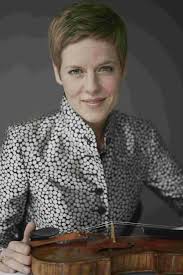
I Faust

Bach’s cello suites are regularly performed but the solo works for violin are far rarer. No wonder then that All Saints was sold out for a two part recital which included the three sonatas and three partitas for solo violin.

The works are as demanding of the listener as they are of the performer if one is to fully appreciate the complexity of the writing and the virtuosity of the soloist. Isabelle Faust opened in somewhat austere fashion with the Sonata No 1 in G minor, the Adagio having an acidic edge to it which was only relieved by the following Fuga. The Siciliana was equally reserved and introspective, a mood which continued until the flourish of the final Presto at last brought a touch of warmth.

The Partita No1 in B minor is in a different world altogether. A dancelike joy filled the opening Allemande and the second part (the double) had a charmingly floating, flowing line. The Corrente was more robust with the double positively racing at breakneck speed. Here, and in all the rapidly articulated passages, Isabelle Faust showed a technical mastery which was utterly captivating. The Sarabande returned us to a more reserved if not quite courtly style before the double produced a wandering, almost improvisatory, line which insisted we follow to the end. The final Tempo di Borea brought an unexpected liveliness and attack which continued through the double to the end of the work.

Sonata No2 in A minor is a more approachable work that the first, the opening Grave having a fine sense of lift to the phrasing and a wonderfully hushed ending. The Fuga built on this mood as it appeared to spiral ever further upwards before the sublime lyricism of the Andante unfolded in all its polyphonic splendour. The final Allegro had fire and a sense of virility which brought the first part of the evening to a magnificent and enthusiastically received conclusion.

In the second part, which followed almost two hours later, Isabelle Faust played the second and third Partitas and the third Sonata. Unfortunately I was not able to stay for these – very much my loss I am sure.