ENO: The Queen of Spades

London Coliseum, 6 June 2015

spades

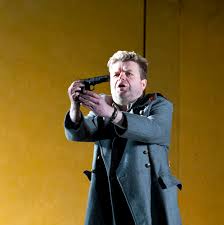
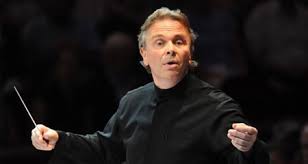
This was Edward Gardner’s last production as Music Director for ENO, though he returns next season for a new Tristan and Isolde, and it drew on all of the strengths he has shown during his time with the company. The orchestra was on exceptional form with a rich romantic sound throughout and the cutting intensity which is a particular quality of Tchaikovsky’s late score. Added to this was choral singing which was outstanding throughout, high quality soloists and a production that drew just a few boos at the end!

The conductor has worked closely with David Alden over the years and this new production was as challenging as we have come to expect. The easiest approach, I find, is to go with the flow. Don’t expect beds in bedrooms or bridges from which to commit suicide, and don’t be put off by furry animals appearing in the party scenes. After all, Hermann is insane, and while he may be less so at the start of the work than at the end, there is little doubt about his sanity. Gideon Davey’s deliberately ill-fitting set, painted in acerbic pastel colours, is lit throughout with a harsh cruelty by Wolfgang Goebbel to highlight the nightmare which surrounds Hermann.  The costumes drift across the centuries with little sense of connection except where they impinge on what is actually happening in Hermann’s mind. Peter Hoare is outstanding as Hermann. After a slightly shaky start the voice quickly settled and he produced ringing, often Wagnerian, tone with dramatic intensity which was entirely convincing. Giselle Allen’s Lisa is a lost soul, unsure how to react and buffeted by events around her. The claustrophobia of the settings aptly reflect the way the world closes in upon her to the point where she brutally kills herself rather than accept the on-going chaos. Vocally she is a fine foil to Hermann and grows in strength as the evening progresses.

Felicity Palmer’s voice does not reflect her age, and its stamina and subtlety are never in doubt. When on stage she is the centre of attention and effortlessly draws the focus towards herself.

The large cast of smaller parts are carefully individualised – some more effectively than others – but the insistence on so many smoking on stage, while possibly historically accurate, does raise inevitable concerns. The presentation of Pauline, a vocally strong Catherine Young, was simply confusing. The more naturalistic approach to Prince Yeletsky, a virile Nicholas Pallensen, was more pleasing.

This has been a superb season, running from Otello through The Pirates of Penzance to The Queen of Spades and the next season looks just as exciting and challenging.


Beethoven by the Sea

Bexhill Music Festival

Royal Philharmonic Orchestra, Brian Wright

De La Warr Pavilion, Bexhill, 4 June 2015

An all-Beethoven programme brought a full house to the De La Warr Pavilion on one of the most beautiful evenings so far this year. It was almost too nice to be inside, though the music-making more than made up for this. But we need to start with an honest appraisal of the problems facing any orchestra working in the De La Warr – the acoustic. While solo wind and brass instruments can carry where the string sound is light, there were times when the wind section all but vanished and the horns sounded as if they were coming from another room. This was all the more obvious in the opening Overture Leonore No3, where the ‘off-stage’ trumpet, from the gallery, was far more piercing and effective than the brass actually on stage. None of this was the fault of either the musicians themselves nor of Brian Wright who guided his forces with tact and virile enthusiasm throughout.

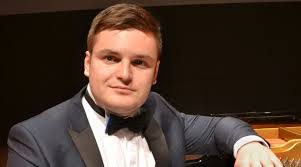
Brian Wright takes a very brisk approach to Beethoven, giving us a dramatically forceful reading of Leonore No3 before the Emperor concerto with Alexander Panfilov, winner of the 2015 Hastings Piano Competition, as soloist. The Yamaha, though not a full concert grand, is an impressively loud instrument though Alexander Panfilov tamed it when it came to more reflective passages. The second movement was particularly effective, with much subtlety of touch and phrasing, in marked contrast to the youthful enthusiasm he brought to the opening movement and the final Rondo. It was easy to see how he had won in Hastings and let us hope that his very warm reception will encourage this public concerto prize to become a regular feature. Young musicians of this quality certainly deserve it.

Alexander Panfilov

The surprise piece of programme planning was the inclusion, immediately after the interval, of another overture – Coriolan. The forceful and often anguished approach was effective, and allowed the more reflective second subject to be all the sweeter.

The symphony was the Fifth, which Brian Wright approaches with an excitement and fire which comes from very brisk tempi. As he notes himself, even his tempi are not as fast as those indicated by the composer but can seem challenging in a world of conductors who dwell in the moment but ignore the narrative pulse of the work as a whole. Beethoven’s Fifth should challenge us and this approach certainly did. The first movement burst into life leaving little time for reflection as we moved rapidly on to the climax. Cellos, placed firmly outside of the arch, benefited greatly and sounded superb in their solo passages. Where solo wind were able to penetrate they were equally effective and there was some sublime piccolo playing towards the end. The brass choruses were finely formed but again they were battling the proscenium arch and unable to create the bloom we hear regularly from this orchestra in other venues.

With playing of this quality, maybe next time the promoters will think more carefully about where they place the players to allow us to hear the musicianship we know this orchestra can bring. They deserve it as much as we do.


CDs June 2015

INTO THE STARS
FAIRHAVEN SINGERS, conductor RALPH WOODWARD 
GUILD GMCD7417 (69’14)


This collection of choral music commissioned for the Fairhaven Singers presents some beautiful music in a range of styles by some well-known contemporary composers. Although I enjoyed all the music here I found the move from the unaccompanied first half to the addition of The Will Todd Trio (piano, bass and drums) rather jarring. I wonder if this would have worked better at the beginning of the CD. The final arrangement of an English folk-song also seemed a little out of place.


SMITH & HANDEL – JULIAN PERKINS, harpsichord
CHANDOS  CHACONNE  CHAN 0807 (77’50)

This is a lovely combination of unfamiliar music played by a fine musician on an original single manual (c1770) and a modern (1982) double manual harpsichord. The use of the two instruments allows for more variety than in some recordings. The bulk of the CD consists of a premiere recording of music dating from 1755, John Christopher Smith’s Six Suites of Lessons for the Harpsichord, Op 3. This is preceded by an overture by Handel, Riccardo Primo, re d’Inghilterra . Despite loving the sound of the harpsichord I sometimes find a whole CD too much. This is not the case here. A very enjoyable performance.

POWER OF LIFE – CHRISTOPHER HERRICK, Metzler organ, Poblet Monastery, Tarragona, Spain
HYPERION  CDA68129 (67’08)

This recording takes its title from  the opening track, an energetic composition dedicated to the performer by Mons Leidvin Takle. The Disc is a complete mix of styles but the programme is constructed in such a way that it works incredibly well. Alongside music by Mozart, Dupre, SAont-Saens & Walton are less familiar names – Hans-Andre Stamm, Vincenzo Petrali , Franz Wagner and Marius Monnikendam. There is a beautiful arrangement of Amazing Grace by George Shearing & further arrangements of melodic pieces by Villa-Lobos and Warlock. A highly enjoyable collection.

GREAT EUROPEAN ORGANS No 93
KONSTANTIN VOLOSTNOV, WALCKER organ, Riga Dom, Latvia
PRIORY PRCD 1111

This is a lovely collection of “solid” organ music linking another impressive large-scale organ with expert performances from a Moscow organist and seven preludes and fugues. The Russian composers – Glazunov, Karatygin, Catoire & Goedicke flank a central prelude & fugue of JS Bach (D major, BWV 352). The Russian music dates from the early 20th century and there are clear influences from German organ music.  A useful addition highlighting a neglected area of the organ repertoire.

THE COMPLETE ORGAN WORKS OF THOMAS TERTIUS NOBLE Vol 1
JOHN SCOTT WHITELEY, organ of York Minster
PRIORY  PRCD 1116

The beginning of another complete works collection provides some interesting music in another set of convincing performances by an organist who knows this instrument well. There are several pieces based on popular hymn tunes, as well as some “light” programme music. Of particular interest are the Pastorale-Prelude on a Chinese Christmas Carol and Two Traditional Hebrew Melodies. The most substantial work is the final track, Introduction & Passacaglia. I look forward to the subsequent volumes.

GREEN & PLEASANT LAND – KEVIN BOWYER, organ of Woburn Parish Church
PRIORY PRCD 1131

This is a very personal project by Kevin Bowyer who, after being asked to give a recital on this organ, was so taken by it that he wanted to make a recording. The music here has been inspired by thoughts of what might have been played by organists who later ended up serving in the First World War, and is taken from a set of volumes of the monthly periodical, The Organ Loft (1900-1915). I really enjoyed this collection of pieces – none of which I had heard before. Interesting biographical notes are included for all the composers. Kevin Bowyer has often introduced listeners to new organ music. He does the same here. It is just that this “new” repertoire dates from a century ago!

SIGFRID KARG-ELERT – The Complete Organ Works Vol 12
STEFAN ENGELS, Steinmeyer organ, Marienkirche, Landau/Pfalz, Germany
PRIORY  PRCD 1088 (76’13)

This volume in the continuing series is an enjoyable programme in its own right. Stefan Engels’ masterful playing of this large Romantic organ makes for a very musical recital. This CD comprises three of the composer’s larger works – Trois Impressions Op 72, Partita for organ Op 100 and Homage to Handel Op 75.

L’ORGANO A FIRENZE DAI MEDICI ALL’UNITA D’ITALIA
(Organ music in Florence from the Medici period to Italy’s Unification)
GABRIELE GIACOMELLI,  organs of Basilica di San Lorenzo, Firenze
TACTUS  TC 860002 (79’03)

This CD presents a wealth of music presented in chronological order from  the late 15th Century up to the late 19th Century. Two organs are recorded, dating from 1773 and 1864 respectively. I was particularly interested to hear some of the earlier music. Whilst the performances are all very good I found the overall sound of this disc to be harsh and it quickly became wearing. Perhaps it is my English sensitivity but I expected some of this music to have a gentler feel. It is still an interesting recording but perhaps to be listened to in small doses.

ET IN ARCADIA EGO – Italian Cantatas & Sonatas by Handel, A Scarlatti, Lotti & Mancini
CONCENTUS VII (Emily Atkinson, soprano & instrumentalists)
RESONUS  RES10142 (67’16)

A lovely programme of Baroque secular solo cantatas and oboe concertos makes for an enjoyable listening experience. Much of this music is less familiar.

LENNOX BERKELEY – CHAMBER WORKS
BERKELEY ENSEMBLE
RESONUS  RES10149 (59’48)

I really enjoyed listening to this disc. The music here deserves to be much better known and appreciated. There are small ensemble pieces including a String Trio, Sonatine  (clarinet and piano) and a Sextet. Three pieces for solo viola take the listener into a different sound world. The Introduction and Allegro is for the unusual combination of double-bass and piano. In memoriam Igor Stravinsky (for String Quartet) gives an insight into one of Berkeley’s influences. The short Piece for flute, clarinet and bassoon provides a lovely way in to this programme.

SP June 2015



WNO: Pelleas et Melisande

Millenium Centre, Cardiff, 29 May 2015

pelleas

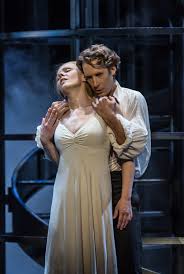
David Pountney seems to be back to his old form with this troubling and often enigmatic production of Debussy’s Pelleas et Melisande. If a first sight of the set, with its vast metal cage and hanging skeleton, is momentarily off-putting then the arrival of the protagonists puts one immediately at ease. Keeping closely to a world of fantasy, where the unusual remains unexplained, is a real strength throughout the evening. Melisande emerges, chrysalis like, to be discovered by Golaud, and the unfolding narrative makes no attempt to explain why things happen – they simply do as part of the cycle of life. The final scene, when both Melisande and the baby disappear gently before our eyes and we are returned to the opening state, a hand emerging from the chrysalis like a flower coming gently into bud, is the most optimistic reading of this work I can recall.

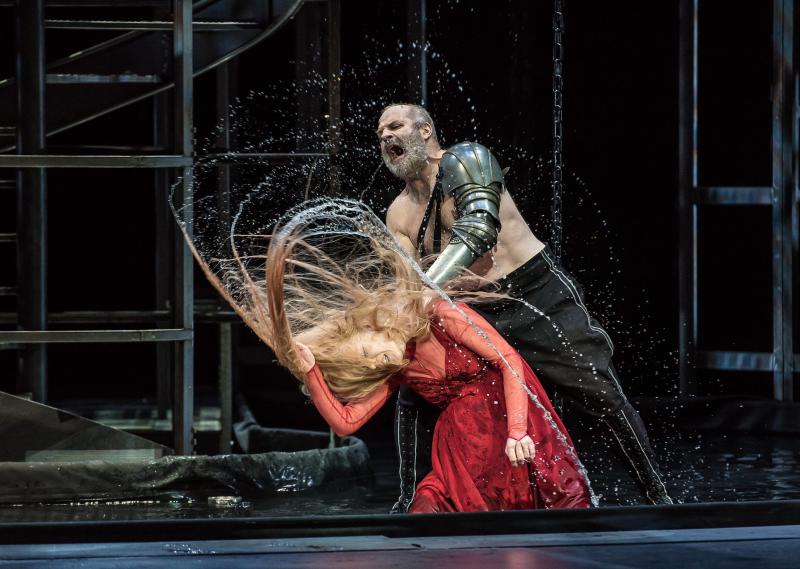
Along the way there are many telling moments. Water, so heavily noted in the text, is ever present and the singers spend much time moving through it or into it. Golaud’s vicious attack on Melisande seems all the more unsettling for the way in which she is drenched by its conclusion. There are also frequent moments of telling insight. The parallels with Parsifal are there as the wounded Golaud/Amfortas is brought water by Melisande/Kundry. It emphasises the sense that Melisande is an unknown quantity with a whole history which we can never really comprehend. Rather than exiting and keeping Je ne sais pas heureux to herself, she says it directly, and almost naively to Golaud. When she insists Pelleas tell the truth, she looks at her ring finger.

pelleas 2

Throughout Jurgita Adamontye is an enigmatic Melisande without ever being waif-like. Her very physical presence makes her all the more enigmatic. Her Pelleas, Jacques Imbrailo, is by contrast almost impossibly naïve at the start – a little boy who is at odds with the complex relationships of an adult world. He grows visibly as the story unfolds and is only just at the point of maturity when he is killed. It is a wonderful piece of characterisation and completely convincing.

Christopher Purves is a troubled Golaud, his passion often at odds with his authority until it breaks through and destroys everything he loves. The scene with Yniold – a touching Rebecca Bottone – is masterly as Golaud tries to force his son to admit to things which probably did not happen but which are anyway beyond the boy’s understanding.

Leah-Marian Jones as Genevieve and Scott Wilde as Arkel create a secure framework within which events are allowed to unfold, their presence at the end marking the continuity from one generation to another even in the face of death.

Johan Engels metal cage works surprisingly well and is superbly lit by Mark Jonathan, allowing the day light to creep in at the right moments but never overtake the darkness – even when the stars are out. In the pit Lothar Koenigs provides a subtle and luminous account of the score and one which I would be very happy to encounter again.

After a few less than convincing evenings this is WNO at its best again.

Photos WNO Clive Barda

Waterloo Day Celebrations

WATERLOO DAY     SATURDAY 20 JUNE 2015 

COMMEMORATING THE 200TH ANNIVERSARY OF THE BATTLE OF WATERLOO AND THE KING’S GERMAN LEGION IN BEXHILL

Manor Barn, De La Warr Road, Bexhill Old Town TN40 2JA

12.00 to 18.00  –   Free Admission

THROUGHOUT THE DAY: –

  • HANDS ON HISTORY – ‘living history’ activity and equipment,
  • Exhibition of military equipment, model of battlefield, information on King’s German Legion and historical context, recorded music.
  • Refreshments

EVENTS IN MANOR BARN

From 12.00    Soldiers Lunch – Soup and roll

13.00   Slide Show   ‘Bexhill and Kings German Legion’ – Peter Cole

14.00   FORMAL OPENING CEREMONY

by Duke of Wellington & Napoleon Bonaparte

From 14.30   Cake and mug of tea

14.45 – 15.15    DVD screening, Part 1: the approach to Waterloo

15.30 – 16.10    CONCERT featuring the NEW SCORPION BAND

‘FROM BEXHILL TO WATERLOO’

Act 1, The Story of the King’s German Legion in Bexhill 1804 – 1814

16.30 – 17.00    DVD screening  Part 2: The Battle of Waterloo

17.20 – 18.00    CONCERT   Act 2, The KGL at Waterloo

Waterloo Day is organised by the Bexhill Hanoverian Study Group.  Manor Barn is sponsored by the Bexhill Old Town Preservation Society; visit their exhibition at nearby Barrack Hall.

Information / Enquiries:  John Dear   jdear@outlook.com

And   www.bexhillhanoveriankgl.co.uk

RAMBERT DANCE COMPANY TO WORK WITH GARSINGTON OPERA

As the curtain goes up on Garsington Opera’s fifth season at Wormsley, Douglas Boyd, Artistic Director, is delighted to announce the 2016 season which will include a collaboration with the dance company Rambert on Haydn’s The Creation.  The season will also feature a further three new productions:  Tchaikovsky’s Eugene Onegin, conducted by Douglas Boyd and directed by Michael Boyd, Rossini’s L’italiana in Algeri conductor David Parry, director William Tuckett and Mozart’sIdomeneo with Tobias Ringborg conducting and Tim Albery directing.

Rambert  will be the first dance company to appear on the stage at Garsington Opera.  Together with Garsington Opera orchestra, chorus and soloists, Haydn’s masterpiece The Creation will be conducted by Douglas Boyd and brought to life by choreographer Mark Baldwin, who is Artistic Director of Rambert and visual artist Pablo Bronstein.

Douglas Boyd said:  We want to celebrate our wonderful Opera Pavilion and Garsington Opera in every possible way and I am delighted to be collaborating with Rambert.  Bringing together different art forms is something that I believe enhances and compliments our opera festival as we continue to explore partnerships with some of the most vibrant arts organisations of our time.

Mark Baldwin said: Music and cross art-form collaboration have always been an integral part of Rambert’s work and a particular passion of mine. I am hugely excited to be collaborating with Garsington Opera and Pablo Bronstein on this very special project which will see Rambert’s world-class dancers join the incredible Garsington soloists, orchestra and chorus. I believe this will maximise the creativeness and beauty of Haydn’s masterpiece and prove to be a glorious and uplifting experience.

David Pickard appointed Director of the BBC Proms

David, 55, is currently General Director at Glyndebourne and will take up his new role later this year, reporting to Alan Davey, Controller of BBC Radio 3.
D Pickard

Edward Blakeman, Director, BBC Proms 2015, will continue to lead the festival throughout this year’s season and ahead of David’s arrival.

Helen Boaden, Director of BBC Radio, says: “David has an outstanding track record in bringing new audiences to classical music, as well as a background in both orchestral and operatic music. I am absolutely delighted he will be working with Alan to build on the success of the BBC Proms. I would also like thank Edward Blakeman for leading the Proms with skill and flair as Director, BBC Proms 2015, and on delivering another excellent programme this year.”

Alan Davey says: “David comes from a background of musical excellence and exploration, and will bring a whole host of fresh ideas to help us ensure the greatest classical music festival in the world continues to provide the place for people to discover and rediscover the best classical music. His achievements at Glyndebourne have included the discovery of exciting new artistic talent and the establishment of a range of new initiatives to bring opera to wider audiences through Glyndebourne’s touring, education and digital activities.

Garsington Opera on Screen

Garsington Opera’s 2015 production of Così fan tutte will have free screenings in three coastal communities Louth (5 July), Grimsby (29 Sept) and Ramsgate (Oct), as well as in Oxford (2 July) and Waddesdon (3 September).  Their 2014 production of Offenbach’s Vert-Vert will also be screened at Marlow Festival (14 June).

These free public screenings, together with extensive education projects, are part of the Garsington Opera for All programme, set up by Magna Vitae and the Coastal Communities Alliance after a successful bid made in the autumn to Arts Council England.

Garsington Opera for All  will work with secondary and primary schools for a week in each area where the film will be screened.   Each project will see the young people developing their own short opera based on the themes of Così fan tutte, devising and composing their own production and their residency will end in a performance to the school. All the participants will come to the screening of the opera.  On the day of the opera screening Garsington Opera will work with up to 40 adults from the community to learn and explore themes on Così fan tutte, to produce a 5-10 minute promenade performance.

Garsington Opera’s production of Così fan tutte features international star Lesley Garrett in the role of Despina, Romanian soprano Andreea Soare (making her UK debut)and Kathryn Rudge in the roles of Fiordiligi and Dorabella.  The award-winning Irish tenor Robin Tritschler (Ferrando) and Ashley Riches (Guglielmo), a former Jette Parker Young Artist, allow themselves to be drawn into the intrigues of their cynical friend Don Alfonso, sung by Welsh bass-baritone Neal Davies, who persuades them to put the love of their fiancées to the test. Garsington Opera Artistic Director Douglas Boydconducts, John Fulljames, Associate Director of Opera at the Royal Opera House directs and Dick Bird designs.

SCREENING DETAILS

MARLOW                  Sunday 14 June 7.30pm        Marlow Festival Enclosure

OXFORD                   Sunday 2 July 6pm                 Magdalen College Fields

LOUTH                       Sunday 5 July 1.30pm            SO Festival, Westgate Fields

GRIMSBY                   Tuesday 29 Sept 12noon        Grimsby Auditorium

WADDESDON           Thursday 3 September           Waddesdon Manor

RAMSGATE              October                                   Ramsgate Arts

Brighton Festival:

Janacek & Shostakovich

Halle Orchestra, Brighton Festival Chorus, Mark Elder

Saturday 23 May, 2015

mark elder

Janacek gives us such life and vitality in his scores they can hardly fail to leave an audience uplifted. When these are combined with the enthusiasm and joy of Shostakovich’s Concerto for Piano, Trumpet and Strings, we are bound to leave feeling better.

The Halle opened with the Suite from The Cunning Little Vixen where the warmth and sweetness of the score was allowed to glow within the ambience of the concert hall rather than being restricted to the opera pit. Mark Elder kept the pace firmly in hand so that the softer moments never tipped over into sentimentality but there was never any sense of the academic to the playing.

I first encountered Shostakovich’s concerto when I worked, almost half a century ago, for a ballet company where we had a work set to it called Attitude Greque. It was as tongue in cheek as the score itself and always a favourite. Pianist Benjamin Grosvenor was joined by the Halle’s first trumpet Gareth Small for an exhilarating romp through the score which shows the composer at his most relaxed. The combination really should not work but it does because of the sustained invention of the musical line and the insistence that we do not take it too seriously. The slow movement was beautifully phrased and gave way to a riotous conclusion. All perfectly conceived and delivered.

The Glagolitic Mass is deceptive. Though Janacek was an atheist the work comes across as emotionally more convincing than many settings from committed believers. There is an urgency, a fervour, to the score which was beautifully captured by all involved, particularly the incisive choral singing and the strident tessitura of tenor Peter Berger. Darius Battiwalla was the organist for the extended impassioned organ solo towards the end of the work. The brass section was a delight throughout, producing raucous fanfares and ear-splitting power as required. in these hands the score seems at times to be almsot uncomfortably modern.

As the main classical offering of the Festival this year it was a fine evening, and appeared to be sold out with a queue waiting for returns. Perhaps there is a need for more?