CD REVIEWS – November 2015 – 2

DANCING DAY – MUSIC FOR CHRISTMAS
Choir of Men & Boys of ST THOMAS, FIFTH AVENUE, NEW YORK
JOHN SCOTT, Conductor
SARA CUTLER, Harp,  STEPHEN BUZARD & BENJAMIN SHEEN, Organ
RESONUS RES10158 (63’58)

This is a lovely recording of seasonal works from the 20th and 21st Centuries based on medieval texts and melodies. There are two main works – Britten’s A Ceremony of Carols & Rutter’s Dancing Day. Both of these also feature the harp which adds a further link to the past and variety of timbre. The CD opens with Matthew Martin’s lively Novo profuse gaudio. There is a poignancy to this release in that it includes an arrangement by the much lamented Philip Ledger of the Sussex Carol and that John Scott died unexpectedly in August. A lasting record of John Scott’s work with this choir.

NOVA! NOVA! – CONTEMPORARY CAROLS FROM ST CATHARINE’S
Choirs of ST CATHARINE’S COLLEGE, CAMBRIDGE
EDWARD WICKHAM, Conductor,  WILL FAIRBAIRN, Organ
RESONUS RES 10159 (66’00)

Edward Wickham presents the girls choir and mixed student choir in a programme that mixes the sacred and secular, as carols have done for centuries. Some of the carols are commissions for St Catharine’s. Many familiar contemporary composers are featured including Sally Beamish, John Tavener, James MacMillan and Roxana Panufnik. Two extended compositions are included – Christopher Fox’ A dream of winter and Stevie Wishart’s Three Carols. These together with six other carols are world premiere recordings. An interesting showcase of recent Christmas compositions.

L’ORGUE SYMPHONIQUE – FRENCH ORGAN WORKS FROM WINDSOR CASTLE
RICHARD PINEL, Harrison & Harrison organ, St George’s Chapel, Windsor Castle
RESONUS RES 10160 (74’40)

Fine examples of French symphonic organ works are to be found on this CD. Richard Pinel  presents a wonderfully evocative programme, showing his own musicianship and the suitability of this organ for this repertoire. Roger-Ducasse’s one movement Pastorale follows the contrasting five movements of Vierne’s Symphony No 2 in E minor. The disc ends with Durufle’s Suite, Op 5 which begins in dark, brooding fashion and ends with a brilliant Toccata. I really enjoyed this CD.

J.S.BACH ORGAN WORKS VOL 3
ROBERT QUINNEY, Metzler organ of Trinity College Chapel, Cambridge
CORO  COR 16132

The two previous Bach volumes by Robert Quinney have presented interesting and well balanced programmes, sympathetically played on this beautiful new organ. This volume does not disappoint. Here we have Fantasia & Fugue in G minor, 3 Preludes on Nun komm, der Heiden Heiland, Pastorella, Prelude & Fugue in C (BWV547), Canonic variations on Vom Himmel hoch and Prelude & Fugue in G (BWV541). There is a freshness to some of these recordings even when the music is quite familiar. Lovely!

J S BACH – 18 LEIPZIG CHORALES
ALEXANDER KNYAZEV, Walcker organ of the Riga Dome
MELCD 10 02397 (106’58) (2 CDs)
I haven’t encountered many Russian organists so it was good to find this CD from Alexander Knyazev, who graduated from two Russian conservatoires specialising in a different instrument at each – organ and cello. Here we have a complete recording of Bach’s so-called Leipzig Chorales – part of a collection of revised compositions from throughout his life which Bach made in the last decade of his life, selected as being particularly significant to him. Although performed very well I didn’t initially like the sound of this recording. The cavernous acoustic made for some indistinct lines and overall blurriness. However, the varied registration and sympathetic interpretation of these settings drew me in. A welcome addition to the host of recent all-Bach releases.
CHARLES-MARIE WIDOR – THE ORGAN SYMPHONIES VOL 4
JOSEPH NOLAN, Cavaille-Coll organ of La Madeleine, Paris
SIGNUM CLASSICS SIGCD337 (98’03) 2 CDs

Joseph Nolan’s complete Widor symphonies cycle continues with this 4th volume. Symphony No 7 Symphony No 8 are featured on this double CD. Both large scale works are expertly performed here on an authentic instrument. Mr Nolan’s performances allow this music to truly come alive and to appear fresh and exciting. Vol 5 is due to be released very soon. Music to be immersed in.

MASAAKI SUZUKI PLAYS BACH ORGAN WORKS
Schnitger/Hinz organ in the Martinikerk, Groningen, The Netherlands
BIS BIS-2111 (79’26) Hybrid CD/SACD

A new recording of organ music by JS Bach is not an uncommon thing. I often wonder why so many recordings continue to be made, especially when they feature Toccata & Fugue in D minor, BWV565. However, good programming, mixing the familiar with the less so and with variety of style and registration, performed by a sympathetic and talented organist on a  splendid instrument, can still excite and entertain. Such is the case with this CD from Masaaki Suzuki on the Groningen organ. The recording is superbly produced.  The programme includes the extended Pastorale in F major, Partita: O Gott, du frommer Gott and the Canonic variations: Vom Himmel hoch da komm’ ich her’ alongside the E minor and G major Prelude & Fugue and the Fantasia in G major.

MAX REGER – COMPLETE ORGAN WORKS
Christian Barthen, Stefan Frank, Bernard Haas, Hans-Jurgen Kaiser, Edgar Krapp, Ludger Lohmann, Wolfgang Rubsam, Josef Still, Kirsten Strurm & Martin Welzel
organs of  Evangelical Church, Giengen an der Brenz – Fulda Cathedral – Trier Cathedral – Passau Cathedral – St Martin’s Cathedral, Rottenburg am Neckar – Christuskirche, Mannheim – Rockefeller Chapel, University of Chicago.
NAXOS 8.501601 (over 19’) 16CDs

Described as “the greatest German composer for organ since Johann Sebastian Bach” Reger’s catalogue is prolific. Here Naxos has created a wonderful collection of his complete organ works. Large scale compositions include the Symphonic Fantasia & Fugue & Fantasy & Fugue on B-A-C-H. Alongside these are the exstensive chorale settings and smaller scale pieces . The use of twelve organists and seven different instruments brings added variety and interest to this most useful and well-presented set. A very useful reference work as well as a source of hours of entertainment and inspiration.

SP
PULL OUT ALL THE STOPS – 2

THIERRY ESCAICH
Royal Festival Hall, London 2nd November 2015

THIERRY ESCAICH

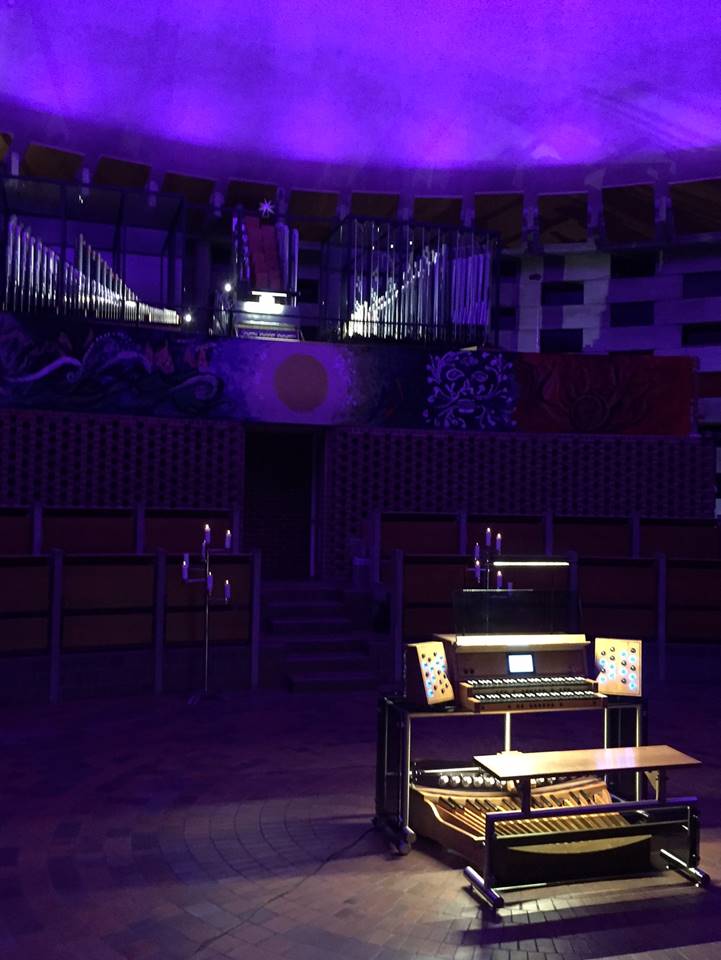
After the brilliantly eclectic opening concert with James McVinnie and members of Bedroom Community in September the series continued with a solo concert from French virtuoso Thierry Escaich. As well as being a well established performer he is rightly known as a skilled practioner in the art of organ improvisation.

The evening opened with a flamboyant rendition of Bach’s Toccata & Fugue in D minor (Dorian). This left the audience in no doubt about the power of the RFH instrument or of Mr Escaich’s ability to control it. To my ear the pedal line in the fugue could have benefitted from a more positive registration.

Two contrasting movements from Vierne’s Symphonie No 4 in G minor allowed some different voices to be heard. In Alain’s Variations sur un theme de Clement Jannequin we were taken back in time to a Renaissance sound world, albeit with 20th Century interventions. There was some beautiful registration here. The second piece by Alain, Litanies, (“an incessant repetitive musical prayer”), was given a passionate rendition, mostly at breakneck speed.

The second half really allowed Thierry to showcase his skills as an exciting performer, arranger and improviser together with much more variety of registration, style and mood.

His own arrangement of Liszt’s Les Preludes opened in dramatic style but also had moments of intense beauty. There were bombastic pedal reed passages contrasting with ethereal tremulant flutes. A very exciting and engaging performance, as was the extended improvisation, Tryptique (on given themes). Throughout Thierry masterfully wove contrasting rhythmic and harmonic ideas using a variety of registration and contrasts of style and dynamic. The second melodic fragment, Scarborough Fair, kept reappearing in a variety of surprising guises. A wonderful experience.

A brisk encore followed the enthusiastic applause of the appreciative audience, bringing a very entertaining evening to a close.

The next concert in the series features David Titterington on February 8th 2016.

Stephen Page in Battle

Emmanuel Centre Battle, 31 October 2015

S Page Battle Oct 15 (7)

Stephen gave the last recital in the old Methodist Church and has now given this first organ recital in the new Emmanuel Centre, though the organ is the same and he opened with the final work heard in the old church – Karg-Elert’s Choral Improvisation on Nun danket.

If the organ is not quite up to the rigours of late romantic music it certainly has enough scope to provide some very beautiful sounds, particularly in more reflective works. In the first half Martin Howe’s Elegy and two choral preludes by Michael Corah were particularly effective. The three pieces by Bach also demonstrated the strengths of the organ in a bright reading of Wir glauben all’an einen Gott and a briskly cheerful Badinerie.

The second half brought a more relaxed feel with Saint-Saens’ Danse Macabre setting a proper mood for Halloween before the softer tones of Howells’ Preludio sine nomine. A lengthy tribute to John Williams allowed us to spot the tunes from a wide range of popular block-busters, with Harry Potter sneaking in between the super-heroes. The final piece was a splendid coming together of the popular and the classical with Lefebure-Wely’s Sortie in E flat.

The large audience responded with enthusiasm and looked forward to further events in this new but already highly valued venue.

Oxford Lieder Festival 2015

With events running over two weeks and not a single day starting later than lunchtime it is impossible for even a hardened lieder-lover to really do justice to the Oxford Lieder Festival. I spent two whole days this year and managed to take in eight concerts which were clearly focused on the main theme of the festival – Singing Words, poets and their songs.

Lunch with Faure and Schubert

NICHOLAS MOGG

The two lunchtime recitals on Wednesday and Thursday 28-29 October, focussed on songs by Faure and Schubert. The first was given by baritone Nicholas Mogg, who won this year’s Oxford Lieder Young Artist Platform and it was easy to see why, as not only is the voice remarkably well focused but his presence is alive and he communicates warmly,  introducing the songs with relaxed confidence. He brought a profound yearning to Faure’s Vaisseaux, nous vous aurons aimes en pure perte and a sensitive integrity to Schubert’s An die Musik. I look forward to hearing him again soon. He was very ably accompanied by Jams Coleman who showed a keen ear for the dynamics of the recital, coming into his own with the more dominant writing for Faure’s Serenade.

The following day brought us two singers from the National Opera Studio, Katherine Crompton and Hann-Liisa Kirchin. Soprano Katherine Crompton had asked our indulgence as she had been suffering from a throat infection but this did not seem to inhibit the charming rendition of Faure’s Mai or the sentimental Noel.  Mezzo-soprano Hann-Liisa Kirchin impressed with the more powerfully emotional pieces, filling out Faure’s Au bod de l’eau with operatic enthusiasm and bringing real power to Au cimetiere. By contrast there was an unnerving simplicity to Faure’s Les trois soeurs aveugles.

Settings of Thomas Hardy

N Pritchard

A new venture this year has been the inclusion of a number of free recitals, given in Exeter College Chapel. These focused on a single composition within a limited time-frame to given those who might be hesitant of hearing a complete song recital a taste of what is in store. In the event they proved to be the best events I attended across the two days, starting with a magnificent performance of Britten’s Winter Words from tenor Nick Pritchard accompanied by festival director Sholto Kynoch. If there is was ever a need to demonstrate the close relationship between words and music these surely do it. Nick Pritchard brought great clarity to the text, within quite a difficult acoustic, and his body language enhanced the impact of his voice. In The little old table he found an emotional intensity which is not immediately obvious in the text and was deeply moving in the gentle sensitivity of The Choirmaster’s Burial. If there is pessimism here, as so often in Hardy, it is lifted by the universality the score brings to the text, none more so than the final Before Life and After. This was a splendid occasion and if anybody was hearing lieder for the first time this could not surely have been a better start.

That afternoon baritone Benedict Nelson brought us Gerald Finzi’s settings Earth and Air and Rain. Deeply romantic in style, the verse concentrates on a range of Hardy’s rural voices, from the folksy Rollicum-rorum to the reflective In a churchyard. Though there was no obvious problem with his voice, the text did not carry well and it was, retrospectively, obvious just how clear Nick Pritchard had been earlier in the day. This did not matter too much as we had the text before us but may matter more if Benedict Nelson wants to be comprehensible without us having our heads buried in the programme.

These two concerts really did reflect the sensitivity of the composer to the text, something which we would come back to later in the day.

Strauss & Chopin

Festivals can often find a place for an oddity and Richard Strauss’ Kramerspiegel is certainly that. Roger Vignoles gave us an extended introduction to the work as it has a fine back-story. In the days when copyright was a far more difficult process, composers often found themselves obliged to hand over works to publishers with whom they no longer wished to work. Strauss found a way round this by writing a song cycle which attacked publishers, hoping that his own would refuse to publish and thus get him out of his obligation. Readers will need to look up the history for themselves, but it will be worth doing so for the fun of it alone. Suffice it to say that there is great play on the names of publishers, most of whom fortunately have names which are also animals or objects eg Bock – Goat. Strauss has great fun with these, as did we listening to them from Elizabeth Watts, whose sense of humour shone through as well as the voluptuous voice she brings on all occasions. Roger Vignoles delighted in highlighting the musical allusions (much here toying with Rosenkavalier etc) and providing sterling and vigorous support throughout.

Late on Wednesday evening Imogen Cooper gave us a little respite from the voice with an all Chopin recital in the Ante-Chapel of New College. Of a finely crafted programme the Fantasie Op49 was exceptionally beautiful, and the final G minor Ballade left us wanting more even though it was close to midnight.

Wildflowers and A Shropshire Lad

The two main evening recitals, though they brought the largest audiences, were both problematic. Anna Stephany’s concert on Wednesday evening seemed unbalanced and bity. While her singing was not at fault the long narrative of Haydn’s Ariann a Naxos was surprisingly unmoving though the nobility of Schubert’s Lied eines schiffers an die Dioskuren somewhat made up for this.

The second half opened with the world premiere of Rhian Samuel’s Wildflower Songbook , settings of poems by Anne Stevenson. Throughout the three songs the vocal setting is more lyrical than the accompaniment so there is a continuous underlying tension between text and music. This often works well, particularly when there is a sudden coming together emotionally as at the shell-frail colour of harebells, but at other times can make for more uncomfortable listening. On a first hearing, the whimsical charm of Digitalis impresses and it would be good to hear the cycle again to get a better feel of its merits.

Of the rest of the programme, the Sibelius songs had the power of simplicity, and Michael Head’s Foxgloves and Sweet Chance were particularly beautiful. Sholto Kynoch was the accompanist demonstrating yet again great versatility and sensitivity whatever he is called upon to play.

The final event I attended also proved to be the most contentious. On paper, performing Housman’s A Shropshire Lad, interpolating settings of the poems as the evening proceeds, should be a simple matter. In the event it was something of a dog’s dinner. While individual items impressed the whole simply did not hang together. It was also deeply hampered by the introduction of regular auto-biographical details which gave an un-necessary slant to the text which we were experiencing. If we add to this the wide range of settings, the whole was, in essence, a mess. C W Orr’s Wagnerian approach, many of his settings soundly distinctly sub-Tristan, sat uncomfortably beside John Ireland and Vaughan-Williams. Not that the voices helped. The three male singers, all in evening dress, seemed intent on presenting the songs like Edwardian ballads rather than the potential simplicity, even naivety which the texts imply. Graham Johnson had pointed out at the start that Housman’s verse is almost entirely monosyllabic and there is a reason for this which goes to the heart of the work. The further one gets away from the simplicity the less effective the texts become. I am very glad to have encountered this performance as I had often thought I would like to mount the cycle using the songs. There is no problem with the poems, there is no problem with the settings by their individual composers, but putting them all together is, in retrospect, a mistake, from which I hope we all can learn.

After so much that had been outstanding over the 48hours I was in Oxford, it seems a pity to end on a sour note. I’m just glad that the Festival draws our attention to so many fine young singers and to works which we might otherwise never hear.

Next year’s Oxford Lieder Festival runs from 14 – 29 October and will bring us the complete songs of Robert Schumann. As a warm up, there will be a Spring Weekend of Song, 4-6 March 2016 which will include the auditions for the Young Artist Platform. 

Prince Regent’s cello heads to Brighton Dome for special concert

311-year-old instrument to be played at Brighton Philharmonic Orchestra concert.

A cello once owned and played by the Prince Regent, later King George IV, is to feature in Brighton Philharmonic Orchestra’s November concert at Brighton Dome. The instrument, made in Naples in 1704 by Alessandro Gagliano, was allegedly given to George as a gift by the King of Spain. Considered a “very superior” player of the cello, the Prince Regent studied with the leading cellist of the day, John Crosdill, with the instrument itself kept at the Royal Pavilion.

Whilst little is known about Gagliano, the instrument itself was the subject of an article titled ‘Fit for a king’ by John Dilworth in The Strad in 1997. Dilworth wrote that the instrument ‘has a living quality which changes with the light, the season and the time of day’ and describes the wood, workmanship and tone as being of ‘the highest order, a level which Gagliano did not always maintain’.

The cello may have been one of the number of instruments in the possession of the Royal Family that were sold around 1913 as a contribution to the war effort. It came into the possession of Hills of London, who restored the instrument and retained it in their collection until it was bought in 1941 by Boris Rickelman, Principal Cellist with the London Philharmonic. Since then it has been in the hands of a number of players.

The instrument heads back to Brighton courtesy of the exciting young cellist Gemma Rosefield, who joins Brighton Philharmonic Orchestra on Sunday 8 November 2015 to perform Tchaikovsky’s “Variations on a Rococo Theme”. The concert starts at 2.45pm, with a pre-concert interview with Gemma on stage taking place at 1.45pm. In addition to the “Rococo Variations”, the programme includes Elgar’s “Sanguine Fan” and Schubert’s “Symphony No.9 – the Great”.

Sussex University Organ restored

A Lunchtime recital offers the first opportunity to hear the Meeting House organ after major refurbishment

Sussex Uni organ

A lunchtime recital this week offers the first opportunity for students and staff to hear the iconic Meeting House organ being played after a major refurbishment. It also marks the appointment of D’Arcy Trinkwon, an international concert organist and the organist at Worth Abbey in West Sussex, as the University’s new organist. Mr Trinkwon’s first concert in the Meeting House chapel – a varied programme including Mozart’s Fantasia in F minor – will be on Wednesday (28 October) at 12 noon. Monthly recitals will then take place on the last Wednesday of each month – with the exception of December, of course.

This summer’s overhaul of the organ – the most comprehensive since it was made nearly 50 years ago – involved several months’ work by expert specialists, who painstakingly removed and cleaned each of the 1,546 pipes and replaced the original 1960s wiring and electrical equipment.

Paul Hale, an organ consultant who advised the University on the project, describes the instrument as “a modern organ but inspired by historical sounds”, and adds: “It is one of the leading instruments of its period but now brought up to date.”

A cutting-edge wireless console (one of only two in the country) and MIDI system has been installed, which means, says Mr Hale, that the organ will “deal better with the uses it might be put to as music technology develops”. For example, the organ can now also be used to play any other instrument, so it would be possible to have a piece for organ and other sounds. Even before the latest enhancements to the instrument, it was considered by experts to be an excellent example of the school of neo-classical organ design and construction in Britain. “It is particularly important as the number of completely new organs made in this style was small,” explains Mr Hale.

Some of the organ’s visually striking features (including plate-glass enclosures with a black metal framework, as well as the black finish to the organ console) have been commented on by observers and constitute part of its iconic and now historic significance.

If you would like to see and hear the organ in its resplendent new state, do come along to Wednesday’s debut recital – and feel free to bring your lunch, too. The organ will of course also play a central role in the annual Carols by Candlelight, to be held this year on Sunday 6 December. In addition, a number of organ concerts and other events are being planned for 2016, to mark the 50th anniversary of the Meeting House.

And now that the historic organ has been brought into the 21st century, Mr Hale expects it to require nothing more than routine tuning for a further 30 years. In fact, he predicts that the renovation will “enable the instrument to perform reliably and musically for the next 50 years”.


Peter Copley performances

Peter Copley

Recent compositions by Peter Copley can be heard as noted below

On Saturday 31 October at 5pm (please note the start time)

St Nicholas’ Church, Dyke Road, Brighton – a collaboration with the Riot Ensemble – music for flute, oboe, harp, percussion, violin, viola and cello.

The programme will be centred around Jonathan Harvey’s beautiful and haunting Death of Light, Light of Death (Jonathan Harvey was an enthusiastic supporter of NMB and an Honorary Members) and will include works by Helen Grime (Oboe Quartet), David Lang (Lend/Lease for piccolo and woodblocks) and NMB composers:

Peter Copley                     In memoriam
Phil Baker                         Sequentia III
Patrick Harrex                  … dreams, shadows, and smoke
Jonathan Clark                 Fragment for a Violin Concerto 

Tickets (on the door) £10

On the 7th November, the Musicians of All Saints will give the first complete performance of ‘A Copper Garland‘ – six folksongs from the Copper family songbook freely arranged for string orchestra.

Saturday 7 November 2015 7.45 p.m.

All Saints Centre, Friars Walk, Lewes

Directed by Andrew Sherwood

Vivaldi             Flute concerto Op.10
(Soloist Anne Hodgson)
Peter Copley  A Copper Garland
Mozart           Divertimento in B flat Major (K.137)
Janácek        Suite for Strings

WNO: Madness

As David Pountney notes in his introduction to this new season, Madness is possibly more endemic to opera than any other emotion. The three works which make up the autumn season focus on very different forms of madness but are none the less more closely connected than recent seasons, some of which have seemed somewhat fanciful in their linkage.

Orlando

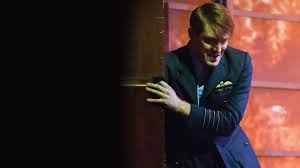
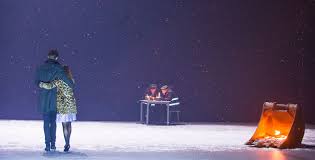
Handel’s Orlando, which I caught at the Bristol Hippodrome on 21 October, centres on the madness of the hero when confronted with the polarity of love and duty. Harry Fehr’s production moves the action to somewhere during World War II and a military hospital. Though this may seem too far from the mythical medieval realm of the original story it works remarkably well. Orlando, a fighter pilot, is seen dealing with the demons that war brings and the ensuing mental breakdown. The anonymity of a hospital, the almost surreal calm and staff going about their duties, ignoring the passion raging before them, makes sense both of the narrative and the intensely personal music which Handel provides. Arias are inner monologues rather than narrative devices and we have many glorious moments of intense beauty and – frequently – pain.

The production also highlights the importance of Dorinda, radiantly sung by Fflur Wyn. A staff nurse, she has little importance in the hierarchy but her sensitivity sees to the heart of the situation even when she herself loses by it. Her Nightingale aria at the start of act two was exquisite. But there were no weaknesses in the cast with Lawrence Zazzo a noble hero, Rebecca Evans ever so slightly snobbish as Angelica, but one whose pain we feel, and Robin Blaze a finely understated Medoro. The premise of the hospital is held together by the figure of Zoroastro, in this case the senior consultant, who guides his staff to allow nature to take its course. The only low voice in the cast he added a genuine gravity to the excesses of emotion around him.

There is no pit in the Birmingham Hippodrome which helps baroque works, though the orchestra under Rinaldo Alessandrini seemed larger than is needed to be. Not that this provided any lack of balance with its carefully moulded musical lines and the plethora of ornamentation coming from the stage.

sweeney

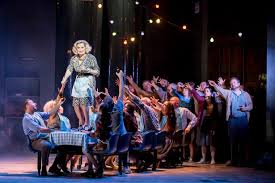
The following night was the first of three performances of Sondheim’s Sweeney Todd. It is obvious that this is excellent box-office for WNO as the house was packed and enthusiastic. I have always liked Sondheim though we seem to have had rather a lot of Sweeney’s recently. While this was efficiently staged and well sung throughout I found myself wondering if the work was not somewhat more limited in scope than I had been led to believe. I have yet to see a production which gives me any real alternative insight into the characters. James Brining’s direction highlights the idea of madness by setting the opening in Bedlam and coming back to this on a number of key moments during the work, but they are hinted at rather than used. Maybe the whole evening could have been set within Bedlam – like the Marat/Sade – which would give another nuance to the text but, no, we were on very familiar ground. The containers which make up the set mirror the anonymity of the killings and a world in which things, and people, can be moved around unnoticed, but this did not impinge itself on the action as such.

Janis Kelly is as good a Mrs Lovett as one could wish for with a keen sense of humour as well as a real moral ambivalence. Other characters are more two dimensional, though Aled Hall makes a sleazy and nasty minded Beadle. In the lead, David Arnsperger looks good and sings well as Sweeney but never really convinces us that he is a drive man – close to the madness which is supposed to lie at the heart of the season.

Apollo Theatre, Oxford, 3 November 2015

I puritani

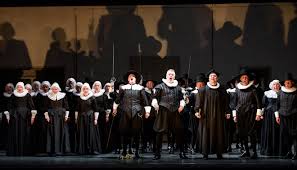
Madness is even more at the heart of Bellini’s I Puritani than either of the other two works in this season, for the heroine goes mad in each act. This becomes the lynch-pin for Annilese Miskimmon’s production as Elvira is never really sane across the whole evening. Setting the naturalistic story line in Ulster during the troubles makes sense of the civil war and gives an added bite to what might be romantically historical. We start in a bleak church hall where the Orange Order are assembling for a parade. As Elvira descends even further into hallucination we drift back to the seventeenth century and the hall physically collapses around her. This is very effective and manages at all times to make sense of the libretto, even the rather startling line in act three where she refers to waiting for Arturo for over three centuries.

Linda Richardson has now taken over as Elvira for the remainder of the tour. She sings strongly and the top of the voice is secure but her presence is rather two-dimensional and lacking the emotional dynamism the part needs given that everything hangs on her. Alessandro Luciano was a late replacement for an indisposed Barry Banks as Arturo. As with Linda Richardson he has no problem with the tessitura for the part, which is certainly demanding, but he did little to win our affection or convince us that he is in emotional and political turmoil. Only David Kempster’s sterling performance as Riccardo really gave us the sense of power that the work as a whole needs if it is to be lifted out of the canary cage.

Happily the best part of the evening came from the orchestra under Carlo Rizzi. It is always a pleasure to welcome him back to the pit (not that there is one in Oxford) and his sensitive, often deft handling of the score was a delight the whole evening. There was also some very fine solo playing, particularly from the first horn.

WNO returns in the spring with three – yes three – Figaro operas.

ENO’s new The Force of Destiny

 Calixto Bieito directs ENO’s first new production of Verdi’s tragic love story The Force of Destiny in 20 years

Opens Monday 9 November at 7.00pm at London Coliseum (8 performances)

Calixto Bieito

“The Quentin Tarantino of opera “, Calixto Bieito, returns to ENO with a new production of Verdi’s The Force of Destiny. A rarity in ENO’s repertory, the Company’s last new production of this powerful work was in 1992. ENO’s Music Director Mark Wigglesworth conducts.

This production of The Force of Destiny is a co-production with the Metropolitan Opera, a special relationship that has developed over the last ten years and has included a variety of spectacular, large scale and critically acclaimed productions including Satyagraha,Nixon in ChinaDoctor AtomicTwo BoysThe Pearl FishersThe Death of KlinghofferEugene Onegin and  Madam Butterfly (directed by the late Anthony Minghella),which will return to ENO in May 2016.

Based on the Spanish drama Don Álvaro o la fuerza del sino (1835)by Ángel de Saavedra, the opera tells the ill-fated love story of Don Alvaro and Donna Leonora. The Marquis of Calatrava, Leonora’s father, curses his daughter as he lays dying. Although his death is accidental Don Alvaro and Donna Leonora are forced to flee. Her brother Don Carlo di Vargas pursues them, determined on vengeance. Can Don Alvaro and Donna Leonora escape their fate?

Catalan director Calixto Bieito returns to ENO to direct his fifth new production for the Company. Known for his distinctive take on classic operas, Bieito’s personal interpretation of The Force of Destiny is set during the Spanish Civil War. Sets are designed by Rebecca Ringst, costume design is by Ingo Krugler, with video design by Sarah Derendinger and lighting by Tim Mitchell.

Mark Wigglesworth conducts his second production for the Company since becoming ENO’s new Music Director in September 2015, leading an 80 piece orchestra and 80 strong chorus. His work on Lady Macbeth of Mtsensk, ENO’s opening production of the 2015/16 season, has been critically acclaimed. The Telegraph said “the evening’s outstanding feature is the absolutely magnificent chorus and orchestra… Mark Wigglesworth conducts them in a masterly interpretation marked by extreme contrasts between silken sensuous pianissimi and boilingly thunderous fortissimi. The playing is as good as anything in London.” The Evening Standard commented it was “a triumphant debut as Music Director”.

Leading a world class cast is Welsh tenor Gwyn Hughes-Jones making his role debut as Don Alvaro. Gwyn was most recently seen at ENO in Richard Jones’s Olivier Award-winning production of The Mastersingers of Nuremberg.

Making her ENO and role debut as Donna Leonora is soprano Tamara Wilson. A rising star, she recently made her debut at the Metropolitan Opera in the title role of Aida. She will also make her British debut in this production.

British baritone Anthony Michaels-Moore sings the role of Don Carlo di Vargas, Donna Leonora’s brother. His most recent appearance for ENO was as Germont in the revival of Peter Konwitschny’s acclaimed production of La traviata in February 2015.

Israeli born mezzo-soprano Rinat Shaham makes her ENO debut as the gypsy Preziosilla. She has previously sung the role with Opera Australia in 2013 and performed with numerous opera companies including Glyndebourne, Aix-en Provence Festival and Berlin State Opera.

British baritone Andrew Shore is Fra Melitone. A versatile performer he is currently receiving rave reviews in the comic role of Dr Bartolo in the latest revival of Jonathan Miller’s production of The Barber of Seville.

Former ENO Opera Works singer Clare Presland will make her role debut as Curra. Clare is currently appearing as Sonyetka in Dmitri Tcherniakov’s five star production of Lady Macbeth of Mtsensk, the Guardian commented that she “made a big impact in the tiny but critical role of Sonyetka”. She made her 2012 ENO debut as the Palestinian Woman in John Adams’s The Death of Klinghoffer and has since appeared in numerous productions with the Company.

Celebrated American bass James Creswell is Padre Guardiano. His previous roles for ENO include Pogner in Richard Jones’s Olivier Award-winning production of The Mastersingers of Nuremberg and Sarastro in Simon McBurney’s production of The Magic Flute, a role he will reprise in its revival in February 2016.

British bass Matthew Best sings the role of Marquis of Calatrava. He is currently performing as Old Convict in Dmitri Tcherniakov’s production of Lady Macbeth of Mtsensk. His recent roles for ENO include Tiresies in the world premiere of Julian Anderson’s Thebansand Swallow in the revival of David Alden’s acclaimed production of Peter Grimes.

British baritone Nicholas Folwell as Alcade and Australian tenor Adrian Dwyer as Trabuco complete the cast.

The Force of Destiny opens on Monday 9 November 2015 at 7.00pm for 8 performances – 9, 13, 18, 20, 25, 27 November, 2, 4 December at 7.00pm.

ENO: La Boheme

London Coliseum, Friday 16 October 2015

ENO boheme

Benedict Andrews’ new production of La Boheme raises more questions than it solves. While the approach is updated and naturalistic, the settings consistently appear to be at odds with the narrative. Are these students actually impoverished or are they rich boys playing games? The waste of highly expensive paint in the final act is a case in point.

The vast studio of act one is shown in the final act to be a ground floor apartment next to a beautiful park in which is a children’s playground. How can impoverished students afford it? And why so many candles in the first act when there is more than enough light flooding the stage? These problems are exacerbated when Rudolfo and Mimi both shoot up while sharing their autobiographies. Are we to take O suave fanciulla as a drug induced delusion which then spills over into the rest of the evening?

While the sets for act one and four raise questions they are at least serviceable, and the simplicity of Johannes Schutz’ design for act three is highly effective. However, the Café Momus scene is a mess, lacking any sense of focus and ability to tell the story with clarity.

All of this would matter less if the musical side had been universally strong. The women could not be faulted. Rhian Lois is a feisty Musetta whose compassion shines through in the final act. Corinne Winters is more complex as Mimi. How far can we trust her girlish simplicity when she is clearly an addict from the start and remains so – Marcello checks her arm for marks at the start of act three? She sings with boldness and clarity, easily riding the orchestra and allowing her dying self to simply slip away. It is very effective.

The men never really reach this level. Duncan Rock’s Marcello comes closest and improves across the evening. Neither Ashley Riches’ Schaunard or Nicholas Masters’ Colline are given enough within this production to create any sense of individuality. Showing them all up was Simon Butteriss’ masterly doubling of Alcindoro and Benoit. Tiny parts, but etched into the memory by the clarity of characterisation.

Zach Borichevsky has shown in the past that he has the potential for Rudolfo but was not in good voice across the whole evening, straining at the top and unable to ride the orchestra in moments which really require it.

Xian Zhang has conducted La boheme before for ENO and her approach is solid if rather pedestrian for much of the time. The second act in particular lacked fire though there was some very sensitive playing in act three.

Any new production has the real challenge of being compared with the previous one. Jonathan Miller’s production, last seen only two years ago, may have been showing signs of age but actually worked far more successfully than this new one does. Maybe we will come to love this in time but the signs are not hopeful.