St. Nicolas, Pevensey

Yes it is almost Christmas but before we get to the traditional candle-lit Christmas Services at St. Nicolas (details are published by the churchwardens – pevenseywarden@btinternet.com if you want to be on their mailing list), there is a concert on 6th December for the Restoration project: ‘Project 16’. I wrote to you about this concert a couple of weeks ago you may recall.

Sunday 6th December: Vivace! Seasonal Concert @ 3:00PM – St. Nicolas Patronal Festival Day and Parish lunch (bring and share) at Marsh Hall.

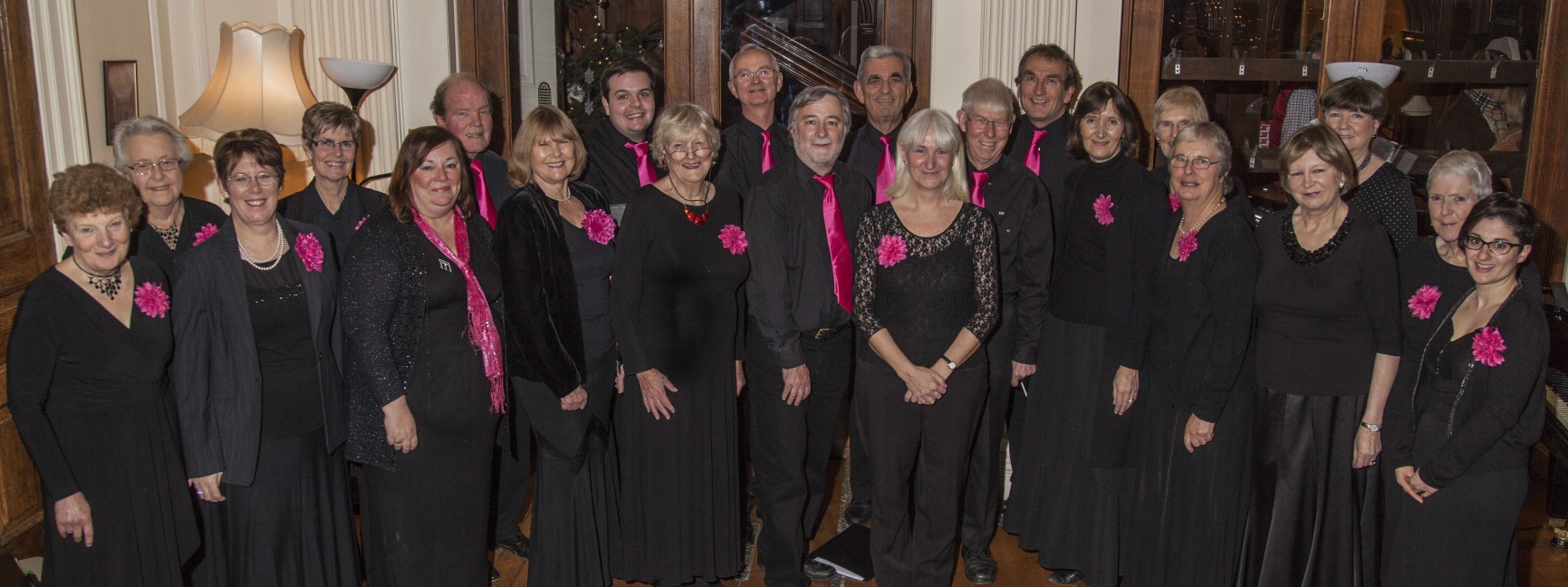
Vivace! is an ‘a cappella’ choir (they sing without instrumental accompaniment but can make instrumental vocal sounds). They have a wide repertoire of light and ‘serious’ pieces and this year for the first time the audience will be invited to join in with some of the items. So it should be a good, fun afternoon beginning at 3:00PM. Tickets £10: in aid of the Restoration Fund.   Tea and home—made cake follow!

Wednesday 16th December: 7:00PM

Another opportunity to open up the lungs and vocal chords with Carol singing in Pevensey village, starting at 7:00 PM under the Christmas tree at the entrance to Pevensey Castle from the High Street, and then progressing to the hostelries. We normally finish soon after 8:30PM. You are very welcome to swell the numbers and enjoy a ‘Good Fun’ evening. Funds raised will be for meeting Parish running costs.

Saturday 19th December: Pevensy Yokels @ 10:00AM

‘Coffee and Carols’ in St. Wilfrid’s Hall, Pevensey Bay. By now you will be in good voice to sing every carol, while you enjoy coffee and cake etc. lead by the ‘Pevensey Yokels’ a local group who intersperse the carols with often  humorous ditties and recitations – many with a thoroughly local flavour! Another ‘Good Fun’, thoroughly informal and relaxing couple of hours.  Funds raised will be for Parish running costs.
Maidstone Symphony Orchestra

Mote Hall, Maidstone, 28 November 2016

A highly demanding programme for the orchestra and one not without its challenges for the audience. Brian Wright brought together four late romantic works which complemented each other with their respective approaches to narrative. All four take us on a journey, some more overtly picturesque than others, but nothing that could be called abstract.

Richard Strauss’ Don Juan is a case in point. It may not follow Byron in any literal sense but the episodes and emotional turmoil of the Don’s life are clearly displayed for us. If the strings seemed a little thin at the start they soon gained courage and by the end brought us the lush richness Strauss requires. There was some splendid playing from the horn section, and throughout the sense of pace and tone colour was finely etched.

Laura v d H

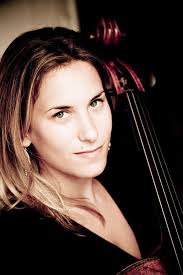
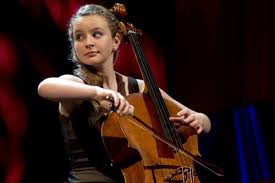
It was a real pleasure to welcome back Laura van der Heijden as soloist in Walton’s Cello Concerto. It was with this work she won the BBC Young Musician of the Year in 2012, and in the intervening years her approach has deepened and gained an even more captivating warmth. Where Walton’s orchestral writing can be quirky and strident, the solo line is always approachable. She brought a joyous spontaneity to the second movement and led us through the more introvert solo passages of the final movement with ease and conviction. It was a privilege to hear her again. Maybe there are plans for another of the great cello concerti in future?

Albert Roussel is hardly a household name but the suite from his ballet The Spider’s Banquet is more than just a charming rarity. The writing sits comfortably between Debussy’s romantic web-spinning and the intensity of early Stravinsky. I don’t think it is taking things too far to suggest that Roussel has passages that are remarkably like The Rite of Spring in their insistent rhythms and attack. Of course, unlike the Stravinsky, they do not last but they are certainly there. Brian Wright drew our attention to these even as we easily followed the story of the ballet itself, and the life and death of the insects.

In The South is Elgar at his most extrovert and the concert overture sits well beside Strauss’ Don Juan. There is little of English melancholy here and a great deal of extravagant rushing about. There are many passages that look towards the scherzo of the Second Symphony in the frenetic energy which is required from the players and listeners. Yet at the heart of the work is the melting viola solo – wonderfully played by David Hesketh – which could only be by Elgar.

A splendid evening – would that there had been even more there to enjoy it.

The next concert on 30 January brings us Nielsen, Mozart and Dvorak.

Old Cartes

PLEASE NOTE THAT THE PERFORMANCE

BY

OLD CARTES

scheduled for Sunday 29 November

has had to be postponed until March.

Details will be posted as soon as they are available

or contact oldcartes@yahoo.co.uk


ENO: The Mikado

London Coliseum, 21 November 2015

koko

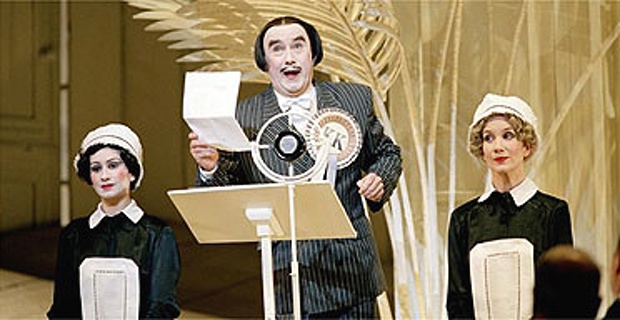
Jonathan Miller’s production of The Mikado reached its 200th performance at ENO with the current revivals – and it still sparkles and entertains as well as it ever did. This is something we will need to return to before the end, but for the moment lets enjoy the success of a fine evening – as much musically as dramatically.

Anthony Gregory is a young singer who is really making his mark. The voice is full and his personality communicates with the audience without obvious exertion. His Nanki-Poo is deft in its reserved approach to life and his singing wins our hearts. If Mary Bevan’s Yum-Yum seems at times to be a little too knowing this is very much in keeping with the approach, and her singing of The Sun whose rays was heart-melting. Richard Suart seems to have been part of the production as Ko-Ko since the start, yet there is nothing jaded about his characterisation which communicates with ease throughout. His Little List was suitably updated, raising extra laughs, though it was noteworthy that Gilbert’s original text raised just as many laughs across the evening. Where elderly critics like myself were brought up on G&S – and have to supress a desire to sing-along to every word – there were obviously large numbers in the audience last night who were unfamiliar with the work or Gilbert’s dry humour.

Graeme Danby and George Humphreys as Pooh-Bah and Pish-Tush showed us how important it is to sing Sullivan as if it were Donizetti, as well as creating believable civil servants. Yvonne Howard is certainly not as plain as Gilbert would like Katisha to be, which makes the denouement for Ko-Ko much easier to accept.  Richard Angus had for so many years been at the heart of the evening as The Mikado as to be a hard act to follow but Robert Lloyd had no problem assuming the vast costume and even bigger character. Let us hope that when it is revived again – as I expect it to be – he and Richard Suart will still be in tow.

Conductor Fergus Macleod may only be 28 but his grasp of the score and his handling of the whole evening was stunningly effective. He seemed to have an innate understanding of the pace needed for G&S and allowed the genuinely romantic moments to blossom. I am sure we will see him again soon.

As for the production, it is now almost thirty years old but has certainly not outstayed its welcome. The tap dancing waiters, the use of affectation in the pronunciation of the text, the comic details which never up-stage the narrative, all demonstrate the strength of the approach. The same is true not just of Jonathan Miller’s other productions – La Boheme, Rigoletto – but of many recent ENO productions. We have had some which have been exemplary and which I have rightly praised here, but we have had others – the recent La Boheme among them – which have not been as good as the production they replaced. The Board at ENO really does need to give careful thought to what it is offering its audiences. Of course we do not want to get stale, but there is a danger of throwing out the effective old for an inferior new.

ENO: The Force of Destiny

London Coliseum, 18 November 2015

ENO force

I gather that this new production will be broadcast by the BBC over the Christmas period. Listen to it, as musically it is a delight throughout, and has managed to assemble some of the finest singers we have heard even when compared to recent outstanding singing at the Coliseum.

The leads provide substantial voices with Tamara Wilson and Gwyn Hughes Jones frequently thrilling as Leonora and Alvaro. Anthony Michaels-Moore is a dark toned Carlo, his emotional turmoil always evident in the voice. James Creswell is a strangely ambivalent Father Superior and the production does not allow us to guess how sympathetic he may be to Leonora’s situation.

The chorus are on top form and Mark Wigglesworth brings splendid nobility and fire to the orchestra.

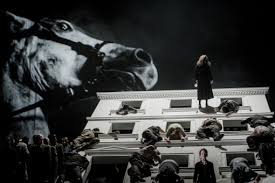
So far so good. This is joint production with the Metropolitan Opera and there are different expectations across the pond, where the music comes first and foremost. This may account for many of the strange decisions which Calixto Bieito makes in his production. Rebecca Ringst provides some of the largest sets I can recall at the Coliseum. Vast white buildings fill the stage, smoothly moved even with cast upon them. They have a sepulchral feel to them which is in keeping with the narrative and should be very effective. However very little happens within them. The chorus regularly appear as a block who simply stand and sing. There are many occasions when we seem to be at a costumed concert performances rather than a staging of the work. There is no battle in Act 3 and throughout the scene Carlo and Alvaro simply stand and stare at us.

When there is any action it is vicious and often at odds with the text. Rinat Shaham’s Preziosilla continuously assaults a pregnant woman before calmly executing a line of captured (or fleeing) civilians. Blood flows frequently, right from the first scene where Leonora smashes a plate and cuts her hand. Her preparation for her retreat as a hermit includes a crown of thorns made of barbed-wire. Only Friar Melitone – a splendid crisp characterisation from Andrew Shore – makes sense under the circumstances. The Friar is normally played as a comic character but here his attack on the depravity of the inn scene makes depressing sense.

This has proved to be a bumpy season so far. Some superb music making but more dubious decisions both by way of productions and choices for revivals. Let us hope it picks up after Christmas.

Brighton Philharmonic Orchestra – 1

The Dome, Brighton, 8th Nov 2015

It’s an interesting idea to programme a geographically diverse concert in chronological reverse with works written in 1917, 1876 and 1826 in England, Austria and Russia, respectively. Such a range ensured a lively afternoon although the augmented percussion section and harp for the Elgar seemed rather a waste of (excellent) resources as they weren’t needed in the other two works.

But what Elgar! I have to confess The Sanguine Fan was completely new to me. A short (20 minute) episodic ballet piece which Elgar was asked to write for a wartime charity, it includes some sublimely plummy Elgarian string and brass work interspersed with a minor key passage which echoes  Dvorak in gypsy mode and later some jazzy syncopated work which anticipates Shostakovitch.  It was a real pleasure to hear something unfamiliar – and yet worthwhile – get an admirably well played outing and it sits well in the overture slot. Let’s hope this performance starts a new fashion.

Gemma Rosefield

Gemma Rosefield found an attractive bright mellowness in Tchaikovsky’s Variations on a Rococo Theme especially in the showpiece trills and harmonics, while Barry Wordsworth deftly kept soloist and orchestra in sync. It’s a tricky piece to hold together because, of course, it doesn’t work like a concerto and there’s a lot of detailed quasi-duet between orchestra and solo cello. Gemma Rosefield looked terrific in her black lacy dress and red shoes but if you’re a compulsive foot tapper (and I sympathise because I have the same problem) then you need to wear soft shoes. I could hear her left foot beating time from well back in the balcony.

Schubert’s Great C Major began at a measured pace with close attention to the piece’s luxuriant detail. Barry Wordsworth controlled the balance and ensured that we heard all the finer points. The andante com moto bounced along with plenty of “moto” and an emphasis on the movement’s attractive simplicity. He made the counterpoint 6/8 melodies sing joyfully in the scherzo too, before bringing proceedings to a resounding conclusion and ensuring that everyone noticed Schubert’s homage to Beethoven in the final allegro.

Overall this was a very creditable and enjoyable concert. And as a guest reviewer and a newcomer to Brighton Dome I really appreciated being part of a (gratifyingly large) audience, educated and disciplined enough not to applaud between movements.

Susan Elkin

A Cappella Choir Concert by VIVACE!

In aid of Pevensey Parish Church Funds
St. Nicolas Church, Pevensey
Sunday 6th December at 2:30PM

Vivace

A concert programme of seasonal music performed by Vivace! – a Sussex based a cappella choir of mixed voices. A wide range of music and song, from classical to comical, with something to suit all tastes.And always for good causes! 

Tickets  £10. Available on the door or in advance (advisable).

Interval refreshments available

Call 01424 216651 or online ‘www.wegottickets.com.

BBC ‘Last Choir Standing’ qualifiers 

ROXANNA PANUFNIK COMMISSIONED TO WRITE OPERA

Garsington Opera has commissioned a ‘people’s opera’, Silver Birch, designed to be performed by professional singers together with community and children’s choruses aged 8 upwards.   A dynamic creative team has been engaged to create the 70-minute opera including Roxanna Panufnik (composer), Jessica Duchen (librettist),Karen Gillingham (director) and Douglas Boyd (conductor).  The work aims to appeal to the broadest audience of all ages and levels of opera experience.

Roxanna Panufnik

During the 2017 season the ‘people’s opera’, which is part of Garsington Opera’s Learning & Participation programme, will be performed on the main stage following on from the successful community opera mounted in 2013.

Recruitment of the 150 participants has already begun in local schools and community centres.  Devising workshops took place in which schoolchildren and members of the local population joined the creative team to explore the theme of war and its universal impact on families, as well as the significance to them of World War 1. Both the character and poetry of Siegfried Sassoon will play an important role within the piece, connecting the 2017 World War 1 commemorations with modern-day warfare.  Performers will include 5 professional singers, 2 child soloists, 50 primary school, 40 secondary school, 30 teenage dancers, 40 adults, 17 professional and 20 youth instrumentalists.


Brighton Festival Chorus @ Christmas

Brighton Festival Chorus are pleased to announce that their annual Christmas Concert will this year be, for the first time, with the Brighton Philharmonic Orchestra.  It will be a joyous celebration of the very best of Christmas music, from traditional to modern, including all your best loved carols and festive favourites.

The concert will be at Brighton Dome on Saturday 12 December at 6 pm. 

James Morgan, the Music Director of bfc, says, “It’s lovely to be part of what is becoming the start of the Christmas festivities for many families in Sussex – we get to perform all the well known traditional carols as well as introduce our audience to some fantastic new ones.  The combination of symphony orchestra, organ, massed choirs and the audience singing together is always a very special moment in the year for us.”  Tickets can be booked by calling the Brighton Dome Box Office on 01273 709709.