Mark Wigglesworth to step down as Music Director at the end of 2015/16 Season

The following has been released from ENO:-

We regret to confirm that Mark Wigglesworth feels unable to continue as Music Director despite the best efforts of the Board and Senior Management to persuade him to remain. We are disappointed that he will not be staying to lead the artistic forces through this particularly challenging period.

Mark has agreed to complete this season as Music Director including conducting Jenufa and to return as a guest conductor for two scheduled productions in the 2016/17 season. Mark is a world class conductor and we look forward to welcoming him back as guest conductor in future years.

–ends–

Brighton Philharmonic Orchestra

The Dome, Brighton, Sunday 20 March 2016

What a glorious conclusion to a very fine season which, I think, has also brought increasingly large audiences. Vaughan Williams’ A Sea Symphony is the sort of masterpiece which brings out the best in all involved. Brighton Festival Chorus have the salt air in their veins of course but their enthusiasm and accuracy were a delight to behold. From the opening onslaught of sound to the dying fall we were immersed in wave upon wave of glorious tone. Soprano Elin Pritchard was able to ride the combined might of the orchestra and chorus with ease, producing thrilling sounds and great beauty of line. If baritone Nicholas Lester did not make quite the same impact, his refined singing impressed though the words tended to get lost in the melos. The orchestra was as fine as I can recall it all season, with tonal nuances wafting easily as the mood changes swiftly from introspective to ecstatic.

B Fest chorus

Barry Wordsworth was in his element – so much so that at one point he let slip his baton which was deftly rescued by the soloists.

A wonderful conclusion – though readers will want to know about the first half of the programme. Would that this had been as fulfilling. William Alwyn’s Overture: Derby Day has colour and excitement but rather left this listener standing at the post. The narrative line was difficult to follow and it seemed to go on and then stop. I am sure others will argue there is more to the work than this but on a single hearing it was not obvious.

Bernstein’s Second Symphony The Age of Anxiety draws on W H Auden’s poem as its point of inspiration but unfortunately this was not printed in the programme (as neither were the Walt Whitman verses for the Sea Symphony) and we were rather left to guess at the underlying creative spark. The work has a plaintively haunting opening for two clarinets but as the movements run into each other it is difficult to follow the narrative line. There is a fine extrovert jazz section and a great deal for the solo pianist, Rob Clark, to do, though this is definitely not a piano concerto. Did the programming work? I remain unconvinced and it was only the overwhelming impact of the Vaughan Williams that made for such a successful conclusion.

I am delighted to note that next season starts on Sunday 9th October 2016 – of course you will be there!

Maidstone Symphony Orchestra

Mote Hall, Maidstone, 19 March 2016

In his introduction Brian Wright noted that the concert was book-ended by Adagios. While this was technically true the difference between the two could hardly have been greater. The evening opened with the lush warmth of Barber’s Adagio for Strings which brought richness without ever becoming over romantic. Precise intonation was a harbinger of excellence to come.

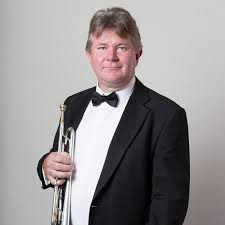
Paul Beniston

As if to give us a little light relief Paul Beniston joined the orchestra as the soloist in Arutiunian’s Trumpet Concerto. I have to admit that in all my years as a music critic this was the first time I had heard the work and it certainly sparkles with a mischievous intensity. While there are hints of Shostakovich in the astringency of much of the writing it also has the romantic washes of sound and colour we associate with Rimsky-Korsakov or Khachaturian. It is not afraid of melody either, and so lies easy on the ear even at a first hearing. Paul Beniston was obviously enjoying himself and his enthusiasm was catching not only for the audience but the soloists in the orchestra, with some particularly fine solo passages for clarinet.

Mahler’s Ninth Symphony is an Everest for the finest orchestras in the world. For Maidstone to tackle it may seem like foolishness but the attempt paid off with many passages of splendid authority. If the opening of the first movement seemed tentative, the first climax galvanised the large forces and brought a thrilling intensity which set a mark for the rest of the performance. The brass produced the raw power Mahler calls for, the first trumpet piercing the hall with its ringing steel. The hushed intimacy of the many bridge passages impressed as the structure gradually unfolded.

The rustic opening of the second movement seemed unusually slow but gathered in pace as the score progressed. Balance in this movement was cleaner than it had been in the first and there was a crispness to the sound which added to the impact. The woodwind rasped its way through the third movement as the score moves towards a chaos which is not easy on the listener but an essential part of the journey. The movement built to a splendid climactic crisis before the gentler pace of the final Adagio. Here we found warmth and steadfastness with a courage to endure. The acid world of shrieking wind and brass are gone and in the magical final pages we sense a striving for a conclusion which remains ever elusive – it recalls the end of Das Lied von der Erde, a fade into oblivion.

Brian Wright was either inspired or close to insane putting the work in this year’s programme but in the event proved that, for all the challenges, it was worth the effort. Players may have been stretched to the limit yet proved themselves more than capable of overcoming the rigours of Mahler’s writing to produce a memorable and moving performance.

ENO’s new Tristan and Isolde

World-famous sculptor Anish Kapoor joins director Daniel Kramer and conductor Edward Gardner for a new production of Wagner’s epic Tristan and Isolde

World-famous sculptor Anish Kapoor will design the sets for ENO’s unmissable new production of Tristan and Isolde. Directed by Daniel Kramer and conducted by former ENO Music Director Edward Gardner, Tristan and Isolde is one of the most hotly-anticipated arts events of 2016.

An epic drama told on a grand scale, Tristan and Isolde is one of the most powerful pieces in the repertoire. Described by Richard Wagner as ‘the most audacious and original work of my life’, the opera retells the legend of Tristan and Isolde’s transcendent but ill-fated love.

ENO’s first new production of Tristan and Isolde since 1996 is directed by ‘theatre’s most exciting young director’ (Daily Telegraph) Daniel Kramer. His previous work with ENO and Edward Gardner includes Duke Bluebeard’s Castle (2009) and Punch and Judy at the Young Vic (2008), for which he won the South Bank Show Award for Outstanding Achievement in Opera. Kramer was also nominated for the Golden Mask award for Best Director for Duke Bluebeard’s Castle when it was performed at the Bolshoi Theatre, Moscow.

For this spectacular staging Kramer collaborates with Anish Kapoor, one of the most influential sculptors of his generation. Winner of the Turner Prize in 1991, he was awarded a CBE in 2003 and a Knighthood in 2013 for services to visual arts. He designed the ArcelorMittal Orbit, Britain’s largest piece of public art, which was constructed in the Queen Elizabeth Olympic Park to stand as a permanent legacy of the London 2012 Olympic Games. Kapoor has also designed stage sets that include Idomeneo for Glyndebourne in 2003 and Pelléas et Mélisande for La Monnaie in Brussels in 2008.

This thrilling score is conducted for the first time by former ENO Music Director Edward Gardner. Following his performances of Richard Jones’s Olivier Award-winning, five-star production of The Mastersingers of Nuremberg (2015), The Stage wrote that his ‘immaculate sense of balance and flow denotes a great Wagner conductor’.

The creative team is completed by Costume Designer Christina Cunningham, Lighting Designer Peter Mumford and Video Designer Frieder Weiss.

Tristan and Isolde opens at the London Coliseum on 9 June 2016 for 8 performances – June 9, 15, 22, 29 at 5pm and June 19, 26 & July 2, 9 at 3pm

Pre-performance talk: 19 June, 1.15-2pm, £5/£2.50 concs

ENO reaches a settlement with Equity

English National Opera can confirm that a deal to change ENO chorus contracts has been reached with Equity.

The settlement will see the ENO Chorus move to a nine-month contract to reflect the length of future seasons at the London Coliseum. These contracts will run from August – April (inclusive). During the months of May – July, when the company performs outside of its home venue, ENO Chorus members will be offered work on a first refusal basis. The Chorus will reduce in number for 44 members to 40 from August 2016. The new chorus pay package will come into effect from 1 August 2017.

Cressida Pollock, Chief Executive of ENO, said, “I am delighted that we have been able to reach a deal with Equity. We recognise the fundamental importance of the ENO Chorus in delivering world-class opera. We listened to the concerns of the Chorus and have reached a fair compromise that preserves the permanent ensemble, focussing on our London Coliseum season, whilst ensuring that we have the building blocks in place to increase our outside work. This settlement will contribute to the wider changes in our business model, to ensure that ENO becomes a more financially resilient organisation, able to move forward on a reduced public subsidy.”

Harry Brunjes, Chairman of ENO, commented, “On behalf of the ENO Board I would like to thank Cressida and the ENO Chorus for their hard work in reaching this compromise. We are now looking forward to the future, and to working together to ensure that our great organisation thrives for decades to come.”

CDs/DVDs March 2016

J S BACH – THE ORGELBUCHLEIN
JAMES LANCELOT, organ of Durham Cathedral
PRIORY PRCD1139

This is a very welcome release. A stand-alone no-frills rendition of the complete organ music from the book presented in order from Advent to Pentecost and concluding with the non-seasonal items.
This is a useful reference work but also a very enjoyable listening experience with James Lancelot in fine form at the Durham organ.

THE COMPLETE ORGAN SONATAS OF AUGUST RITTER (1811-1885)
MICHAEL HARRIS, Ladegast organ, Kirche Altleisnig, Polditz, Germany
PRIORY PRCD1162

The four organ sonatas presented here are of great interest, partly because of the early date of their writing and also because they are mostly unfamiliar to us now. Michael Harris gives fine performances on an organ that is itself an interesting survivor, built in 1868 and now restored, after it was very nearly removed in the 1980s.

ORGAN SPECTACULAR!
ASHLEY GROTE, organ of Norwich Cathedral
PRIORY PRCD1153

I have to confess that I groaned when I saw the contents of this disc, being mostly very well-known items in the organ repertoire. However, I must say, though, that I thoroughly enjoyed the whole CD and was reminded of just how enjoyable many of these pieces are. This CD would make an excellent introduction to the organ but will also be enjoyed by many “old hands” if they are prepared to put prejudice aside and give it a spin! The programme begins with Bach’s Toccata & Fugue in D minor & closes with Widor’s Toccata. The complete Gothique Suite by Boellmann is included. As well as Lefebure-Wely’s Sortie in E flat there is his lesser-known Andante: Choeur des voix humaines. A welcome new piece is the organist’s own Prelude on Cross of Jesus.

GREAT EUROPEAN ORGANS No 98
ANTHONY HAMMOND, organ of L’Eglise St-Vincent, Roquevaire, France
PRIORY PRCD1156

Sadly this long running series is nearing it’s end. In the meantime we have another release which combines expert playing on a lesser-known organ with interesting modern repertoire. Largely focussing on the art of improvisation this CD has compositions by Naji Hakim and Pierre Cochereau, together with works dedicated to him by Jean Bouvard & Daniel Roth. There is also the organist’s own Improvisation:Triptyque and Marius Monnikendam’s Toccate Concertante. Excellent!

THE COMPLETE PSALMS OF DAVID SERIES 2, Vol 9
Choir of SALISBURY CATHEDRAL,  directed by David Halls with John Challenger, organ
PRIORY PRCD 1150

Moving to the choral repertoire we have another series nearing its end. Whilst not having quite the impact on me that the original series did I have been enjoying these releases as they bring further renditions of this staple of the cathedral repertoire, often with unfamiliar chants. Here the Salisbury choir demonstrates its familiarity with this genre in what is a well executed set.

GREGORIAN CHANT – MUSIC OF PARADISE
Choir of BUCKFAST ABBEY, directed by Philip Arkwright
PRIORY PRCD1151

There is little than I can say to add to descriptions of the beauty of Gregorian chant. Its simplicity and longevity both help to transport the singer and the listener beyond themselves. I really enjoyed this sequence of chant from the mixed voices here give a glimpse of the musical traditions still in place at the abbey. Sublime.

MESSIAEN – L’ASCENSION
TOM WINPENNY, Rieger organ of St Giles’ Cathedral, Edinburgh
NAXOS 8.573471  (66’33)

Tom Winpenny gives an inspiring all-Messiaen recital here. Alongside the title work we also have Diptyque, Offrande au Saint-Sacrament, Prelude, Le Banquet Celeste and Apparition de l’Eglise eternelle. There is a good rapport between organist and organ and understanding and sensitivity of this music.

BARRY BRINGS BERNSTEIN TO BRIGHTON

The final concert of the Brighton Philharmonic’s season at Brighton Dome sees another exciting collaboration with the Brighton Festival Chorus which brings over 100 singers and 80 musicians together on stage. Vaughan Williams’ epic A Sea Symphony (Symphony No.1) is a powerful setting of the poetry of Walt Whitman in what could be seen more as one huge song rather than a traditional symphony. Soloists Elin Pritchard (soprano) and Nicholas Lester (baritone) join the orchestra and choir under the baton of Barry Wordsworth in this stirring work that evokes the power and grandeur of the sea with its shimmering strings, swirling woodwind, pounding brass and crashing percussion.

James Morgan, Music Director of the Brighton Festival Chorus, is delighted the choir is performing with the Brighton Philharmonic Orchestra again: “The choir love working with Barry, and never more so than on core English repertory like this – the Sea Symphony is a great, tumultuous sing which BFC are all looking forward to performing.”

The concert begins with a short but scintillating overture by William Alwyn, a British composer perhaps best known as a prolific writer of film scores. His bustling overture Derby Day, commissioned in 1960 by the BBC, was named after the famous panoramic oil painting by William Frith that depicts the Epsom Derby in 1858, and the overture delightfully portrays the diverse race crowd, with people from all classes and backgrounds mingling together intent on enjoying themselves on a day out at the races.

Leonard Bernstein’s Symphony No.2 takes its subtitle “The Age of Anxiety” from a poem by WH Auden which the composer said was “one of the most shattering examples of pure virtuosity in the history of English poetry”. The symphony it inspired is an eclectic and kaleidoscopic mix of moods and musical textures depicting the Seven Ages of man from infancy through to death. Written in 1949 (at the same time as West Side Story) and scored for orchestra and solo piano, Bernstein intended the pianist to be an almost autobiographical protagonist in the quest for meaning and faith in the aftermath of the Second World War. Rob Clark, Head of Music for the Royal Ballet, takes on this role in an energetic work that seems at times more like a concerto, with echoes of Brahms and Rachmaninov in its two movements that mirror Auden’s text through 14 variations.

This piece is particularly dear to the heart of the Brighton Philharmonic’s Conductor Laureate, Barry Wordsworth, who has long wanted to bring Bernstein’s symphony to Brighton, having conducted it at the Royal Opera House in 2014, again with Rob Clark as pianist.  Of the piece Barry says: “I am very excited to have the chance to play Bernstein’s Age of Anxiety in Brighton. It is a piano concerto in all but name, and our hero, who eventually overcomes the deep anxieties of life with a display of all conquering courage and confidence, is our soloist, and my great friend and colleague Rob Clark. This masterpiece is a reflection of our time, and all three works speak in different ways of triumph through adversity. It is interesting that the American Bernstein used poetry by an English poet whilst Vaughan Williams, a British composer, used the poetry of an American. This programme should inspire everyone present to leave the concert with a deep feeling of confidence for the future.”

The concert is dedicated to the memory of Martin Lindsay-Hills, a keen sailor and long-time generous supporter and sponsor of the orchestra.

The Brighton Philharmonic Orchestra are most grateful to the William Alwyn Foundation for their financial support of this concert.

SUNDAY 20 MARCH 2016, 2.45pm, BRIGHTON DOME CONCERT HALL:
BRIGHTON PHILHARMONIC ORCHESTRA
Conductor BARRY WORDSWORTH
Piano ROB CLARK
BRIGHTON FESTIVAL CHORUS
Soprano ELIN PRITCHARD
Baritone NICHOLAS LESTER
WILLIAM ALWYN Overture: Derby Day
BERNSTEIN Symphony No.2 (The Age of Anxiety)
VAUGHAN WILLIAMS Symphony No.1 (A Sea Symphony)

Tickets from £11.50-£36.50 (50% student discount) are available from Brighton Dome Ticket Office in person, by telephone (01273) 709709 and online: www.brightondome.org
 

Messiah: Canterbury Choral Society

Hanover Band, Richard Cooke
Canterbury Cathedral, 12 March 2016

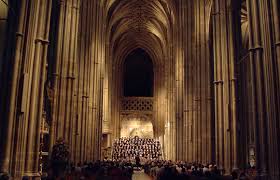
Canterbury choral

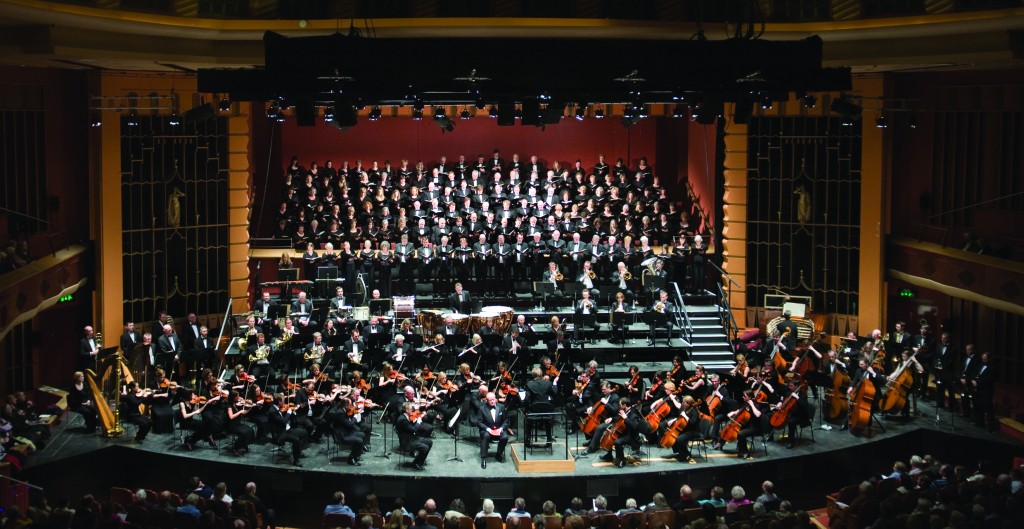
It is always a treat to hear Messiah and, personally I never tire of it – from the crisp rhythms of the Overture to that wonderful top A from the sopranos, nine bars before the end, which somehow encapsulates the wonder of the whole piece. And this performance pushed most of the buttons.

It’s slightly incongruous to hear it sung by big forces accompanied by the original instruments of the Hanover Band. It’s arguably a contradiction. Nonetheless it’s a pleasure to hear those slender 18th century trombones, positioned next to the altos for Glory to God. The enjoyable clean, dry sound of the old timpani is quite different from the rumbling resonance of their modern descendants. And of course the trumpet, slightly understated in this performance and quieter than a 21st century one, dramatically underpins The Trumpet Shall Sound.

Visually, Canterbury is probably the most iconically atmospheric building in the country. But it isn’t a concert hall. Even with the huge and very competent Canterbury Choral Society on a steeply tiered seating west of the rood screen there is still an acoustic problem. Tenor, Jamie MacDougall began Comfort Ye carefully under tempo but it was still fuzzy even from row F where I was sitting.

The lofty acoustic seems to be kinder to higher registers than lower ones. Alexander Chance, counter-tenor, gave a very sensitive, performance with total clarity and perfect diction especially in the 6/8 lilt of O thou that tellest glad tidings to Sion and in his searingly moving I Know That My Redeemer Liveth. Chance, the son of counter-tenor Michael Chance, is a recent graduate from New College College Oxford where he was a choral scholar so he’s still very young. I’m sure we shall hear more of him. There was also elegant work from soprano Jessica Leary who sings with a smile in her voice.

Rather disappointing, however, was bass Barnaby Rea. Apart from acoustically caused vocal muddiness, his intonation was sometimes doubtful. He seemed, moreover, to be reading every note from his copy as if rehearsing an unfamiliar work, so there was very little audience eye contact.

The choir, however, like the orchestra, does an excellent job. A member of Canterbury Choral Society told me recently that they have to sing crowd-pleasing Messiah more often than some members would like and that other good, but less popular works get fewer outings. Well, I understand her frustration but it works in the choir’s favour too. Because they clearly know Messiah so well they sing it with terrific confidence, panache with plenty of very professional focus on the conductor. There’s none of that heads-buried-in-copies which bedevils so many amateur choirs. And that enables Richard Cooke to coax an exceptionally coherent sound from them.

I’m now looking forward to CCS’s Verdi Requiem with Royal Philharmonic Orchestra in June.


Garsington Opera: INTERNATIONAL COLLABORATIONS IN SANTA FE AND PERFORMANCES IN PARIS

PARIS

The cast of Garsington Opera’s outstanding production of Fidelio, staged to critical acclaim in 2014, will perform a semi-staged concert performance in Paris on 24 November 2016 in the renowned concert hall of the Philharmonie de Paris.  The orchestra, Orchestre de chambre de Paris will be conducted by its Music Director, and Artistic Director of Garsington Opera, Douglas Boyd. The original cast including Rebecca von Lipinski (Leonore), Peter Wedd (Florestan), Stephen Richardson (Rocco), Sam Furness (Jaquino) and Jennifer France (Marzelline) will be joined by Andrew Foster-Williams (Pizarro), Bradley Travis (Don Fernando) and the Chœur de chambre accentus from Paris.  It will be directed, with video, by Peter Mumford.

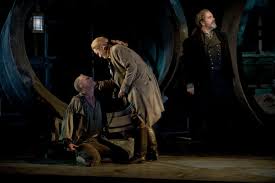
fidelio

On 27 June 2017, Garsington Opera’s production of Le nozze di Figaro staged in the 2017 season, with principals and chorus from Garsington Opera will be given a semi-staged concert performance in the Théâtre des Champs-Élysées with the Orchestre de chambre de Paris conducted by its Music Director, Douglas Boyd.

SANTA FE

In 2018 Garsington Opera will present Capriccio in collaboration with Santa Fe Opera.  It will be directed by Tim Albery, designed by Tobias Hoheisel  and conducted by Douglas Boyd. The production will be seen at Santa Fe in their forthcoming 2016 season.

Douglas Boyd said: I am particularly thrilled to be bringing Garsington Opera to Paris where I am the Music Director of the Orchestre de chambre de Paris and to be collaborating with one of the world’s greatest summer opera festivals – Santa Fe Opera.  These are very important developments reflecting our ambitions to broaden our reach as we continue to grow artistically as an international summer opera festival.

Brighton Philharmonic Orchestra

The Dome, Brighton, 6 March 2016

I have a Penguin score of Brahms’ Variations on a Theme of Haydn which I purchased for 2/6 while studying for O level Music over half a century ago. It is still a favourite work and it was a real pleasure to encounter it again at the opening of yesterday’s matinee concert in the Dome.

H Shelley

Howard Shelley was both conductor and soloist, bringing a relaxed professionalism throughout. The Brahms brought us beautifully extended phrasing and an elegant balance across the surprisingly limited forces – just double wind and no trombones.

As if to prove that even concert pianists move with the times, he led Shostakovich’s Second Piano Concerto with the aid of an Ipad, controlled by a Bluetooth pedal. All very innovative and effective as it avoids flicking pages and presumably makes page-turners redundant from now on.

The cheeky opening movement was a fine contrast to the romantic warmth of the Brahms, but the gently spun lines of the second movement reminded us that Shostakovich was not averse to melody when he wanted it. The rapid articulation of the final movement was crisply held across all the players.

Where Mendelssohn’s Hebrides Overture sparkles as the sunlight bounces off the sea and the cliffs of Staffa, the Scottish Symphony is altogether more sombre. The clouds are much in evidence and not long after the start a storm briefly erupts. If the clarinet leads us in a dance in the second movement there is little that is distinctly Scots about it. The reflective third movement and urgency of the opening of the finale maintain this sense of unease, and it is not until the final pages blaze forth that there is any sense of light breaking through. It took Mendelssohn twelve years to complete and is one of his most sombre compositions. Howard Shelley found the nuances and questions that lie within the score and left us moved if not slightly uncomfortable.

A splendid afternoon and I hope we see Howard Shelley again soon.