The True St. Nicolas

St. Nicolas Church Pevensey 11 June 2016

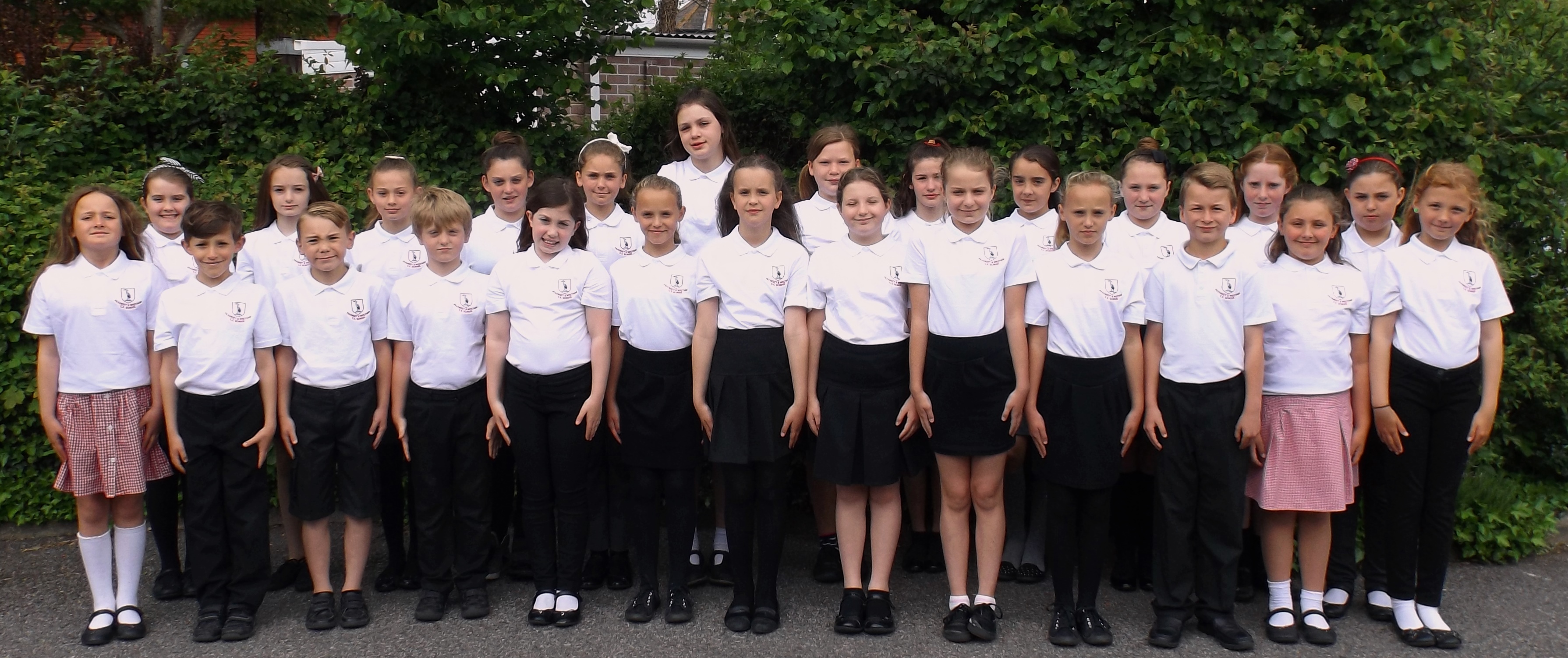
This concert featured the world première performance of an especially composed six part Cantata’ – ‘The True St Nicolas’, to celebrate the 800th anniversary of St Nicolas Church, Pevensey. The piece was composed for sixty combined voices of Hailsham Choral Society, celebrating its own 55th anniversary, and children from Pevensey and Westham School.

Pevensey & Westham School Choir

The exciting new cantata from established Sussex based professional composers Ruth Kenward and Martin Neill, ‘The True Saint Nicolas’ had its first performance at Saint Nicolas Church, Pevensey, on Saturday June 11t . Appropriately it has been written for children to sing with adults. Here for the first ever performance it was children from Pevensey & Westham Primary School with members of Hailsham Choral Society.

The school choir was especially formed for this performance – the first choir at the school in twenty-five years. They sang wonderfully with clear diction and confidently, with tuneful expression throughout. It was an outstanding performance by the choir of eight to eleven year-olds under the baton of Josick Kotz. The balance between the adult and children’s voices was perfect in the excellent acoustics for which St. Nicolas church is renowned.

The 20-minute piece which followed a spirited and vibrant performance of Haydn’s ‘St. Nicolas Mass’ (Missa Sancti Nicolai – Mass no. 6 in G Major) by the Hailsham Choral Society opened with the children asking the adults to tell them the story of the real ‘Santa Claus’. They are led on a journey through a series of miraculous events attributed to Saint Nicolas, some of them more fictitious-sounding than others! The character of the man himself is revealed through the stories told and, by the end, the children recognise the link between the generous nature of both Father Christmas and the true Saint Nicolas. Matthew Johns


WNO: Cav & Pag

Birmingham Hippodrome, Saturday 11 June 2016

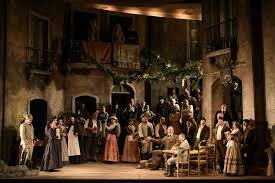
Seventy years ago WNO mounted its first full scale production of Cavalleria Rusticana and I Pagliacci. It was fitting therefore to revive the most recent productions in this anniversary year, and invite Carlo Rizzi back to conduct after his long association both with the company and this particular staging.

wno cav

Today Elijah Moshinsky’s approach seems comfortably old-fashioned and lacking in provocation, but it does allow singers scope for individuality and the chorus to show their exemplary strengths. Camilla Roberts is a fine Santuzza, making much of the claustrophobic setting which hems her in and reacting impressively to the spite of the chorus. Her duet with Turiddu was one of the highlights of a fine evening and her final despair left us in no doubt that there was never going to be a happy ending. Anne-Marie Owens made a gentle Mama Lucia, for ever picking up the pieces.

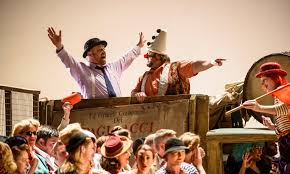
If Meeta Raval’s knowing Nedda meets a far stickier end in I Pagliacci it is difficult not to think that she had it coming to her. Her brazen approach gave her a sharpness of character which helped to heighten the tension throughout, though Gyula Nagy, as her lover Silvio, seemed ill at ease throughout and was vocally restrained.

wno pag

The key to both operas lay with the two male leads. David Kempster was an unusually authoritative Alfio, far richer than is often the case, which makes him a much more persuasive foil for Turridu. If he was suave as Alfio, the vitriol came to the fore as Tonio, though the prelude was sung with great bravura. Gwyn Hughes Jones was indisposed and Peter Auty took over at short notice – not that anybody would have noticed as he brings such beauty of line and sense of presence to everything he does. This was an outstanding performance by any standards.

Carlo Rizzi knows these score very well and brings an easy romanticism to them which never strains towards sentimentality or goes over the top.

This was the final night of the Welsh season – with two performances of In Parenthesis to come at Covent Garden in July. We can look forward to Macbeth opening in September – and the start of the next seventy years.

BBC ARTS ONLINE ENABLES GARSINGTON OPERA TO REACH WIDER AUDIENCE

BBC Arts Online is enabling Garsington Opera to reach a wider audience.  Short clips of their 2015 production of  Così fan tutte are now available to view at http://bbc.in/1VOILjc .   Later in the month their acclaimed production of  Eugene Onegin, currently in repertoire, will be available.

Eugene Onegin will be screened to Skegness (2 July), Ramsgate (23 July), Bridgewater (20 August) and Grimsby (30 September) as part of the Garsington Opera for All programme. In each location a large-scale programme of education and outreach work is firmly integrated with the digital free public screenings and provides ground breaking opportunities for communities to be involved in creating, learning about, and performing opera.

Opera for All is a three-year partnership project between Garsington Opera, the charitable trust Magna Vitae, and the Coastal Communities Alliance, and is supported by Arts Council England’s Strategic Touring Fund.

Nicola Creed, Executive Director of Garsington Opera said:  We are delighted to be making opera available free of charge potentially to thousands of people. This is an important addition to our outreach programme and we are thrilled to be launching opera from Wormsley on BBC Arts Online.

ENO: Tristan and Isolde

London Coliseum, Thursday 9 June 2016

tristan 1

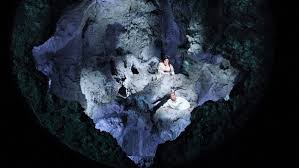
Wagner productions have almost priced themselves out of the market, so we have to treasure them when they do come along. If ENO are still somewhat under a cloud, the new Tristan and Isolde should go a good way towards restoring morale. Though not perfect – what Wagner production could ever be? – there are so many good things going for it they far outweigh any smaller niggles. For Daniel Kramer this was baptism by fire. Not only was he directing a major opera for the first time at ENO, this was to be his first work since being appointed Artistic Director. That he comes out of it with considerable aplomb is a tribute both to himself and the company. The highest compliment to pay has to be his sensitivity to the score itself. Nothing he asks of his soloists gets in the way of the music or the text. Where so many modern productions are intellectually or politically apt, they too frequently do so at the expense of the score. Daniel Kramer always allows his singers to explore the characters and to communicate them through the music. Even where we may disagree with the approach – and the Waiting for Godot overtones for Kurvenal are certainly challenging – the character is never asked to do anything out of kilter with the score.

He is fortunate to have some of our best singing actors to ensure his ideas are met. Stuart Skelton is as fine a Tristan as we can ask for today. A true heldentenor who has surprising levels of sensitivity and vulnerability without the need for unmusical extravagance in the voice. He has more than sufficient reserves for the final act, and his warmth in the love duet was most impressive. After fifty years of Tristan performances his is, in my experience, one of the finest and we are lucky to have heard him.

If Heidi Melton has yet to find the full flowering of Isolde she certainly made a fine start. Her attack and vitriol in act one were superb and she warmed to Tristan in act two without becoming over harsh at the top of the voice. Surprisingly the Liebestod was underpowered but this may have been first night nerves.

There were no smaller parts on this occasion. Craig Colclough was a rugged Kurvenal even if his characterisation was unexpected. The third act was particularly moving as he became almost the faithful guard dog to his wounded master. Karen Cargill’s Brangane was superb throughout, and I am waiting for the BBC broadcast to focus on her warning as it was somewhat upstaged by the visual effects during the love duet. Matthew Rose was un-necessarily aged but sang with middle-aged authority even when surrounded by beds and superfluous medical staff at the end of act two.

The orchestra under Edward Gardner were superb, the strings particularly effective in weight and depth. At the end of the evening there were cries of Come back as he took his curtain call. You may think that – I couldn’t possibly comment.

tristan 2

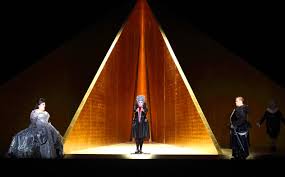
If I have left Anish Kapoor’s designs and the video design to the end it is essentially because so much has been written about them already. I was fortunate enough to be sitting centrally so had no problem with either sight lines or acoustic, but I accept that those at the sides had a very different experience from those of us fortunate enough to see the whole stage. There has not been a good history of artists working for stage design – David Hockney being very much the exception – so I have to admit to being initially concerned. His designs certainly work well and give a monumental sense of place. The only surprise is act three, where a grey drop curtain in front of the massive cave-like structure of act two is all we have. That the act works so well is down to Stuart Skelton’s singing and Daniel Kramer’s sensitive direction.

And what happens at the end? Many years ago I recall a Peter Hall production in which Tristan rose again behind Isolde. It was a thrilling, magical, moment. But what is happening here? After an evening almost obsessed with drug taking (essential to the plot so not in itself a problem) and madness, we seem to be given the most naturalist and yet optimistic of endings. Both Tristan and Isolde have long grey hair. The servants are equally old even if Mark is unchanged. Tristan retreats into the act two cave, where Isolde appears, equally grey haired. She then appears to die of a heart attack. So what is the Liebestod? It appears to be the continuation of love after death, overcoming the potential impact of drugs and society. If this is what Daniel Kramer intended it is wonderfully effective. I only hope we get a chance to see the production again once he has had time to smooth out the minor problems. With him in charge maybe ENO has turned a corner.

GARSINGTON OPERA EXTENDS TO FOUR PRODUCTIONS FROM 2017

In 2017 Garsington Opera will extend to an eight week season from Thursday 1 June – Sunday 30 July. The main season will expand from three to four opera productions annually, and will see the start of a partnership with the Philharmonia Orchestra. In addition, next year  there will be a large scale, newly commissioned community opera.

The season will open with a new production of Handel’s Semele to be conducted by Jonathan Cohen with  Annilese Miskimmon directing.  The Philharmonia Orchestra will be joining for a new production of Pelléas et Mélisande with conductor Jac van Steen and director Michael Boyd.  John Cox’s celebrated production of Le nozze di Figaro will be recreated for the Wormsley stage, conducted by Douglas Boyd , and Martin Duncan’s acclaimed production of Rossini’s Il turco in Italia will be conducted by David Parry.

Silver Birch, a new commission by composer Roxanna Panufnik and librettist Jessica Duchen, uniting professional artists with 170 members of the local community, will be presented by Garsington Opera’s Learning and Participation programme.  It will be conducted by Douglas Boyd and directed by Karen Gillingham.


Pull Out All the Stops 5

Royal Festival Hall, London  6 June 2016

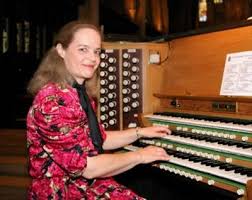
Margaret Phillips

Margaret Phillips closed the 2015/16 season of the RFH organ series with a magnificent programme spanning 250 years, beginning with Nicolas de Grigny’s Suite on Veni Creator where reeds were often to the fore. Fantasia in G (Piece d’Orgue) is a lovely example of JS Bach’s ability to surprise – the contrasts between the light and playful opening and the relentless driving passage which longs to be resolved at the end were given full effect in this performance.

The remaining pieces were all from three giants of the 20th Century organ repertoire.  The first half was closed with effective symmetry as Durufle’s Prelude, Adagio et Choral vare sur le theme du Veni Creator  took us back to the source material of the opening work.

In a description of the evening’s concert we were promised an “exploration of the organ’s nethermost regions”! This was certainly the case throughout the concert with a wide range of registration from the quietest strings, and burbling flutes through to fiery reeds and full chorus. It was particularly noticeable in the hugely entertaining 18 variations by Jean Guillou. As an introduction to an exciting world of timbre, texture and rhythm this piece is highly recommended. The horizontal layout of the pipework in the hall also added an extra spatial dimension to this music.
Although Dupre’s Prelude & Fugue in G minor is in some ways written in more conventional fashion it is nevertheless an interesting and technically demanding work.

Throughout the evening Margaret’s ease with, and thorough knowledge of this particular instrument and repertoire was evident. This was again demonstrated with a beautifully understated performance of a gently rhythmic and spacious encore, Shalom, by Toon Hagen (organist in Zwolle) – a lovely contrast to the dramatic ending of the Fugue to send us on our way

Over five concerts an impressive variety of music has been presented in wonderful performances by some fine musicians on this most remarkable organ. The 2016/17 series of “Pull out all the stops” begins on 3rd October with Jane Parker-Smith.

Stephen Page

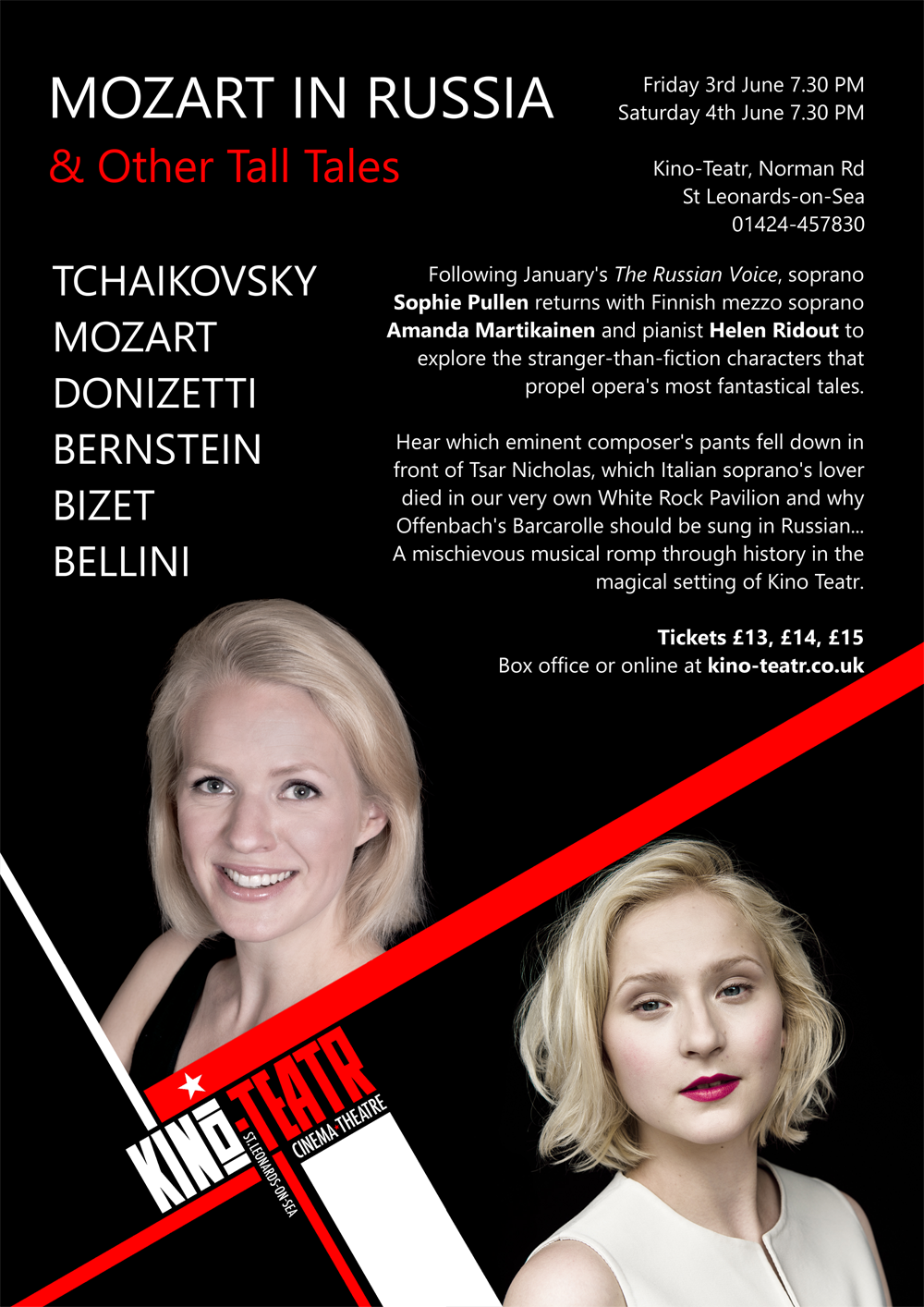
Mozart in Russia

Kino Teatr, St Leonards-on-sea, 4 June 2016

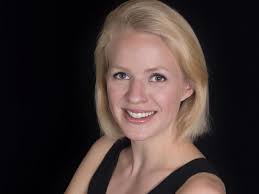
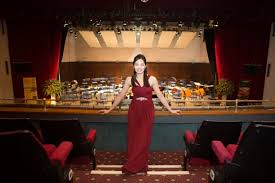
S Pullen

Sophie Pullen’s delightful operatic evening was entitled Mozart in Russia but could as easily have been called Wanderings in Opera-land. It seemed to assume we were all opera buffs – well, some of us are – and that we would recognise arias not only without introduction but also without translation or programme notes.

She made it easy enough for us at the start. A bright confrontation between Suzanna and Marcellina in Mozart’s Via resti servita and Suzanna’s gently seductive Deh vieni, were easily recognisable but the following duet for Lisa and Polina from Tchaikovsky’s Pique Dame was less familiar though beautifully sung. Olga’s act one aria from Eugene Onegin suited Amanda Martikainen liveliness and sense of humour but the leap into the Barcarolle from Les Contes d’Hoffmann seemed to lead us in an entirely different direction.

If most of the opening arias had been based on intimate characterisation we were back on firmer ground with Donizetti’s All afflitto e dolce il pianto from Roberto Devereux. This is a wonderful work which is performed all too rarely and this lovely aria gave a brief hint of its real strengths.

The first half came to a close with Mira o Norma, which would be familiar to most, and another tribute to the fine duet work from both singers.

The second half gave up all pretence of logic and simply brought us a clutch of pieces, splendidly performed. Bernstein’s Candide is fiercely difficult to sing but they made light work of Little Women and the old Lady’s aria Easily Assimilated.  I had hoped Sophie was going to sing Glitter and Be Gay – some other time perhaps? She did however give us two arias by Massenet, one from Manon and the other from Werther – neither of which I could trace easily, but both were easy on the ear. Amanda gave us a conversational rendition of the Seguidilla from Carmen, and the evening closed with the Flower Duet from Lakme, which presumably everybody knows if only from TV ads! The encore proved lively but incomprehensible.

Helen Ridout had provided the accompaniment from the piano throughout and was allowed to show her more personal style in fine performances of Debussy’s L’Isle Joyeuse and Ginastera’s  Danzas Argentinas I and II, the latter adding a little spikiness to an otherwise romantic programme.

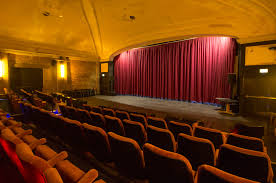
Kino teatr

The Kino Teatr is a fine building, remarkably comfortable and welcoming. It is a pity the acoustic is hard and could show up the tiniest flaws in any voice. Thankfully this was not a problem for Sophie Pullen and Amanda Martikainen, whose ample voices often over-powered the space but never uncomfortably so. It would be good to hear it for a lieder recital. Anybody offering?


Romantic Classics – Bexhill Festival of Music

Royal Philharmonic Orchestra, De La Warr Pavilion, Bexhill, 2 June 2016

Tzu-Yin Huang

Tzu-Yin Huang is a formidable and engaging young pianist, whose approach to Rachmaninov’s Second Piano Concerto brought clarity and excitement to what can too easily be a romantic wallow. The slow, powerful, slightly ominous opening demonstrated the authority she can command and the weight of sound she can rouse from the Del La Warr’s piano. She seems to have an instinctive ability to unite clarity of phrasing with innate passion, thus attacking the ear and mind at the same time. It was enthralling and I am only sorry I did not catch her winning performance at the Hastings International Piano Concerto Competition.

The evening had opened with a finely articulated reading of Smetana’s Overture to The Bartered Bride. The acoustic is always a problem in the De La Warr Pavilion but seemed somewhat better on this occasion, though there is still a real disparity between first and second violins where the first are outside and the second within the proscenium. The brass and wind seemed to carry better but this may simply have been the choice of works which were better suited to the building.

Tchaikovsky’s Fifth Symphony is a favourite of Brian Wright’s and he brings a loving attention to detail as well as letting rip where needed. The second movement had an intense melancholy which verged on depression, with the horn solo seemingly in another world, far removed from those of us in the hall. The fury of the final movement seemed at times to tip over into madness and this was totally convincing – there is, after all, not a long way between this manic-depressive state and the desolation of the end of the Sixth Symphony.

A wonderful evening – thoroughly enjoyed by a packed house. I know these events are very expensive to mount but surely Bexhill could run to them a little more often?

CDs/DVDs May 2016

Beethoven Symphonies
ARTHAUS 102175/6/7
Dvorak Symphony No8
BR KLASSIK 900145
Bavarian Radio Symphony Orchestra, Mariss Jansons

The Beethoven symphonies are issued on three DVDs with three symphonies on each in chronological order. They were recorded live while the orchestra was on tour in Japan, from the Suntory Hall in Tokyo in 2012. They certainly make for exciting listening and an excellent insight into Mariss Jansons conducting style. The early symphonies are rapidly paced with an enthusiasm we expect of Haydn though there is no let-up in the later works, the cycle coming to a triumphant end with a radiant choral symphony.

The Dvorak is also a live recording and the disc includes Suk’s fine Serenade for Strings and Dvorak’s Karneval overture. The symphony is, as with the early Beethoven, driven with panache and fire.  In all, a fine tribute to both orchestra and conductor.

RSC: Henry V
OPUS ARTE 0A 1206 D

This release completes the set which started with David Tennant’s Richard II and moved through Antony Sher’s fine Falstaff in Henry IV 1&2. Here, more than anything else, it is the ensemble playing which impresses and the frequent intimacy of the relationships. Oliver Ford Davies is a superb Chorus and sets the standard for all that is to come. We now have two sets of these plays, with the equally impressive but very different approach from the Globe. As a Shakespeare lover I am very glad to have both!

Beethoven: Fidelio
Zurich Opera House, Nikolaus Harnoncourt
ARTHAUS 109223

It is Jonas Kaufmann’s heroic Florestan which is the obvious selling point for this new release, though the rest of the cast are equally fine with a sterling Rocco from Laszlo Polgar and a radiant Leonore from Camilla Nylund who is also dramatically convincing.

Nikolaus Harnoncourt’s conducting is rapid and tight for most of the evening but he dwells on O namenlose freud though the singers do not actually make eye contact. The production by Jurgen Flimm is conventional and the final scene over static but the music makes up for any minor short-comings visually.

Overtures from the British Isles Vol2
BBC National Orchestra of Wales, Rumon Gamba
CHANDOS CHAN 10898

It is too easy to overlook works like this and it is a shame that orchestral planners do not slip them in at the start of more popular programmes. After all there is nothing here to frighten the horses and much to enjoy. The Walton, Quilter and Coates will be familiar but it is good to hear Ethel Smyth’s The Boatswain’s Mate and Walter Leigh’s Agincourt. Let us hope there is still more to come.

Beethoven: Complete Sonatas for Piano and Violin
Tasmin Little, violin; Martin Roscoe, piano
CHANDOS CHAN 10888(3)

While I understand the interest in recording the ‘whole’ of something there is a case for indigestion if one is not careful. While I greatly admire these works, I needed to spread out the listening to the three CDs in order to more fully enjoy them. The playing is excellent throughout and the more familiar pieces – the Spring and the Kreutzer – respond well, but I found a need to intersperse with other works in order to enjoy them more. Make the effort – it is well worth it.

Cellos concertos by Hasse, CPE Bach and Hertel
Alexander Rudin, cello & conductor, Musica Viva
CHACONNE CHAN 0813

As we delve ever deeper into the archive it is a constant amazement to find the wealth of fine music still to be discovered. While CPE Bach is familiar few will be well aware of chamber works by either Johann Adolph Hasse or Johann Wilhelm Hertel. Hasse is better known as an opera composer but this concerto comes from a massive collection from Wiesenthied near Wurzburg. It probably dates from the 1720s and is uncharacteristic of his later more florid style. Of the known cello concertos by Hertel, two are recorded here, and both have an improvised cadenza in the slow movement. A useful addition.

Friedrich Theodor Frohlich: Complete String Quartets
Rasumowsky Quartet
CPO 555 017-2

There are four string quartets here and if I had come across them by accident would have thought I was listening to some unfamiliar Beethoven. The works have an interesting history, and have yet to be fully studied and edited. A Swiss national, Frohlich has been accused of poor writing technique and plagiarism, though this is certainly not evident to the listener. The tensions between classical form and a yearning towards romanticism can be felt throughout and it would seem that his lack of success as a published composer was more a matter of circumstances in Berlin where he was working as a teacher than of the quality of the compositions themselves. Well worth investing in this cd.