Brighton Connections

Brighton Unitarian Church, Sunday 3 July, 2016

Brighton Connections this summer brings us closer to a number of Sussex composers and Robert Orledge was the focus of the opening concert.

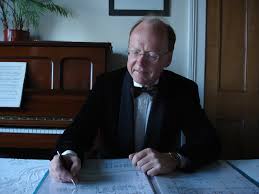
Robert Orledge

It opened and closed with more familiar works but the two central pieces owed their existence to Robert Orledge. The first was a completion of Debussy’s Serenade pour violon et piano. This existed originally as a single page manuscript which Robert has formulated into a gently persuasive work which undulates gently from a solo violin line into increasingly more complex harmonies until it returns to its opening solo line. Existing in a world somewhere between Debussy and the present day it is a charming work, ideal for a matinee in summer.

This was followed by his own composition Le Jardin clos et merveilleux, which was receiving its world premiere. It has strong Debussyan overtones and in his introduction the composer admitted it was closely linked to Monet’s garden. As such its warm wanderings were effective but one would need to hear it for a second time to get a good sense of exactly where it was going.

The afternoon had begun with John Ireland’s early Phantasie Trio in A minor  and concluded with Mozart robust Piano Trio in Bb major K502. The Ireland was deeply romantic in its atmosphere and nowhere near as English as one has come to expect of Ireland. The Mozart allowed pianist Jeremy Young to show what he would be like in a Mozart piano concerto as there is a large amount of writing here which is far closer to the concerto than the trio. He played with relaxed grace throughout, and Peter Adams, cello, and Daniel Bhattacharya, violin, set a high standard for the rest of the summer.

The next concert on Sunday 17 July will include works by Handel, Bach, Jack Redman and Mozart.


Marcio da Silva in Concert

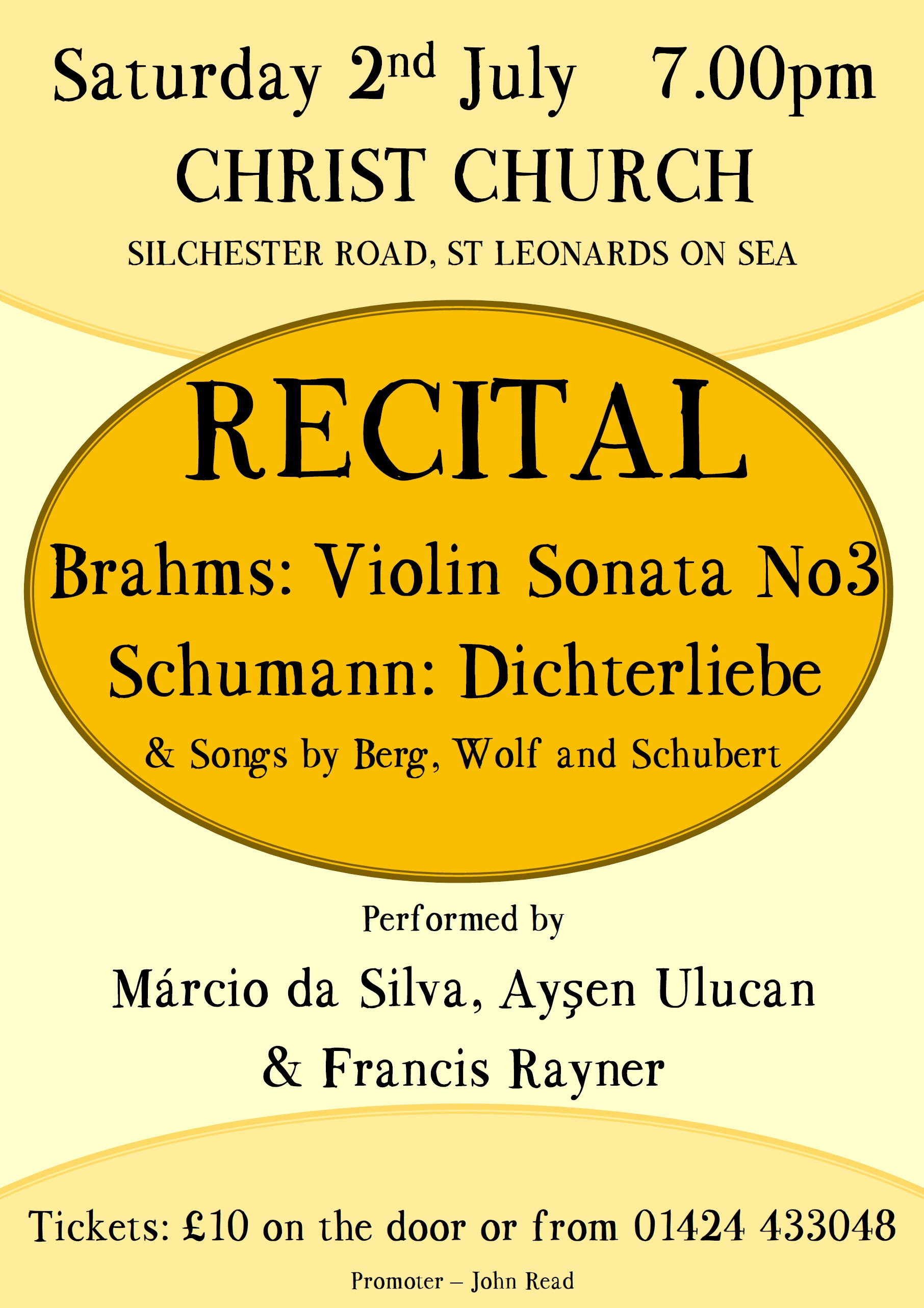
Christ Church, St Leonards, Saturday 2 July 2016

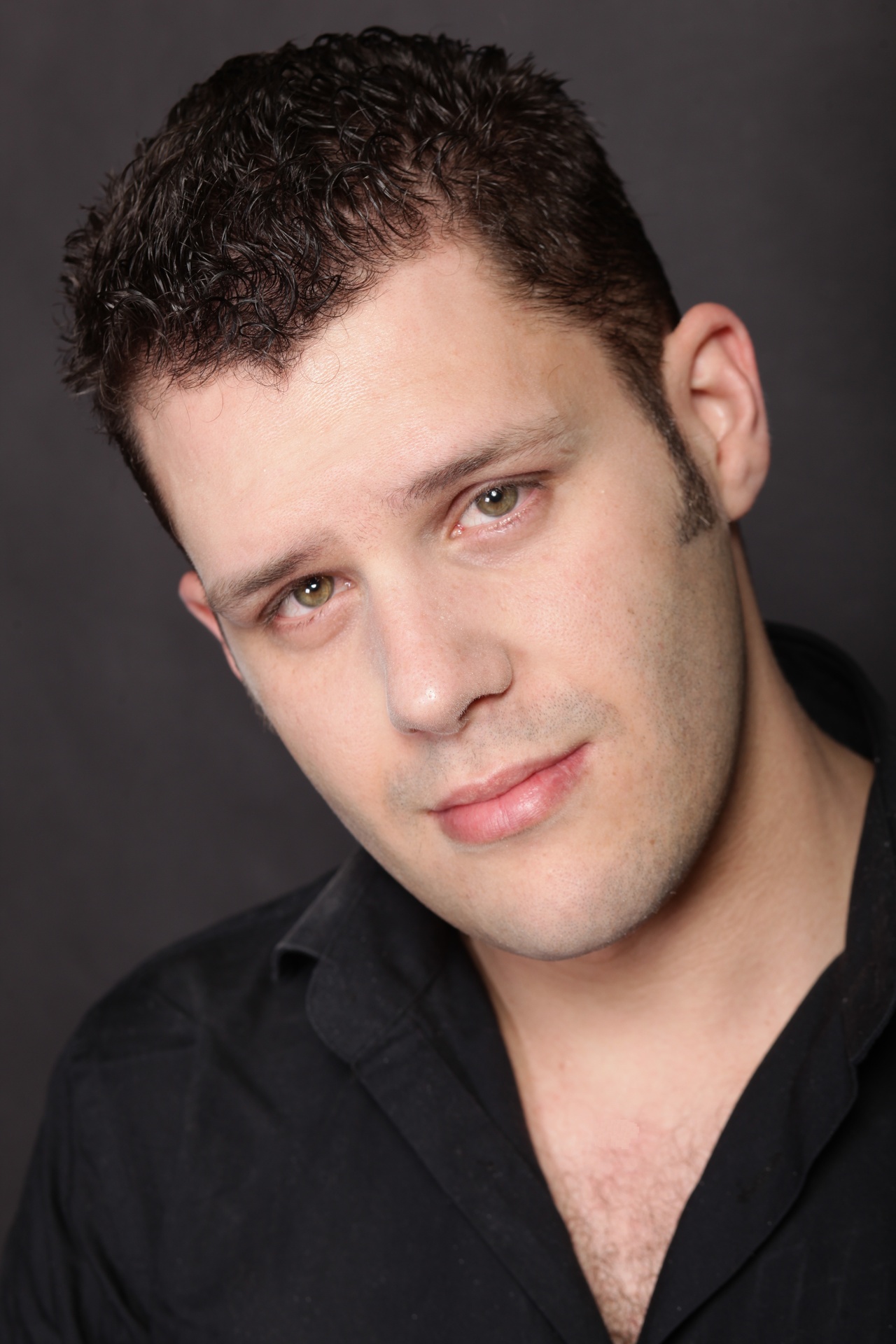
marcio da silva

Most of us know Marcio da Silva as the conductor of Hastings Philharmonic Choir and of the splendid job he has done with them. Many of us are also aware – with memories of O Holy Night – that he has a fine baritone voice – but this was the first opportunity I had had to hear him in concert.

I was, however, in for something of a surprise as the whole of the first half was given over to Aysen Ulucan and Frances Rayner, opening with Berg’s early setting of Die Nachtigall.  Aysen Ulucan has a large soprano voice which easily filled the church with its warm and resonant acoustic. She was a little hesitant at first but by the time we had got into Wolf’s Das Verlassene Magdalen and even more so in Schubert’s Gretchen am Spinnrade she was well focused and dramatically impressive.

F Rayner

Francis Rayner is a fine pianist. I need to say this because one of the problems of frequently accompanying soloists or choirs is that the quality of the individual artist is too easily lost. Here we were able to judge for ourselves his sensitivity and finesses of line as he gave us two Intermezzi by Brahms and the composer’s familiar Rhapsody in G minor. The flowing romanticism and power he brought to the reading was impressive and moving.

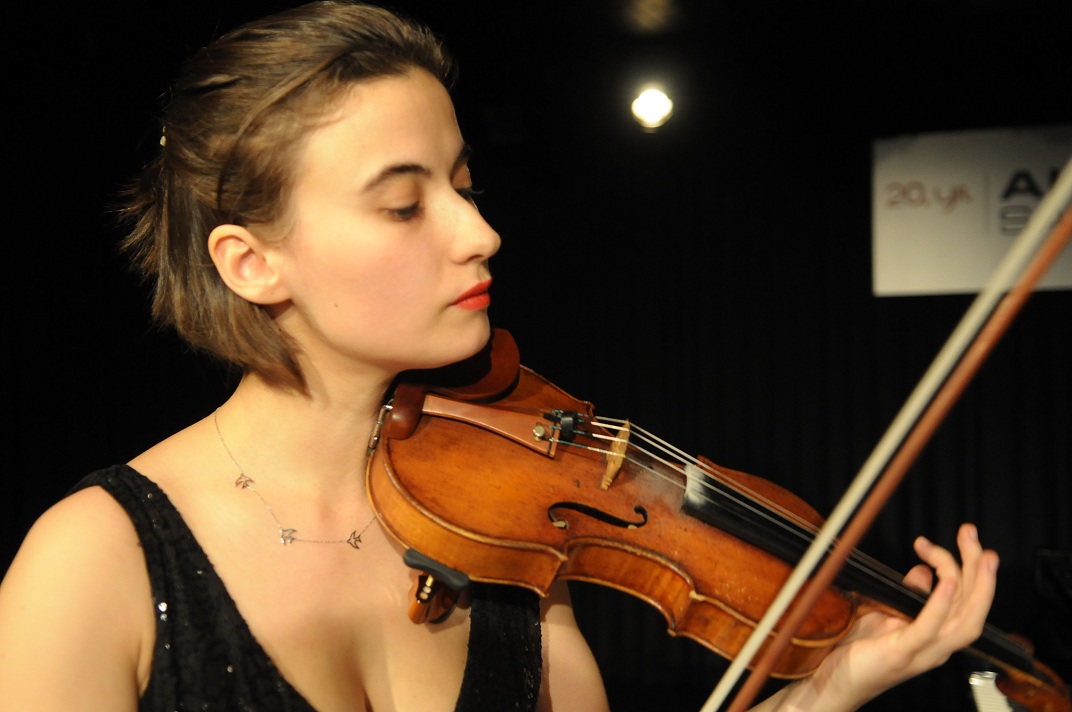
aysen_ulucan

The first half ended with Aysen Ulucan returning to the platform but this time with her violin to perform Brahms’ Violin Sonata No3 in D minor. The four movements are full bloodied and forceful, the richness of sound often being a little lost in the close acoustic, but the double stopping in the second movement was impressive and the nervous energy of the third movement well caught.

The second half was given over to Robert Schumann with Frances Rayner returning to play his Das Abends and the Romanze No2 Op28. Here we had a different sound world and the Bechstein seemed to come into its own even more than it had with the Brahms. The light and clarity of the Schumann shone through and this was also the quality he brought to Dichterliebe which made up the rest of the programme and brought Mario da Silva to the platform.

The cycle may start with some sense of confidence but it rapidly becomes melancholic until we are faced with the same sort of despair we find in Schubert’s Winterreise. The brief enthusiasm of Die Rose, die Lilie does not last, soon transformed into the passion of Das ist ein Floten or the pain of Hor’ ich das Leidchen klingen. As the work progresses, the postludes for piano get ever longer, and Frances Rayner made much of these.  Marcio da Silva’s delivery of the text was cleanly focussed and his warmth of tone made the desolation of the text ever more painful.

It was a pity that the technology seemed to have a mind of its own. The screen with the surtitles worked very well for the first half of the cycle but then decided to turn itself off, unseen to the person changing the slides. A pity, for the system was far better than having a printed text which means that most of the audience are buried in it rather than watching the singer. Marcio hopes there will be another concert next year. We can only hope he is right and that the technology will match the music!


Stephen Page in concert

Hasting Unitarian Meeting Place, Saturday 2 July 2016

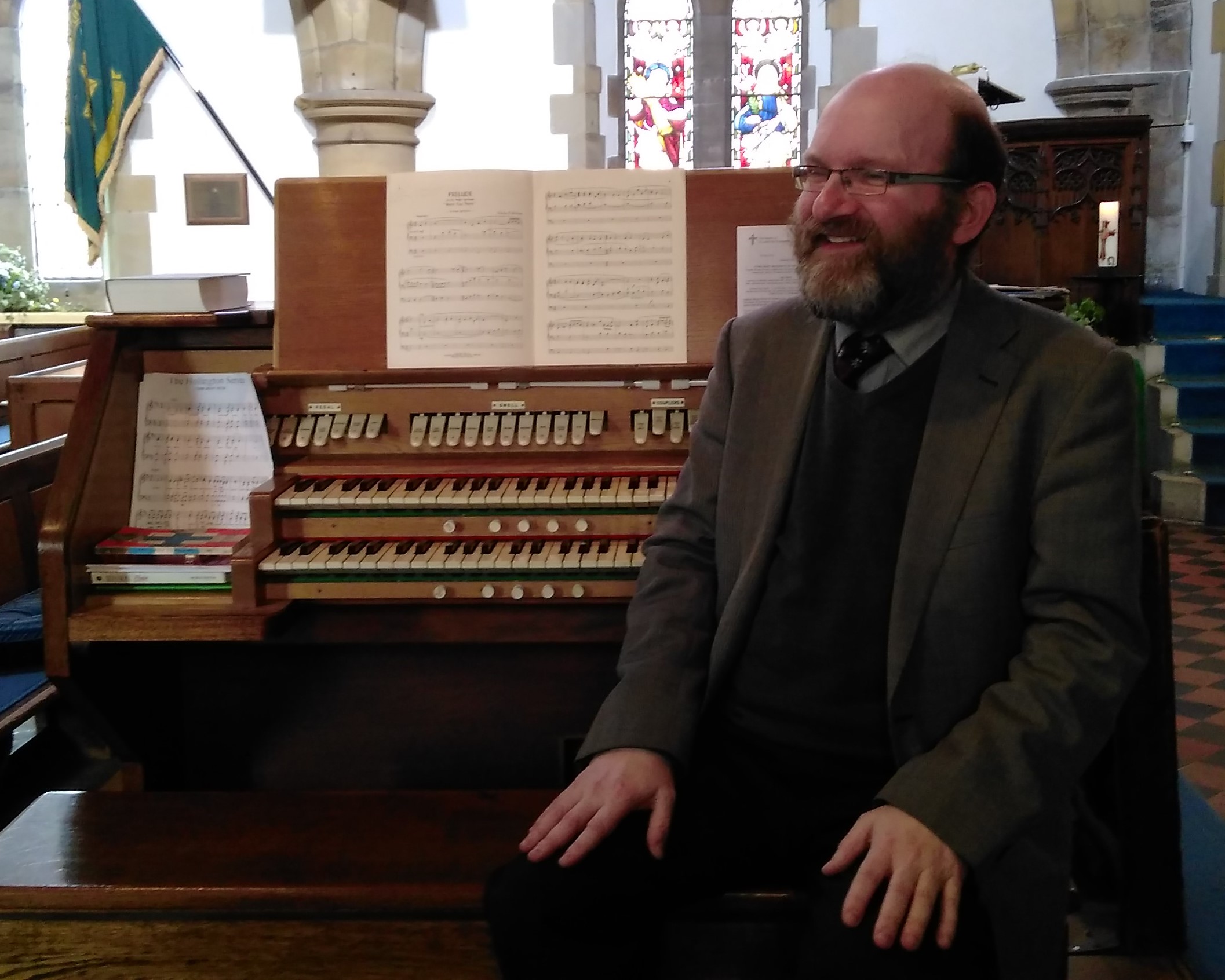
S Page

A beautiful afternoon for beautiful music. Stephen programme was formed around a number of dance movements and opened with a number of pieces which were written at the same time the Schetzler was built – mid 18th century. The March from Handel’s Scipio brought us a bright start and was followed by Haydn’s popular Serenade. Bach’s ‘little’ E minor Prelude and Fugue just about fits the instrument with its limited pedal but Stephen is able to convince us with ease of its aptness. More Handel followed with music for Musical Clocks and then the solid warmth of M Greene’s Voluntary VII.

A move to a later century brought S Wesley’s Sonata in Eb before we returned to the early 17th century for Weckmann’s Praeambulum primi toni a 5. We are celebrating the 400th anniversary of the composer’s birth this year so it was good to hear his slightly austere writing and the nasal snarl of the Hautbois. By contrast, three dances from the Bauyn manuscript proved more relaxed, before we headed towards the present day with Gael Liardon’s 6 variations on We shall Overcome.  This very apt composition led us into the expected popular conclusion to the afternoon with Gossec’s very popular Tambourin and Charles Williams’ The Devil’s Gallop – better known as the signature tune to Dick Barton, Special Agent for those of us of a certain age!

The next concert is in Hastings Week on Saturday 8 October.

BFC: The Somme 1916

All Saints, Hove, 1 July 2016

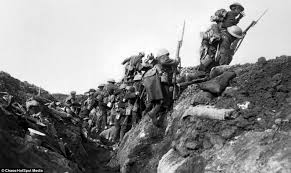
Somme

One hundred years on but the memory is as painful as if it was yesterday. Both my grandfathers survived the Somme, though one was gassed – but that was not the end for both were sent on to other fighting simply because they had survived.

My own memories of them could be set alongside the thousands of personal stories which came together in this moving tribute from Brighton Festival Chorus, drawing on letters, diaries and poems from the period as well as music. Using the lives of composers and poets as the link brought us rare pieces which deserve a far wider hearing.

Francis Warren was one of the many who died at The Somme but was a recognised composer from a very early age. His Ave Verum is a warmly embracing setting which flowered beautifully within the acoustic of All Saints. Herbert Howells’ Elegy for viola and strings is equally rarely performed which seems strange given that it would not be out of place alongside The Lark Ascending  or any of the Butterworth English pieces. The darker tones of Nicholas Barr’s viola playing were particularly effective.

Jerusalem may seem a little out of place on such a reflective occasion, but we were reminded that it was written during 1916 while Parry was living close-by. We were encouraged to sing along with the choir which we did with enthusiasm. Elgar’s Give unto the Lord seemed strangely positive and extrovert, though the final plea for peace is very moving. It was good to note that the chorus are recording the work later this year.

The unexpected item was Tarik O’Regan’s And there was a great calm performed by Brighton Festival Youth Choir. The gently lyrical first half gives way to a lively setting of Each shall arise and an affirmative conclusion with words by Thomas Hardy. Though a modern piece it sat easily alongside the Edwardian works which surrounded it and the youthful voices added a level of joy which was infective.

The whole of the second half was given over to Vaughan Williams’ Dona Nobis Pacem. This may, technically, be a collection of earlier pieces but it certainly does not come across that way in performance, with the sections flowing naturally into one another. There are widely contrasted pieces here, ranging from Walt Whitman to Biblical texts, with the heart of the work built around a funeral procession for two veterans. It is a moving and challenging piece, and perfect for this occasion, where it allowed us to enjoy the solo singing from Ellie Laugharne and Sebastian Charlesworth and the discreet accompaniment of the Arcadian Ensemble.

James Morgan conducted and introduced the first half, managing to tread a very discrete path between the seriousness of the occasion and seeming too relaxed or familiar.

CDs/DVDs June 2016

Glyndebourne 2015
Handel: Saul
OPUS ARTE OA 1216 D
Mozart: Die Entfuhrung aus dem Serail
OPUS ARTE OA 1215 D

These productions were greeted with great enthusiasm last summer and were also seen more widely when televised. Barrie Kosky’s approach to Saul hinges on the madness of the king, which is well conveyed by Christopher Purves in a very moving performance. Lucy Crowe and Sophie Bevan  are the women surrounding not just the king but Iestyn Davies’ beautifully sung David.

David McVicar allows the events of Die Entfuhrung to unfold within their historical context which actually works extremely well and allows characters to flower with ease. Both are well worth investing in.

Meyerbeer: Dinorah
Deutschen Oper Berlin, Enrique Mazzola
CPO 555 014-2

Meyerbeer is today better known for his influence than for his actual works and I can’t think that I have ever seen one staged live. All the more reason to value this live recording of a new edition of his final opera Dinorah which reworks pastoral themes to include storms and magic. It is a well-constructed piece and strongly cast though I doubt if it would really find a regular place is the repertoire.

Michael Haydn: Symphonies vol 1
Czech Chamber Philharmonic Orchestra Pardubice, Patrick Gallois
NAXOS 8.573497

This is the first volume in what expects to be a complete recording of Michael Haydn’s symphonies and starts from those works which are most closely associated with Mozart – the Sinfonia in G was for a long time attributed to the younger composer. The four Sinfonias on this disc are lively pieces written for the court at Salzburg and prefigure much of what was to come later from Mozart himself.

Mendelssohn: Lieder ohne worte books 5-8
Ronald Brautigam, piano
BIS 1983

The delight in this recording is suddenly coming across old favourites in the midst of charming pieces which most of us probably don’t know. Brautigam’s approach is light and convincing without ever becoming too sentimental.

Imogen Cooper’s Chopin
CHANDOS CHAN 10902

The nine tracks on this CD are far ranging, including the Polonaise-fantaisie Op61 and the first and fourth Ballade, together with four Nocturnes. I particularly enjoy Imogen Cooper’s approach which has a naturalistic, open feel to the playing, allowing the nuances to emerge without effort.

British Cello Concertos
Raphael Wallfisch,
CHANDOS CHAN 241-56

This is a collation of recordings made with a number of different orchestras but highlighting Raphael Wallfisch’s enthusiasm and commitment to the British cello concerto which, with the exception of the omnipresent Elgar, are all too seldom heard.  Here we have concerti by Finzi, Bax, Bliss, Stanford and Moeran. Even if all are not totally to your taste there is bound to be something here to arouse interest. I particularly liked the Finzi as it is a rarity, and I have always enjoyed Stanford who is far too little heard today.

Brahms works for solo piano vol 6
Barry Douglas, piano
CHANDOS CHAN 10903

Twenty tracks and almost 80 minutes of playing make this a real bargain. The CD includes a wide range of pieces but focuses on seven Hungarian Dances. The only extended work is the Study No5 based on a Chaconne by Bach. This has been an increasingly impressive series – though I am not sure how much more we still have to come!

Marcio Sings

For those of us who have enjoyed Marcio da Silva’s singing at the Christmas Concerts here is a chance to hear him in more serious vein. Don’t miss it!

marcioconcert

Catherine Rimer @ St Nicolas Pevensey

Sunday 26 June 2016

C Rimer

At the end of the concert Catherine Rimer admitted that the two works she had played were on her bucket list – and that she had been fearful of approaching them – not that we would have been aware of any trepidation from the playing or the emotional intensity she brought to Bach and Britten.

She opened with the fifth of Bach’s six suites for solo cello. This is probably the least performed of the set though there is little reason for this given the magnificence of the writing throughout. She was playing on a baroque instrument of c1750 which was both tuned down, compared with standard orchestral tuning today, and has a flattened top string. Both of these made the work darker and warmer to the modern ear.

This warmth was very obvious in the opening Prelude which fed over into the grace and easy phrasing of the Allemande. If the Courante was slightly more extrovert, we returned to introspection with the mournful not to say melancholic strains of the Sarrabande. The two Gavottes had a lightness and gently fluidity which led into the Gigue which, if not totally joyful, is certainly moving in that direction. 

The second work proved far more challenging. Britten wrote the three cello sonatas for Rostropovich and they are technically demanding as well as asking a lot of the audience. After a brief but complex snatch of melody which is not fully developed we move into a whimsical Fugue, which seems to model itself on Bach, before a long keening Lament which has real lyricism and overt emotion. The song melody returns again briefly before an edgy pizzicato Serenade and a strident March. Both of these prove more demanding than the opening movements but more is to come for the Bourdon is dense and serious, requiring the soloist to create unconventional tones before we return to a Moto perpetuo  which flows into a final brief recapitulation of the song. It is not an easy work, and for many this would be their first hearing. It may have been better to have played the pieces the other way round.

None of  these concerns should however reflect on the quality of Catherine Rimer’s performance of either works, which was moving and often very beautiful. This was not her first visit to St Nicholas and let us very much hope it will not be the last.


ENO: Jenufa

London Coliseum, 23 June 2016

ENO Jenufa Laura Wilde and Peter Hoare 2 (c) Donald Cooper

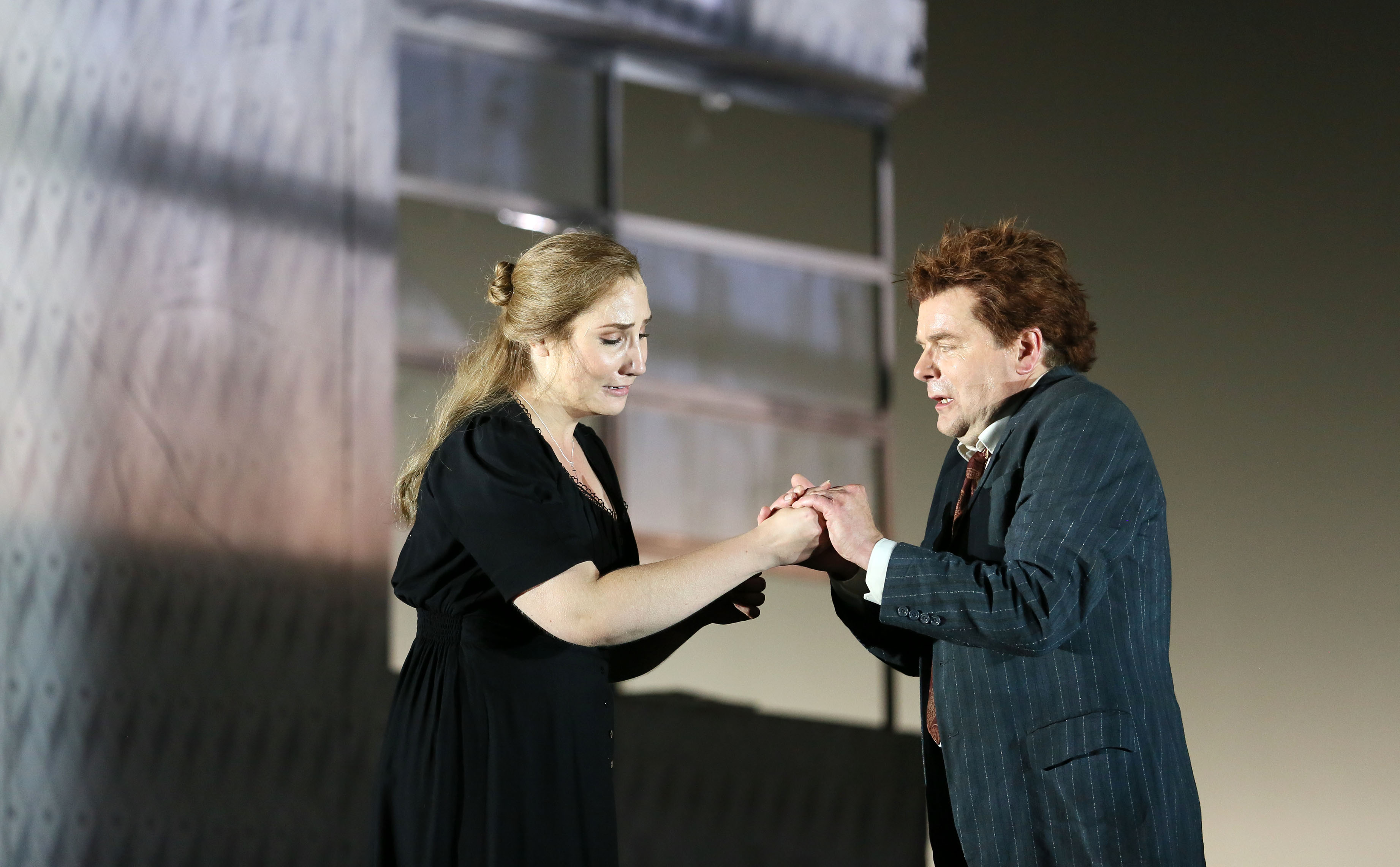
This is the third revival of David Alden’s production and it seems to bounce back better on each occasion. The expressionist approach to the staging serves Janacek’s work well and puts all of the focus on the character relationships. Laura Wilde was making her European and ENO debut in the title role and was touchingly successful. Her calm authority and gentle joy in the third act was immensely impressive, and her singing throughout was warm and passionate, easily filling the theatre.

Nicky Spence was a rather wild Steva in the first act but found more control in the later scenes to give us a more complex and credible figure. Peter Hoare’s Laca grows in stature as the evening progresses and his deep humanity, lost in the machine shed of the opening act, finally comes to its own in the tender final duet.

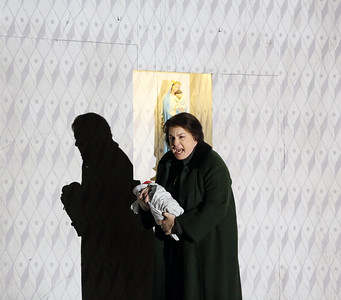
However, it is Michaela Martens’ Kostelnicka which galvanises the evening. Her vocal characterisation is thrilling throughout and the act two soliloquy is terrifying in its intensity.

ENO Jenufa Michaela Martens

The smaller parts were all well cast, with a splendid Mayor’s Wife from Natalie Herman.

Mark Wigglesworth’s reading of act one was rather laid back but he brought a better sense of pace to act two and three, with a well-structured and moving finale.

Yet again, ENO has shown that it has the resources to mount outstanding productions when all the parts are in place.


Verdi Requiem

Canterbury Cathedral, 18 June 2016

Yes, it’s Verdi’s greatest opera. The passionate intensity, the astonishingly colourful orchestration (the piccolo cutting across the bass drum, for instance), the frequent use of unexpected minor keys and haunting rhythms, and the dramatic use of quartets and reprises all remind us that opera was Verdi’s day job.

And this powerful, popular work was in pretty good hands under Richard Cooke in a packed Cathedral. After a slightly shaky start – that sotto voce opening is notoriously difficult to do from cold especially in a venue with such a time lag – it settled into its stride as soon as it reached the firmer ground of Te decet hymnus.

Highlights included a Dies Irae perfomed as dramatically as I’ve ever heard it – enough to terrify even the staunchest unbeliever with every detail, especially in the woodwind, carefully allowed to push through the texture in the tenser passages. In Tuba mirum, the trumpets were temporarily placed prominently on either side of the choir – the effect being very persuasive. The choir was in fine collective voice and it was a delight to see the relatively new CCS Youth Choir, some of them very young, singing among the adults.

Sam Furness brought unusual sweetness as tenor soloist, especially in the Ingemiso tanquam and Offertorio and mezzo Katie Bray found plenty of claret-like richness especially in the lower notes of Lux Aeterna. Slightly (but only slightly) less successful was Michael Pearce as bass, although his Mors stupedit had real impact. Soprano Judith Howarth had her moments but occasionally seemed to be strained and her opening of Libera me was disappointingly lacking in tremulousness.

Of course the RPO is a fine orchestra and their presence raised the bar even above the standard which Canterbury Choral Society routinely achieves. Particularly impressive was the way Cooke ensured that their strength never overpowered the choir (who are assisted by very steep and high raking so that they were positioned well above the orchestra). Moreover he brought out many parts which usually go unnoticed. The Agnus dei moved me to tears, as it usually does, and that was heighted by hearing a string passage tucked into the texture which I’d never before heard stressed like that.

Cooke is very used to working in the Cathedral and to dealing with its poor acoustic. Magnificent building as it is, a concert hall it is not. Cooke waited longer than usual on every pause to let the sound die away completely, and there was a wonderful unrehearsed moment at the end when just as the final note was played the Cathedral clock struck nine as if it was joining in. Cooke kept his baton raised until that sound had died away too.

Susan Elkin

Garsington Opera at Wormsley 2016

The Wormsley Estate seems to have a micro-climate all of its own. While most of England seemed to be battered by storms, the Buckinghamshire valley was remarkably quiet, with the lightest of gentle showers just occasionally reminding us of how nasty it was elsewhere.
EUGENE ONEGIN Garsington 1

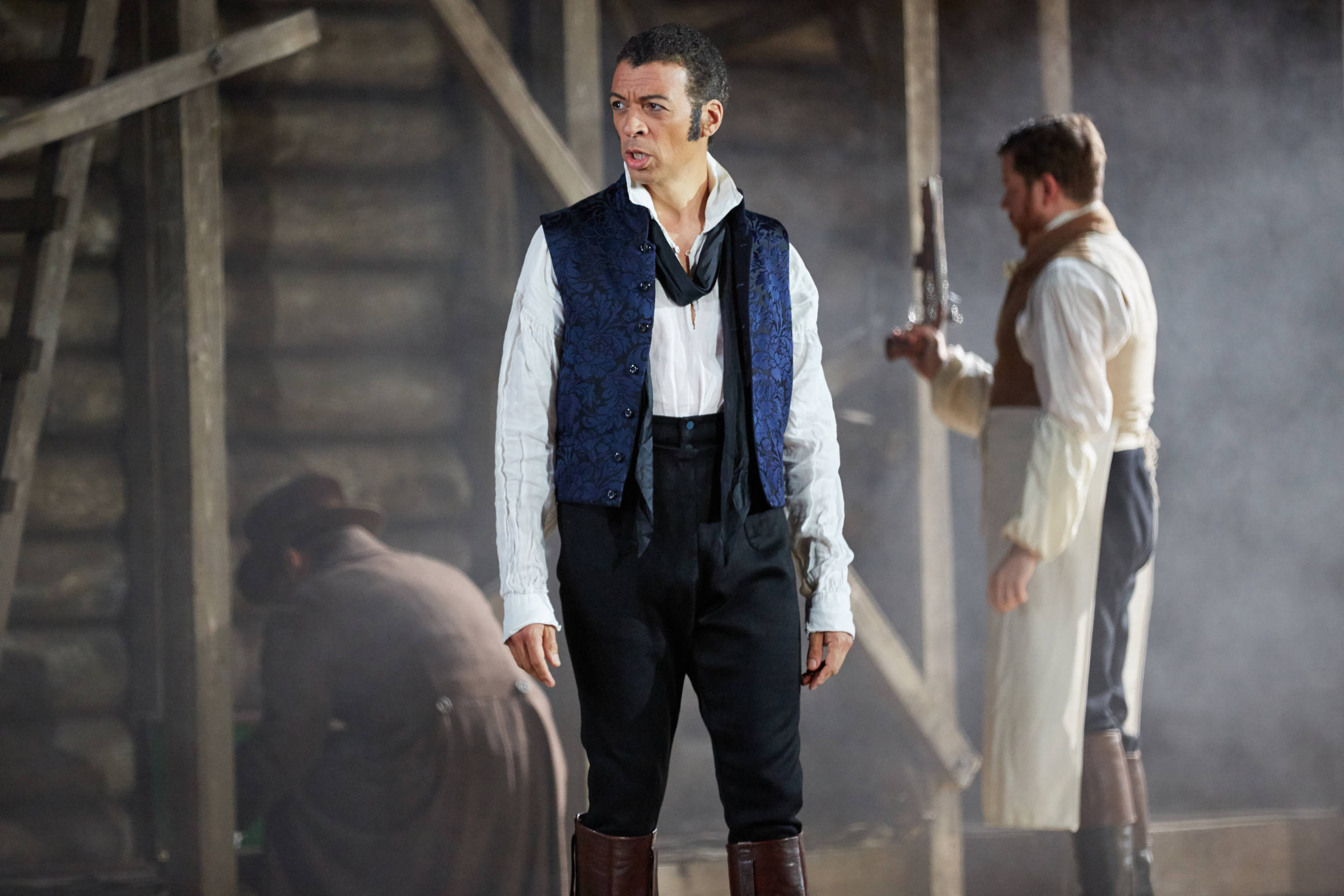
I realised as we arrived for L’Italiana in Algeri that we have been coming to Garsington Opera now for twenty years and the changes in that time are quite remarkable. Not only do they now have a stable and substantial theatre from which to work (I realise it is called a pavilion but it functions like any other theatre in the country and pavilion gives quite the wrong implication) but the quality of performances is regularly on an international level with singers and productions which would not be out of place in any major opera house throughout the world. Michael Boyd’s production of Eugene Onegin was a good case in point. Here was opera theatre at its best, with the focus on the narrative superbly supported by director, designer, conductor and singers. Tom Piper uses five vast units which are made up of split logs on one side, with sets of wooden stairs and supports on the other.

For much of the first half of the opera, which is set in the Russian countryside, this is entirely apt, with both internal and external scenes warmly surrounded by the wooden walls. The stairs allow characters to appear above the stage as well as within the more claustrophobic interiors, and for the duel scene turn to become a vast barn.

The coup comes in the final scenes when the units turn again to reveal a vast gilded mirror, across the full width of the stage, a stark reminder not only of the social split between country and city but of the quality of life within the city and the way it quite literally reflected the hollowness of Onegin’s personality.

Yet most of this could easily be taken for granted within the rapid movement of Michael Boyd’s production which created entirely credible characters. Much of this reflects his many years of work with the RSC where the concept of the soliloquy mirrors the operatic aria. As a consequence characters are regularly allowed to simply stand and sing, with no extraneous business to interfere with the emotional rapport. This is a great asset yet one which is all too rare today. Not that he was afraid of challenging where it was needed. The duel scene has a superb double-bluff at the end when Onegin falls, shot in the shoulder, before realising that Lenksy is also wounded, but in this case, fatally.

It is the relationship between Lensky and Onegin which lies at the heart of the interpretation, for Lensky’s ghost is present for the whole of the rest of the evening. It never upstages the action but reminds us that the emotional relationship between the two men was stronger than that of Onegin for Tatyana.

Vocally it was an immensely impressive evening with Natalya Romaniw outstanding as Tatyana and Roderick Williams giving one of his finest performances as Onegin. They were joined by Oliksiy Palchykov as a lucid Lensky and Brindley Sherratt as the finest Gremin I can ever recall.

The chorus were as fine as ever, and only the dancing caused any concern. The choreography was out of keeping with the rest of the production, particularly in the opening act where it was anything but rustic.

Douglas Boyd’s conducting was full bloodied and romantic without ever tipping over into sentimentality. A glorious evening which was being recorded. Let us hope this might find its way to DVD eventually – it certainly deserves it.
Garsington Opera L'italiana 2

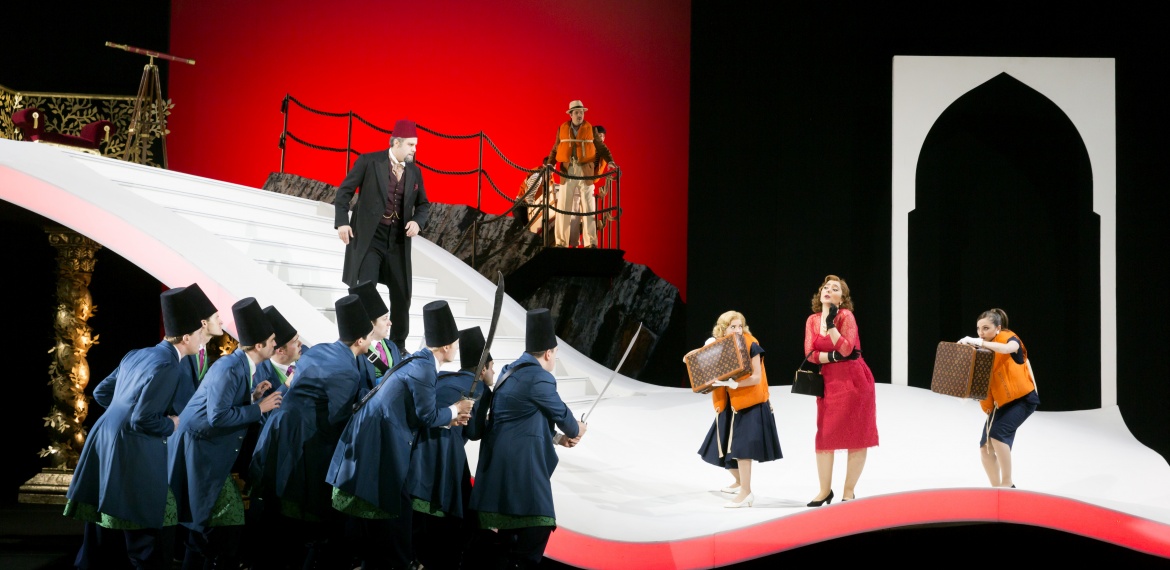
I wish I could be as enthusiastic about L’Italiana in Algeri. There was much fine singing on show with Mary Bevan outstanding as the put upon Elvira and Luciano Botelho as a light voiced but engaging Lindoro. Ezgi Kutlu amused as Isabella and had the presence for the comedy. The difficulty is the work itself which – without wishing to be over politically-correct – has a lot of very dubious nuances in the plot. Added to this, presenting the Mustafa as Douglas Fairbanks Jnr did not really help matters. The fascinating design by George Souglides set the whimsical tone of the evening, and we were presented with another of Garsington’s wonderful ships (I begin to wonder if they have a job-lot in store which they can use whenever necessary!) David Parry’s conducting was brisk, bright and engaging as were the male chorus who appeared, as ever, to be thoroughly enjoying themselves. The second half moves more purposefully than the first, but, even for Rossini, this really is not a great piece – but then this is one of the benefits of summer festivals as we can enjoy what there is even if we would not like it regularly in the repertoire.

Idomeneo and The Creation still to come this summer, and a full programme already announced for next year.