Brighton Philharmonic Orchestra’s new season at Brighton Dome starts this Sunday

There is an autumnal chill in the air in the mornings and the nights are closing in, but whilst for some this heralds the onset of the winter months, the Brighton Philharmonic Orchestra and its regular audience are looking forward to their new season of Sunday afternoon concerts at Brighton Dome.

An array of guest soloists and conductors join the orchestra this season to play popular works by Tchaikovsky, Dvorák, Mendelssohn and Elgar as well as less well-known gems by Scriabin, Korngold, Walton and Greig. Particular highlights this side of Christmas include Sunday 6th November where the orchestra is joined by the Brighton Festival Chorus for a performance of Brahms’ Ein Deutches Requiem, and Sunday 4th December when a “Best of British Film Scores” concert promises an afternoon of wonderful classic film music. Then to liven up the festive season the orchestra presents its traditional New Year’s Eve Viennese Gala with a plethora of foot-tapping marches, polkas and waltzes from the prolific Strauss family and lots of sparkly top notes from guest soprano Rebecca Bottone (who featured in the BBC series David Starkey’s Music and Monarchy).

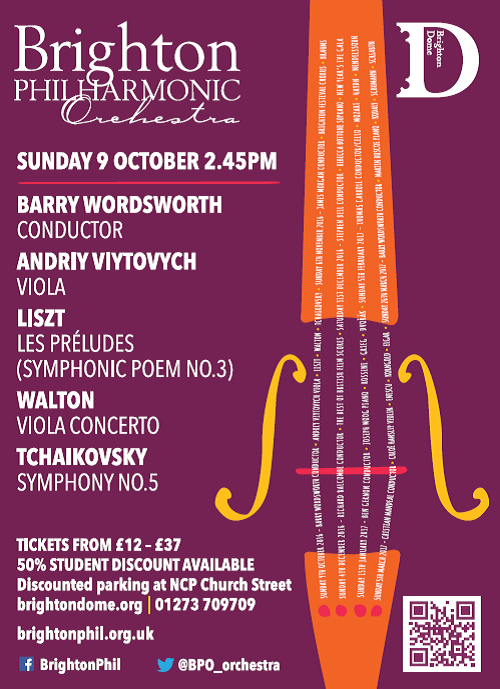
The season opens on Sunday 9th October with Conductor Laureate Barry Wordsworth at the helm with a programme that includes Sir William Walton’s Viola Concerto with Andriy Vytovych and Tchaikovsky’s monumental Symphony No.5.

9oct16concertad

Tickets for all concerts range from £12-£37 with a 50% discount for students and under 18s, available from Brighton Dome Ticket Office (01273) 709709 or www.brightondome.org

For those considering coming by car, discounted parking is available for all BPO concerts at just £6 for up to five hours (from 1pm-6pm) in NCP Church Street Car Park, just a couple of minutes’ walk from Brighton Dome.

For full details of the whole season see: www.brightonphil.org.uk

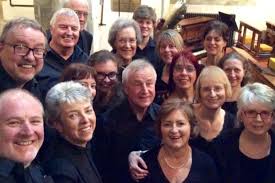
Noteworthy Voices

Wilmington Parish Church, 1 October 2016

noteworthy-voices

Plagiarism may be a problem for musicians today but was normal practise for most musicians throughout history. Handel borrowed widely, including much recycling of his own works. To put together a programme based on these musical connections is therefore both apt and – as it proved to be – highly enjoyable.

The evening opened with works by Morley and Bennett, with their Victorian re-workings. Morley’s Sing we and chant it has a gentle lilt to its line and admirable clarity for the text, which is somewhat lost in the richer harmony brought to it by Robert Pearsall. However his setting of Lay a garland is a strongly evocative piece which harks back wistfully even as it involves us in its melancholy.

The first half ended with four of Parry’s Songs of Farewell. Beautiful works, they are still too rarely heard even in this centenary year. The singers brought a rapt attention to detail and fine internal balance throughout.

After the interval we were back to Gregorian chant to set the bass line for compositions by Conte and Durufle. Again the textual clarity impressed as did the sudden familiarity of Durufle’s Tantum Ergo.

Debussy’s Trois Chansons de Charles d’Orleans are unusual for the composer, being his only unaccompanied choral works. We heard two of them, a warmly indulgent Dieu! Qu’il la fait bon regarder! and the more tongue-in-cheek attack on the weather in Yver, vous n’estes qu’un villain.

Noteworthy Voices  left the finest piece to the end. Even the glories of early music could not compete with the beauty of Eric Whitacre’s This Marriage. A gentle tribute to the strengths of long-lasting married love its very simplicity is an essential part of its character. Against the pomp and bling of so many weddings, this is a piece which should surely become a staple item for any musician approaching marriage. It was a joy to hear.

Ansy Boothroyd conducted with an easy grace and briefly introduced the items, often letting them speak for themselves. Within the close context of Wilmington’s 12th century church, on a site which has drawn worshippers for thousands of years, this was a highly satisfying evening on both musical and spiritual levels.

Noteworthy Voices’ next concert will be in January 2017 – details on www.noteworthyvoicews.co.uk

Brighton Festival Chorus! Open Rehearsal

James Morgan – conductor

Tuesday, October 11th 2016, 7.00pm

Brighton and Sussex Medical School, University of Sussex, Falmer

Want to sing with some of the best UK and international orchestras and soloists, and in some of the world’s greatest venues? Join Brighton Festival Chorus (bfc) for our annual open rehearsal on Tuesday October 11th at 7pm in the Medical School, University of Sussex. An exciting season lies ahead, including completing a recording with the BBC Concert Orchestra and performing in the Royal Albert Hall in a fundraising concert for Parkinson’s UK, bringing together amazing musicians and comedians for a night of music and laughter. Two concerts are lined up so far in the Brighton Dome Concert Hall, including our traditional Christmas concert in December. On November 6th 2016 bfc will join the Brighton Philharmonic Orchestra for a performance of Brahm’s Requiem and Schicksalslied. James Morgan, Music Director of bfc commented “I’m delighted that the Festival Chorus and BPO will once again join forces in such a special programme. Schicksalslied is a miniature masterpiece; this is one concert you don’t want to arrive late for, as the first minute of music is particularly sublime. Then there is the Requiem – such a well-loved piece and a key work of the choral repertoire.” Sing your heart out with bfc in a rehearsal of Brahms’ Requiem on Tuesday October 11th and meet our friendly members for a drink afterwards.

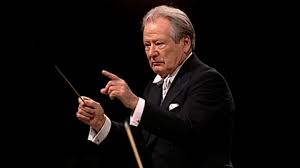
Sir Neville Marriner CH, CBE, Founder and Life President of the Academy of St Martin in the Fields has died

Sir Neville Marriner CH, CBE 15 April 1924 – 2 October 2016

sir-neville-marriner

The Academy of St Martin in the Fields is deeply saddened to announce the death of Sir Neville Marriner, Founder and Life President of the Academy of St Martin in the Fields.

Sir Neville Marriner passed away peacefully in the night on 2 October.

Born on 15 April 1924 in Lincoln, Sir Neville Marriner studied at the Royal College of Music and the Paris Conservatoire. He began his career as a violinist, playing first in a string quartet and trio, then in the London Symphony Orchestra. It was during this period that he founded the Academy, with the aim of forming a top-class chamber ensemble from London’s finest players. Beginning as a group of friends who gathered to rehearse in Sir Neville’s front room, the Academy gave its first performance in its namesake church in 1959. The Academy now enjoys one of the largest discographies of any chamber orchestra worldwide, and its partnership with Sir Neville Marriner is the most recorded of any orchestra and conductor.

Honoured three times for his services to music in this country – most recently being made a Companion of Honour by Her Majesty The Queen in June 2015 – Sir Neville Marriner has also been awarded honours in France, Germany and Sweden.

As a player, Sir Neville Marriner had observed some of the greatest conductors at close quarters. He worked as an extra under Toscanini and Furtwängler, with Joseph Krips, George Szell, Stokowski and mentor Pierre Monteux. Sir Neville began his conducting career in 1969, after his studies in America with Maestro Monteux. There he founded the Los Angeles Chamber Orchestra, at the same time as developing and extending the size and repertoire of the Academy. In 1979 he became Music Director and Principal Conductor of both the Minneapolis Symphony Orchestra and the Südwest Deutsche Radio Orchestra in Stuttgart, positions he held until the late 1980s. Subsequently he has continued to work with orchestras round the globe in Vienna, Berlin, Paris, Milan, Athens, New York, Boston, San Francisco and Tokyo. In 2011 Sir Neville was appointed Honorary Conductor of the newly formed I, Culture Orchestra which brings together the most talented young musicians from Eastern Europe. Sir Neville was Music Director of the Academy from its formation in1958 to 2011 when he became Life President and handed the baton of Music Director to violinist Joshua Bell.

ENO: Don Giovanni

London Coliseum, 30 September 2016

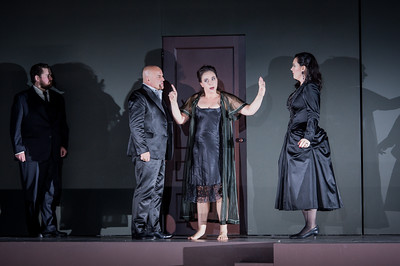
Don Giovanni - Wolfgang Amadeus Mozart - English National Opera - 30th September  Director - Richard Jones Set Designer - Paul Steinberg Costume Designer - Nicky Gillibrand Lighting - Mimi Jordan Sherin  Conductor - Mark Wigglesworth  Don Giovanni - Chris

Richard Jones has directed a wide range of productions for ENO over recent years and while they are often challenging they are normally highly sensitive to the work concerned. Unfortunately he seems to have come unstuck with his approach to Mozart’s Don Giovanni. It is quite reasonable to paint a corrupt world within which Giovanni operates but another altogether to suggest that there is not a single likeable person on stage. In his opening scene we see two rooms; Anna is setting up a sex game with Giovanni while next door her father is with a prostitute. How are we to have any sympathy for Anna in her emotional out-poring to Don Ottavio when we know she brought the whole situation on herself? The same is true of virtually everyone else on stage and as such we are consistently alienated from the action. When we add to this the use of black clothing throughout and the dank, if vast, interior sets and brutalist lighting, there is little to make us engage with the narrative. Added to this, the constant sweep of walls and doors, with the cast endlessly moving about, cuts across the structure of the score.

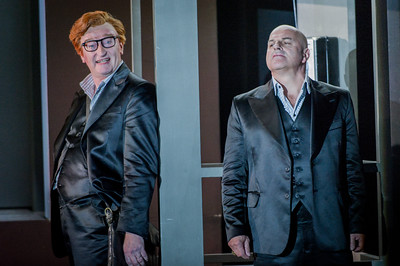
Thankfully the singing is excellent throughout with Christopher Purves a slimy if sure-footed anti-hero. He does not need to seduce any of the women; they simply throw themselves at him. Caitlin Lynch and Christine Rice as Anna and Elvira respectively are heroic in voice even when they are required to act against the score. Most at ease is Allan Clayton’s mellifluous Ottavio, whose refined Dalla sua pace is one of the few reflective moments in the first half. Clive Bailey’s Leporello seems deliberately to mimic Michael Caine though he creates a credible comic follower not averse to acting independently of his master. Nicholas Crawley and Mary Bevan are finely cast as Masetto and Zerlina, their relationship uneasy from the start, though there is no sense of class differences in this production.

Don Giovanni - Wolfgang Amadeus Mozart - English National Opera - 30th September  Director - Richard Jones Set Designer - Paul Steinberg Costume Designer - Nicky Gillibrand Lighting - Mimi Jordan Sherin  Conductor - Mark Wigglesworth  Don Giovanni - Chris

Mark Wigglesworth takes a speedy approach to the score as if he wants to ensure there is no time for us to think or applaud between numbers. The orchestral playing is fine but the endless attack becomes wearing after a time.

With fewer new productions this season there was a hope that Richard Jones’ reputation would launch things in style. Perhaps this was not quite the style we were expecting.

Noteworthy Voices next concert!

We hope you will be able to join us for our next concert at
Wilmington Church on Sunday 2nd October, 7.30pm.
This will be an extended repeat of our last concert in May – to this we have added some lovely new pieces by Byrd, Morley, Bennet and American composer David Conte.
Also in this concert programme:
Pearsall, Parry, Duruflé, Debussy and Whitacre.
For more information please visit our website:

noteworthyvoices.co.uk    call 01323 640033

August / September CDs

Our apologies that, due to holidays, our reviews are far briefer than usual and in some cases this is simply a note of CDs which we are pleased to recommend.

Schubert: Winterreise
Hermann Prey, baritone; Helmut Deutsch, piano
SWR MUSIC SWR19012CD

I heard Hermann Prey many times at the end of the last century and this recording, which dates from 1987, is a wonderful tribute to his art and sensitivity. Even if you already have a recording (or as in my case – many) this is certainly a valuable addition.

Schubert: Schwanengesang
James Rutherford, baritone; Eugene Asti, piano
BIS 2180 SACD

Better known as a Wagner singer (particularly as Hans Sachs) James Rutherford brings a gentle introspection to many of the songs here. There is always a difficulty for lower voices singing this cycle but they opted simply to put the whole thing down a minor third which maintains the relationship of the songs as they follow on. A convincing approach and most effective.

The Romantic Piano Concerto – 68
Moszkowski Op3; Schulz-Evler, Russian Rhapsody
Ludmil Angelov, piano; BBC Scottish Symphony Orchestra, Vladimir Kiradjiev
HYPERION CDA68109

This series seems to run on and on – and here brings us the first recording of Adolf Schulz-Evler’s Russian Rhapsody. Though virtually unknown today this is an interesting curiosity for a composer whose Blue Danube Arabesques still command attention in the concert-hall.

Lehar: Guiditta
Bavarian Radio Chorus; Munich Radio Orchestra; Ulf Schirmer.
CPO 777 749-2

There have been a large number of recordings which originated in radio broadcasts, some of dubious quality. Happily this is among the better versions and – with limited dialogue – the music speaking for itself and often coming happily to life. Lehar deserves some staged performances again! And not just the Merry Widow.

CPE Bach: Cello concertos
Nicolas Altstaedt, cello; Arcangelo, Jonathan Cohen
HYPERION CDA68112


Saint-Saens Quartet Op 11
Chausson Quartet Op30
Schubert Ensemble
CHANDOS CHAN 10914


Beethoven; Piano Sonatas
Angelia Hewitt
HYPERION CDA68131

No9 in E major, Op14 No1; No19 in G minor, Op49 No1; No20 in G major, Op49 No2; No26 in Eb major les adieux, Op81a

Delius
Bournemouth Symphony Orchestra, Richard Hickox
CHANDOS CHAN 10913 X

A reissue of the recording made in 1995. The Walk to the Paradise Garden; A Dance Rhapsody No1; A Dance Rhapsody No2; In a Summer Garden; North Country Sketches.

Apres un reve; A Faure Recital
Louis Lortie, piano
CHANDOS CHAN 10915

As this is listed as Vol1 we can assume there is more to follow! It includes the Pavane Op50 as well as the suite for Pelleas et Melisande Op80 and is charming throughout.

Brahms: String Quartet Op51 No1; Quintet Op34
Brodsky Quartet, Natacha Kudritskaya, piano
CHANDOS CHAN 10892


Berlioz: Romeo & Juliet; Royal Hunt and Storm
BBC Symphony Orchestra & Chorus, Sir Andrew Davis
CHANDOS CHAN 5169(2)

With the exception of Beatrice & Benedict at Glyndebourne this summer it seems a long time since we had any staged Berlioz and this reminds us just how good it is. Romeo & Juliet may not technically be an opera but musically it is in all but name – and surprising that it has not been staged as such. The Royal Hunt and Storm benefits from the massed forces of the BBC Chorus.

Bruckner: Symphonies 0-9
Mario Venzago, conductor, various orchestras.
CPO 555023-2

This set of ten CDs deserves an article to itself rather than this brief notice. Mario Venzago has a unique approach to Bruckner, often making it lighter and more transparent than we are normally used to. He makes a good case for his reading and I certainly enjoyed the approach though accept it may not be to all tastes. If you get a chance to sample it, do so, and be prepared to agree.
Rossini: Il barbiere di Siviglia

Royal Opera House  13 September 2016

garden-barber-sept-16

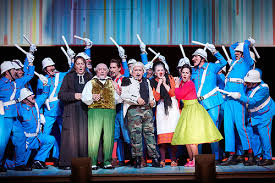
This version of Rossini’s 200 year old comedy is (originally directed by Moshe Leiser and Patrice Caurier, now revived by Thomas Guthrie) is fresh and crisp. There’s a lot of bright colour both in costume and lighting with much of the action set in a candy striped inner stage box to represent Rosina’s “prison” in Dr Bartolo’s house. Of course windows and doors open within it as characters enter often clandestinely – this is comic opera after all. There are also some imaginative ideas such as raising the inner box of the set several feet above stage level and rocking it with the entire cast on board to suggest confusion although I couldn’t help wondering what such a gimmick/coup de theatre (depending on your point of view) added to production costs.

The chorus of guards (reminiscent of the policemen in The Pirates of Penzance) exposed upstage is fun too, especially when they dance with their truncheons. And the translation of the Italian libretto for the surtitles by Kenneth Chalmers is good value. “The cheese has landed on the macaroni” declares Figaro gleefully at one point.

Il barbiere di Siviglia dates from 1816 when Rossini was only 24 and weaving charismatic musical magic around intrigue, trickery and witty dialogue. Sung here in Italian, as usual at the Royal Opera House, it employs a full range of appropriate musical vowel sounds – a strand in the sound texture which disappears as soon as you start translating the words.

It’s a familiar and pretty simple story. Count Almaviva (Javier Camarena) is in Seville to court a beautiful girl Rosina (Daniela Mack) who is due to be married to her guardian Doctor Bartolo (Jose Fardilha). Three hours of shenanigans and misunderstandings later, led by the local barber, Figaro (Vito Priante) we arrive at a happy ending of a sort. Those who know Mozart’s The Marriage of Figaro, based, a generation earlier, on the second play in Beaumarchais’s trilogy will be sceptical. And of course you have to take at face value this world in which  passionate – randy, even – women are imprisoned by buffoonish manipulative men until they are rescued by other rather sexier manipulative men. There’s a lot of it in classical opera.

Camarena is a show-stopper as Almaviva. His sapphire-sharp tenor voice sustains some astonishingly long notes and his dynamic control is top notch.  He’s also an accomplished actor and his music lesson scene with Mack is very funny. A wide register mezzo, some of Mack’s top notes threaten to break glasses while at other moments she plumbs rich claret depths. She too is warmly convincing in character, petulantly throwing darts at the set walls and flouncing about in pent-up frustration in her first real scene, for example. And Vito Priante provides an enjoyable mercurial Figaro for balance. He sings his act one entrance patter number – always tricky because it’s so well known – by coming in from the back and flirting with audience members on his way to the stage which works beautifully. And his comic timing is perfect.

All this is accompanied by the magnificent Orchestra of the Royal Opera House in the pit under youthful-looking Henrik Nanasi. He really brings out the colour and detail in the music. The fortepiano continuo from Christopher Willis is especially fine in its accuracy and responsive sensitivity.

The Royal Opera House claims to be “world class” and of course it is – working here with an outstanding cast of principals from all over the world.  It’s a very enjoyable production which I am happy to recommend enthusiastically although the fly in the ointment – as always at ROH – is that the stalls seat I sat in on press night would have cost over £150.

Susan Elkin


John Beard @ Handel House Museum

John Beard Exhibition Wednesday 14th September 2016 – Sunday 19th February 2017

J Beard

Tickets: included in General Admission price to Handel & Hendrix in London.

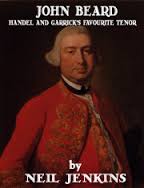
This exhibition explores the extraordinary life of the celebrated tenor, John Beard – Handel’s ‘tenor of choice’. This theatre star and 18th century celebrity premiered several roles for Handel in a variety of opera and oratorio, wowed the public at the pleasure gardens with patriotic ballads and nonsense songs, and expertly managed the Covent Garden Theatre until his retirement. This exhibition presents the curious circumstances of his first marriage, music scores with Beard’s own performance markings, evidence of his kind philanthropy and many other fascinating items from his life. Alongside this, a painting of John Rich, Theatre Manager and Beard’s father-in-law, attributed to William Hogarth will be displayed in Handel’s Music Room in its first public outing, alongside an iconic painting of John Beard by Thomas Hudson. Come and delve into the theatrical world of John Beard.

Tenor Neil Jenkins, who has curated the exhibition adds ‘I am very excited to tell you that the exhibition that I am curating at the Handel House Museum (Handel’s actual London home) in Brook Street, Mayfair is opening to the public on Wednesday 14th September – next week in fact!  It runs until February 19th next year, and has come about because of the biography I have written of this remarkable singer.

For anyone who is in London on Sunday 18th September I am giving a talk, and singing some of the songs that John Beard premiered during his career, at 2pm in the music room at the Handel House Museum, when there will also be an opportunity of visiting the exhibition in my company.
 
Do visit it at some stage in the next 5 months, and learn about England’s first great tenor – who created all the oratorio roles that Handel wrote for the tenor voice – but who had a truly remarkable career on the London stage and at the fledgling music festivals around the country..

Yamaha to become ENO’s Official Piano Partner

English National Opera are thrilled to announce Yamaha as the Official Piano Partner of ENO. Yamaha is now the exclusive supplier of pianos to ENO and will collaborate with the Company to support ENO’s continued commitment to musical excellence.

As part of this exciting partnership, English National Opera will be the first opera company to use the revolutionary TransAcoustic™ piano, which is now located in the orchestra pit in the auditorium.  A fleet of grand and upright pianos across the company’s rehearsal studios in West Hampstead and in the bar spaces at the London Coliseum have also been installed.

Martin Fitzpatrick, ENO’s Head of Music said “At ENO we give our pianos a thorough workout. Creating the orchestral colours on a piano requires an instrument of artistry and reliability, delicacy and toughness, depth and precision. I am delighted that, through this new partnership, Yamaha have provided ENO with pianos that fully meet the demands we place upon them”.

Each model of Yamaha piano installed at ENO was selected following rigorous testing and evaluation by professional staff alongside ENO répétiteurs and music staff to ensure they had the correct tonal flexibility and durability required for its specific use, be that in the pit, a rehearsal room or a bar in the London Coliseum.

Charles Bozon, Director of Classic Division, from Yamaha Music UK commented “Yamaha pianos are to be found in many of the world’s finest venues and studios; this is the first time we have had the opportunity to partner a major opera company and we look forward to combining in introducing and inspiring many more people to music making with ENO.”